


















U.S. Shutdown: Why the Market Didn’t Collapse
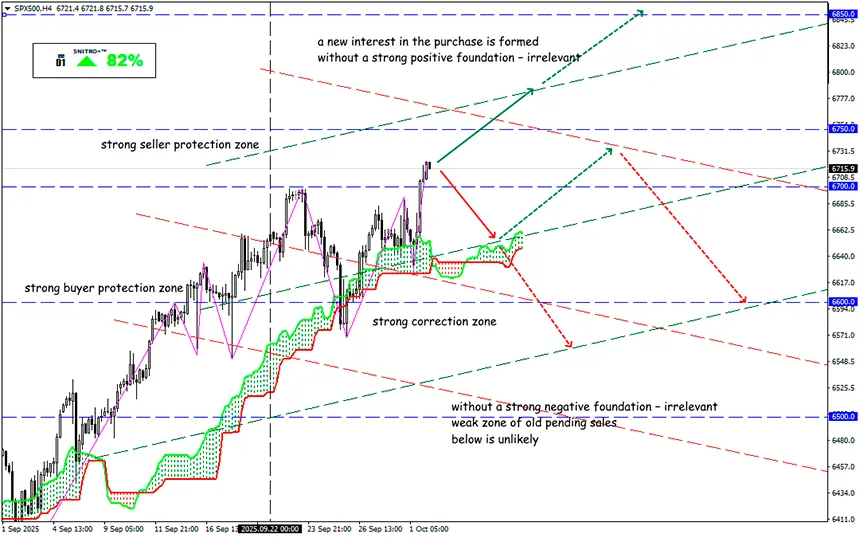
SP500
Key zone: 6,650 - 6,750
Buy: 6,750 (on strong positive fundamentals); target 6,900; StopLoss 6,700
Sell: 6,620 (after a retest of the 6,700 level); target 6,500; StopLoss 6,670
The shutdown increases the chances of a further Fed rate cut and puts pressure on the dollar. As of Thursday morning, the futures market sees a 100% probability of a rate cut in October and more than 85% in December. This is higher than before the shutdown, but is unlikely to exert additional pressure on the dollar.
Powell believes that markets are dangerously overbought, but Wall Street continues to ignore the Fed’s warnings as long as corporate profits keep growing. Moreover, in the recent past, similar threats from monetary authorities triggered not a market correction, but a new short-term growth wave and higher yields.
If September employment data becomes unavailable, the Fed will prefer to act more cautiously. The ADP report showed that 32,000 jobs were lost in the private sector in September, meaning the labor market continues to contract. The Manufacturing ISM also shows no optimism: in September, activity stood at 49.1 (declining), employment at 45.3, the new orders index fell from 51.4 to 48.9, which is also perceived as negative.
At this point, the S&P 500 index has delivered a 12-month return of about 13% – U.S. equities outperform international peers. And the market continues to rise – all indices closed at record levels.
- Past shutdowns did not bring catastrophic consequences.
- Strong sectors – technology and healthcare – support the market.
- Anticipations of Fed policy easing under weak data boost buying.
Investors and traders understand that any shutdown is a temporary problem. Corporate reporting, consumer spending, monetary policy – fundamental drivers continue to work regardless of whether the U.S. Bureau of Labor Statistics is functioning, and certainly regardless of who runs it.
Markets react not to the fact of the shutdown itself, but to its duration and secondary effects. Traders analyze specific data: for example, Nvidia reaches a capitalization of $4.5 trillion, Berkshire prepares to acquire a petrochemical asset for $10 billion, Taiwan stockpiles oil, and so on.
Concern is warranted only if your investment strategy relies on short-term speculative trends, but medium-term methods that account for economic data and fundamentals do not react to political collapses.
The shutdown creates investment opportunities: when politics presses on quotes, quality assets can be bought at very favorable prices. And the fact that defensive instruments – gold, Treasuries, the dollar – show divergent dynamics only indicates a multifactor approach by investors, not panic.
So we act wisely and avoid unnecessary risks.
Profits to y’all!


