


















War of Monopolies: Nvidia vs. Google
Zuckerberg Provokes a Conflict of Interests
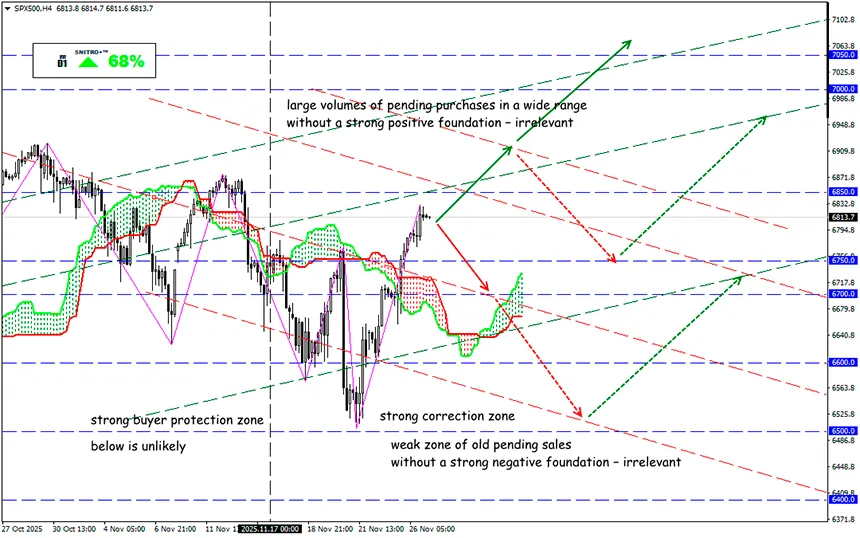
SP500
Key zone: 6,750 - 6,850
Buy: 6,850 (on strong positive fundamentals); target 7,000-7,050; StopLoss 6,800
Sell: 6,700(on a confident breakout of the 6,750 level); target 6,550-6,500; StopLoss 6,750
Any monopoly in an open market eventually begins to weaken. Several dozen of the world’s largest companies continue to fight each other. And this is good.
In Nvidia’s latest impressive report, skeptics have already identified signs of future problems, and the main one is declining business margins due to rising competition. The leader of the microchip market has already received its first major blow in the battle for market share: a company that is itself a monopolist (in the social media market) intends to lease tensor processing units (TPU) from Google.
Alphabet has been developing processors optimized for AI and machine learning since 2015 and until now has used them exclusively inside Google Cloud. Now the company is offering not only to rent out compute capacity but also to sell the chips themselves. The goal is to reclaim at least 10% of Nvidia’s market share.
This is not yet a purchase, but the market sees it as a highly probable scenario — which is confirmed by Alphabet’s stock reaction and the decline of Nvidia/AMD following the news of negotiations. This is already an event that hits Nvidia’s status and reshapes the AI-hardware market. Meanwhile, Meta already has a major cloud contract with Google Cloud worth about $10 billion over six years, focused specifically on AI infrastructure.
Alphabet has been developing processors optimized for AI and machine learning since 2015 and until now has used them exclusively in Google Cloud. Now the company is offering not only to rent out compute capacity but also to sell the chips. The goal is to reclaim at least 10% of Nvidia’s market share.
Why Meta is moving away from Nvidia’s monopoly
- Diversification of risks
- Overheated AI-chip market, shortage of H100/Blackwell, political risks (export controls, etc.)
- Shifting part of workloads to TPU reduces dependence on a single supplier and decreases supply-risk
- Reduction of ownership cost
- For massive LLM clusters of hyperscalers, TPU may be cheaper per model-training cycle than top-tier GPU, especially with deep Google infrastructure integration
In essence, Meta is choosing a hybrid approach: Nvidia (plus its own ASICs) + Google TPU. If Meta becomes an anchor customer, Google Cloud gains the argument: “our hardware is no worse than Nvidia, but tightly integrated with the cloud.”
The Meta–Google deal fits into a broader trend — OpenAI, Apple, Safe Superintelligence, Cohere and others already use or test TPU as an alternative to Nvidia.
At this stage Nvidia was even forced to publicly emphasize its technological leadership and compatibility with most AI models to calm market panic. This signals that the era of near-total monopoly in AI accelerators is ending: major clients are starting to build multi-vendor clusters and are ready to move critical workloads to alternative chips.
For the AI market overall, this is a step toward more competitive, cheaper, and diversified infrastructure. For now, the rise in Alphabet’s stock cannot compensate for the decline in NVDA and AMD.
In fact, there is no global negative news, but the market is still slightly deflating simply due to internal competition.
So we act wisely and avoid unnecessary risks.
Profits to y’all!


