


















US labor market: weak, but stable
What to expect from Nonfarm Payrolls
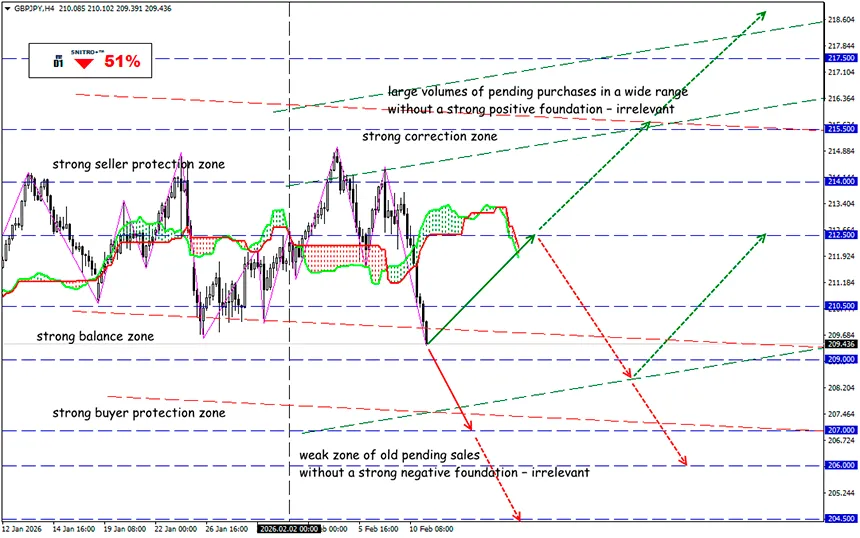
GBP/JPY
Key zone: 209.00- 210.50
Buy: 211.00 (on a confident breakout of the 210 level); target 213.50; StopLoss 210.30
Sell: 208.50 (on strong negative fundamentals) ; target 206.00; StopLoss 209.20
Given the current statistics and political risks, problems in the labor market could increase pressure on the Fed to ease policy and accelerate the rate-cut cycle as early as this summer. This makes today’s release especially sensitive for market participants.
Let us recall:
The dollar reacted poorly to weak retail sales data for December, which indicates a decline in the role of consumers in the economy by the end of the year. This indicator, one of the key measures of consumer activity, showed a significant slowdown.
Consumers remain dissatisfied with the high cost of living and are concerned about the labor market situation. High inflation continues to put pressure on purchasing power, while uncertainty in the labor market forces consumers to be more cautious with spending, preferring to spend money on essential goods.
Since the official BLS data release was delayed, the ADP report was perceived by the market as a key signal about the state of the labor market. The latest data leave little room for employment recovery: opportunities for large-scale job growth remain limited.
In January, private sector job growth in the US turned out to be significantly below expectations. Only 22,000 new jobs were created — the weakest result among all forecasts collected by Bloomberg. In addition, the November figure was revised downward from 7.1 to 6.9 million. This reinforces the problems observed since October last year.
The largest decline in job openings was recorded in: professional and business services (-257K), retail trade (-195K), and finance and insurance (-120K). Against the backdrop of weak labor demand, the hiring level barely changed — in December it remained at 5.3 million.
According to separate data on corporate employment plans, January 2026 became a record month for announced layoffs since the Great Recession of 2009.
The main reasons for layoffs are economic uncertainty, contract reductions, and business restructuring. In addition, companies remain cautious about hiring due to immigration and trade policies, as well as uncertainty around AI implementation.
Concerns are growing that artificial intelligence is behind recent changes in mid-level employment reports released this week. By the way, the BLS report on strikes notes that the end of strikes will increase job growth in January by 1.5K.
And forecasts for today’s release:
- Goldman Sachs expects job growth of +45K, below consensus. The main argument for a weak report is the “birth-death” statistical model, which will be updated together with this release.
- Wells Fargo analysts note that hiring has stabilized at a low level: the main job gains came from education and healthcare, while employment in professional and business services continues to decline.
From Trump’s latest comments, we highlight the following:
- The US should have the lowest interest rates in the world (!!).
- Every 1.0% rate cut saves $600 billion and could eliminate the budget deficit.
- Employment figures remain good after government job cuts.
Apparently, Donny already knows the NFP data and considers them positive within his own logic. The market does not share this optimism.
The Fed’s rhetoric remains balanced, but the market clearly understands that vulnerability in the economy is still concentrated in employment — any changes affecting expectations for wages, working hours, and job openings will inevitably impact the global economic outlook.
Traditionally, we expect the reaction to NFP in USDJPY and the main yen pairs, as well as in the dollar index. Moves will be speculative and will mainly clear accumulated positions on both sides of the market.
So we act wisely and avoid unnecessary risks.
Profits to y’all!


