


















There will be plenty of oil, but It will be expensive

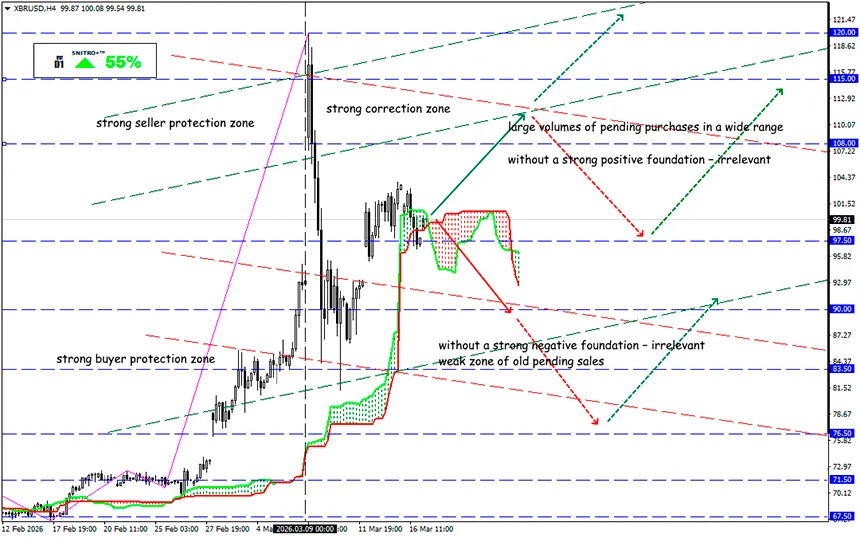
The commodities market is far from stable
XBR/USD
Key zone: 95.00 - 103.00
Buy: 103.50 (on a decisive break of 101); target 108.50; StopLoss 102.00
Sell: 93.50 (on strong negative fundamentals); target 87.50; StopLoss 95.00
The situation in the Middle East remains dominant: the lack of clear prospects for the end of the war and a victory by either side guarantees a wide range-bound market with short-term speculation both in crude oil and in the refined products market.
Prices for key benchmarks have increased by 25–40% and have once again exceeded the $100 mark, while the coordinated release of about 400 million barrels from strategic reserves has so far provided only short-term relief.
The geopolitical situation is deteriorating. Trump has failed to create a coalition to patrol the Strait of Hormuz under constant attacks from Iran.
Let us recall:
The oil market is directly affected by problems with the transportation of raw materials through the Strait of Hormuz, a supply shock, and a simultaneous decline in the volume of energy supplies.
Today, Iran for the first time successfully attacked oil production and gas processing facilities – the Shah oil and gas field in the UAE and the Majnoon oil field in Iraq. Saudi Arabia was subjected to massive drone attacks.
Iran is threatening to keep the strait under fire control until a peace agreement is concluded on its terms.
In addition, attention should be paid to the following facts:
- The strategically important port of Fujairah in the UAE, the largest regional hub for transshipment of both crude oil and refined fuel, has completely halted oil loading after a series of war-related strikes on the only crude export route bypassing the Strait of Hormuz.
- The terminal operated by a joint venture with the Dutch company Koninklijke Vopak NV has also ceased operations at its marine berth.
- As a result of the conflict, rising energy costs are being passed on to consumers in the U.S. and Europe: gasoline prices in the U.S. are currently fluctuating in the range of $3.4–3.6 per gallon, highlighting a real supply shortage.
- Global oil inventories may reach unprecedentedly low levels within a few weeks if the Strait of Hormuz remains effectively closed. The U.S. has stated that the flow of oil from strategic reserves may be increased. This raises the risk of a severe supply shortage and a sharp increase in oil prices.
- Kazakhstan and Azerbaijan are benefiting from the conflict in Iran: traders report a sharp increase in premiums for Caspian oil – Kazakhstan’s CPC Blend and Azerbaijan’s BTC – compared to Brent amid supply disruptions from the Middle East.
Iran’s threat to push oil prices to $200 so far looks like ordinary blackmail, but as the energy crisis deepens, such a scenario is becoming increasingly likely.
And what is the result?
Investors still hope for Trump, believing that the crisis will be resolved quickly and the Strait of Hormuz will soon be reopened. This can be called the “Trump put option” – oil traders are betting that the president will be able to limit the damage to the market. However, this optimism is becoming increasingly difficult to reconcile with reality.
Analysts confirm the intervention of the Trump administration in the oil market; major banks report massive selling of oil options from $100 per barrel.
Even a rapid restoration of operations in the Strait of Hormuz will not lead to an immediate improvement in the situation. According to the IEA, since the beginning of the conflict in the region, oil production of about 10 million barrels per day has been suspended. It may take weeks, or possibly months, to restore these flows.
As long as the route through the Strait of Hormuz remains restricted and dangerous, the upward trend in oil prices persists, and a retest of the $110–120 zone and higher looks increasingly likely. The end of the conflict is the main bearish scenario – futures indicate that the market is ready to return benchmark prices to the $65–70 range if the conflict is stopped within 2–3 weeks.
A prolonged conflict threatens to push the energy market into a real inflationary collapse.
So we act wisely and avoid unnecessary risks.
Profits to y’all!


