

















Inflation and war: the market awaits a truce
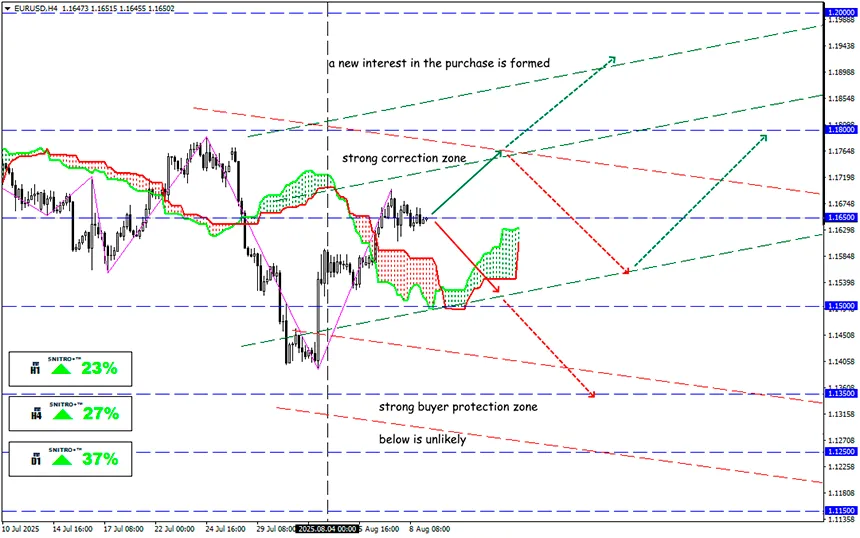
#EURUSD
Key zone: 1.1600 - 1.1750
Buy: 1.1750 (on a confident breakdown of 1.17 ) ; target 1.1950-1.2000; StopLoss 1.1680
Sell: 1.1550 (on strong negative fundamentals) ; target 1.1350-1.1300; StopLoss 1.1620
On August 7, Trump’s full reciprocal tariffs came into effect. This was a shock to most countries that had counted on at least basic business logic from the U.S. president. Unfortunately, Donald is convinced that only the U.S. will profit from a global trade reshuffle, and that all other countries — regardless of political partnership — will dutifully pay any tariffs, even illogical ones.
The impact of U.S. tariffs is already being felt: investor interest in the EU is falling, Canada’s labor market is in trouble, and Japan is facing a political crisis. Of course, part of the lost trade revenue will be passed on to the end consumer through higher taxes, so we expect increased activity from all kinds of populists and opposition parties — with the EU particularly at risk.
The appointment of Miran, head of the White House Council of Economic Advisers, to the vacant seat on the Federal Reserve Board of Governors until January 31, 2026, was an extremely unpleasant surprise. However, with the introduction of the new U.S. monetary system, the Fed’s role will become purely nominal — the markets simply have not yet realized this fact.
Futures on U.S. and European stock indices rose, while oil fell on speculation that the U.S.–Russia leaders’ meeting could increase the chances of ending the military conflict in Ukraine. For now, markets can operate calmly, without fear of U.S. tariffs on Chinese goods over purchases of Russian oil.
U.S. retail sales will help assess the strength of consumer demand, considered the main driver of U.S. GDP growth, but we believe the current market is reacting more strongly to trade balance data. China’s retail sales and industrial production will show how successfully Beijing is shifting toward domestic demand.
The U.S. tariff suspension deadline for China expires tomorrow, with a 90-day extension expected.
The eurodollar rose last week on SNB interventions in EUR/CHF and gains in GBP/USD. There is no intrinsic positive fundamental background for the euro, and even a potential truce in the military conflict could be considered a negative factor in the medium and long term. Due to the hostilities, the EU bet on ramping up military production, but now bloc countries — for example, Germany — are in no hurry to invest in the defense industry.
Nevertheless, the first reaction to a war truce will most likely be positive.
We note U.S. CPI and PPI inflation, expecting a 0.1% YoY increase in both headline and core CPI. The first effects of Trump’s tariffs should appear. We will pay special attention to revisions of past-period data.
Regardless of the actual outcome, the U.S.–Russia meeting will be presented by Trump as an incredible breakthrough, while real market problems will be addressed afterward. There will be plenty of insider reports online — including false ones — and speculators will be triggering StopLosses on both sides of the market.
So we act wisely and avoid unnecessary risks.
Profits to y’all!


