


















The Fed makes its decision
Who are you with, Mr. Warsh?
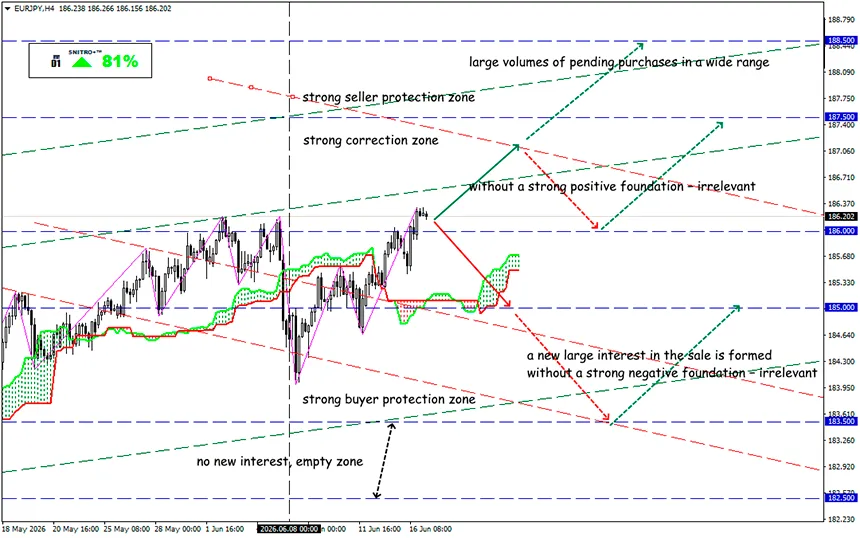
EUR/JPY
Key zone: 185.50 - 186.30
Buy: 186.50 (on strong positive fundamentals); target 187.50-188.20; StopLoss 186.00
Sell: 185.00 (on a pullback following a retest of 185.50) ; target 183.50; StopLoss 185.50
Today, the U.S. monetary regulator is making its first rate decision under the leadership of the new Fed chair. The FOMC meeting is taking place in a situation where inflation in the United States again looks too high for a comfortable policy pivot, while the labor market is no longer overheated but also shows no clear breakdown.
Let us recall:
All of Trump’s previous attempts to strengthen his influence over the Fed failed. He was unable to affect the reappointment of regional Federal Reserve Bank presidents or place enough loyalists on the Board of Governors. One can promise rate cuts as much as one likes, but the real situation is much more complicated. At the moment, there is a strong group of financial officials inside the FOMC who dislike an asymmetry toward easing.
Fresh macro data do not give the Fed a simple reason for imminent easing:
- In May, CPI accelerated to 4.2% y/y, while core CPI was 2.9% y/y.
- The latest available PCE for April showed 3.8% y/y, while core PCE was 3.3% y/y.
- The labor market remains resilient: in May, NFP increased by 172,000, unemployment stayed at 4.3%, and average hourly earnings growth was 3.4% y/y.
- Short-term consumer inflation expectations, according to NY Fed data, remain elevated — 3.5% for 1 year, while labor-market expectations have deteriorated.
The labor market does not yet give the Fed a reason to rush into rate cuts. The consumer and the real sector are sending a mixed but generally non-recessionary signal. Household psychology is deteriorating. This is exactly the combination captured by the Fed’s April statement and minutes.
And note: a rate hike today is an unlikely but not a zero-probability scenario. The April minutes recorded that most participants see an elevated risk of inflation returning to 2% more slowly, while some members directly indicated that additional tightening could become appropriate if inflation remains persistently above target.
If the Fed concludes that the renewed acceleration in CPI/PCE is not only energy-driven but also reflects broadening pressure, aggressive steps are entirely possible.
In the FX market, we will trade long-dollar positions against currencies whose central banks are already closer to the end of the cycle or are beginning to ease. In equities, we prioritize either high-quality large technology names with stable earnings or sectors less sensitive to rate dynamics.
In gold, we will trade the first speculative impulse: gold is currently supported by geopolitics but faces resistance from high real rates and a strong dollar. The most vulnerable assets are cryptocurrencies and the currencies of energy-importing countries.
And what is the result?
The main interest in Warsh’s first press conference is that the market needs to understand his real views on monetary policy. Is he truly ready to fight inflation? Does he plan to reduce the Fed’s balance sheet more actively while following a more restrictive course?
In fact, continuity and stability are extremely important for the U.S. central bank. Former Fed Chair Powell still remains a member of the Board of Governors, and he can suggest how to prepare a speech that will be interesting for the market.
Under U.S. law, dismissing the Fed chair is extremely difficult. Trump has no serious leverage over the Fed, which means Kevin Warsh has no real incentive to remain loyal to the president.
So there is a chance that the rate will be chosen exactly as the economic situation requires. Given elevated inflation, it should be left unchanged at 3.5–3.75%.
So we act wisely and avoid unnecessary risks.
Profits to y’all!


