














The Fed: inflation, war, and Trump
Will the new head of the U.S. federal reserve be more useful than powell
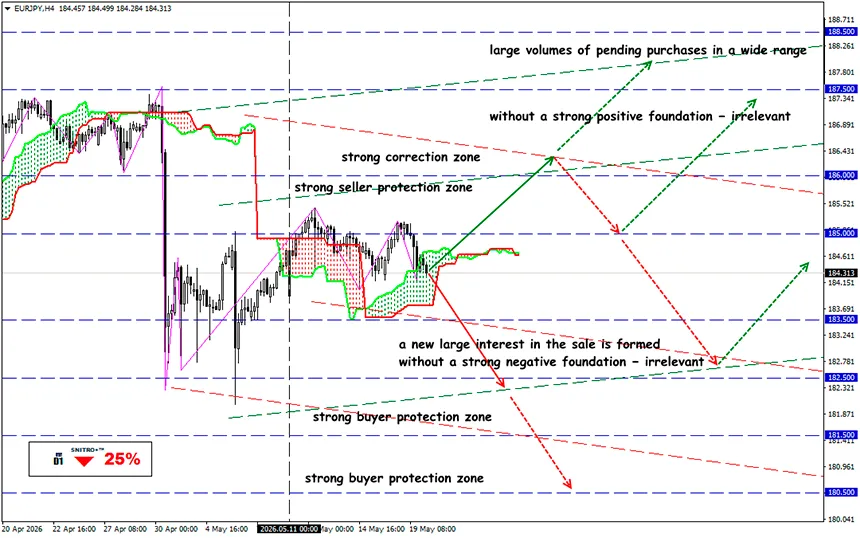
EUR/JPY
Key zone: 184.00 - 185.00
Buy: 185.50 (on a decisive break of the 185.00 zone) ; target 187.50-188.50; StopLoss 184.80
Sell: 183.50 (on strong negative fundamentals) ; target 181.50-180.00; StopLoss 184.20
Kevin Warsh officially took over the Federal Reserve on May 18, 2026 — at the moment of a perfect economic “storm”: inflation at a three-year high, the Strait of Hormuz blocked, bond markets on fire, and the president publicly demanding rate cuts. The next FOMC meeting is scheduled for June 16–17.
Reminder:
The U.S. Senate confirmed Warsh by a 54–45 vote — the narrowest margin in the history of confirmations for the Fed chair position. By comparison, Powell was reconfirmed in 2022 with 80 votes. Only one Democrat — Pennsylvania Senator John Fetterman — crossed over to support Republicans. In other words, the level of trust from colleagues toward the new chairman is minimal.
The key achievement of Warsh’s predecessor was that the Fed managed to significantly reduce the 2022–2024 inflation surge without a classic recessionary spike in unemployment.
- During Powell’s tenure, the Fed passed through four qualitatively different regimes: rate adjustments during the 2018–2019 stress period, crisis easing and lending programs in 2020–2021, rapid tightening in 2022–2023, followed by the beginning of rate cuts in 2024–2025.
- Powell’s strength was crisis management and institutional flexibility: in March 2020, the Fed quickly returned rates to zero, launched large-scale purchases of Treasuries and MBS, stabilized key markets, and simultaneously created a broad range of emergency lending facilities.
- His weakness was a delayed response to the inflationary turning point of 2021, along with poor communication surrounding the average inflation targeting framework.
The final assessment is mixed, but overall above average. Powell’s policy was not error-free, but the correction phase turned out to be unexpectedly effective.
Can Trump’s protégé change the rules of the game?
Warsh spent years seeking the opportunity to lead the Fed and publicly criticized its policies, forecasting architecture, and communication strategy. During Senate hearings in April, he articulated his key principle: “The search for truth matters more than repetition.”
In other words, if dozens of Fed officials regularly issue similar statements, they can create the illusion of consensus where productive debate is actually needed. It is unlikely that this could effectively help a crisis-stricken U.S. economy.
In addition:
The new Fed chair considers the quarterly “dot plot” highly harmful — the framework in which each FOMC member anonymously indicates rate expectations for the next 1–3 years. Eliminating the dot plot or radically changing it would be an unprecedented move and could trigger short-term panic across all markets.
Over the past three decades, the Fed built its reputation on transparency — regular press conferences after every meeting were introduced by Powell, alongside public votes and clear communication. A departure from this model may be interpreted ambiguously by markets.
Ending press conferences after every FOMC meeting and returning to a quarterly format would turn interim meetings into empty technical pauses, sharply increasing uncertainty in how markets interpret Fed behavior.
And let us not forget the main point: Warsh remains under tight pressure from Trump. But the global context has changed dramatically. When Kevin actively argued for lower interest rates, oil traded at $70, inflation stood at 2.4%, and supply logistics through the Strait of Hormuz functioned without disruption. Today, oil is above $107, inflation is 3.8%, PPI is 6.0%, and the Middle East conflict is entering its hottest phase.
Only a financial kamikaze would cut rates under such conditions. We will see how this turns out.
So we act wisely and avoid unnecessary risks.
Profits to y’all!


