











Fresh Trend: Tether Actively Moves into the Dollar
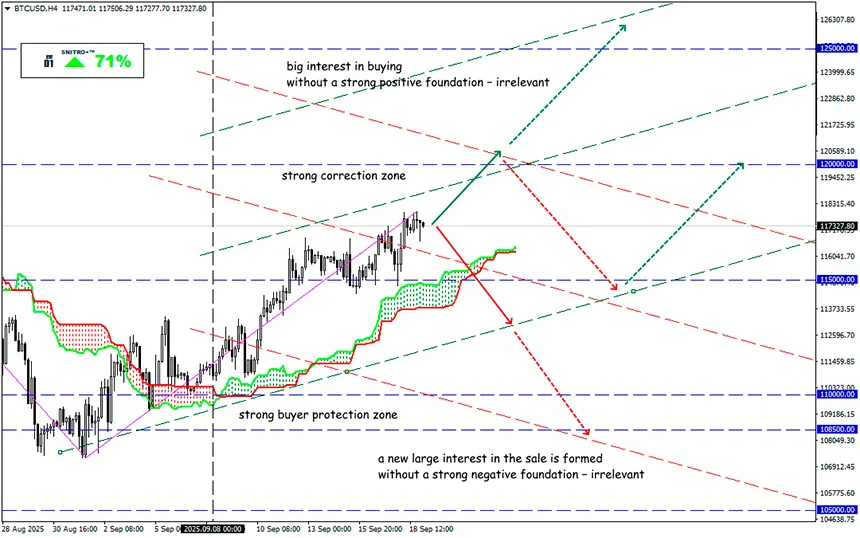
BTC/USD
Key zone: 116,000 - 118,000
Buy: 118,500 (on a confident breakdown of 117,800 level); target 121,000-122,500; StopLoss 117,800
Sell: 116,000 (on strong negative fundamentals) ; target 113,500-111,500; StopLoss 116,800
After years of scandals, the world’s largest stablecoin issuer, Tether, has officially launched a new token in the United States – naturally, dollar-denominated. The launch of USAT is a key event for the company’s future.
The main difference from other company products is that USAT complies with the recently adopted “Trump’s” GENIUS Act. Even issuance was carried out through Anchorage Digital Bank – a regulated financial institution.
For Tether, which has always been criticized for its opacity and offshore schemes, this step marks a real turn toward public legitimacy in the most legally dangerous financial market.
When the company first launched its stablecoin in 2014, it claimed each token would always be guaranteed by a real dollar “one-to-one.” However, in 2021 it turned out that these “guarantee” reserves included commercial papers, loans, and other riskier assets. As a result, the New York Attorney General fined Tether Limited $41.6 million for inaccurate data and “false statements” about its reserves.
Connections with shadow markets also damaged the company’s reputation. USDT transactions repeatedly circulated through the darknet, sanctioned jurisdictions, and money laundering schemes. In response, Tether began actively demonstrating cooperation with law enforcement, freezing over $300 million related to fraud and sanctioned entities in 2023 alone. Yet US regulators continued to treat Tether with caution.
The base stablecoin remains dominant in the crypto economy (with more than $100 billion in circulation). USDT is used in trading, cross-border transfers, and as an alternative to the dollar in economies with unstable banking systems.
However, in the US, institutional investors and regulators avoided Tether due to questionable reserves and past legal issues. The new token aims to attract banks, funds, and corporations that require reliable guarantees. Many in the US also view the launch of USAT as a move against competitor Circle’s USDC.
Globally, the market still trusts the old USDT. In Asia and Latin America, USDT is used as a dollar surrogate under capital controls or inflation. For millions of people, Tether is not an investment but a way to preserve savings. This massive demand could serve as a safety cushion for the company, even if the US experiment fails.
By issuing USAT under US oversight, Tether builds a bridge between the crypto industry and traditional finance. Now Tether promises to hold its reserves exclusively in cash and US Treasury bonds. But the new rules of the game could also bring additional risks.
If the project succeeds, it will legitimize stablecoins as a component of the financial system. If it fails, it will reinforce skepticism toward the sector. Tether is too big to ignore, but now it must prove it is too reliable to fail.
So we act wisely and avoid unnecessary risks.
Profits to y’all!


