


















Rally on global negativity: nothing to celebrate

Why the market feels weak
SP500
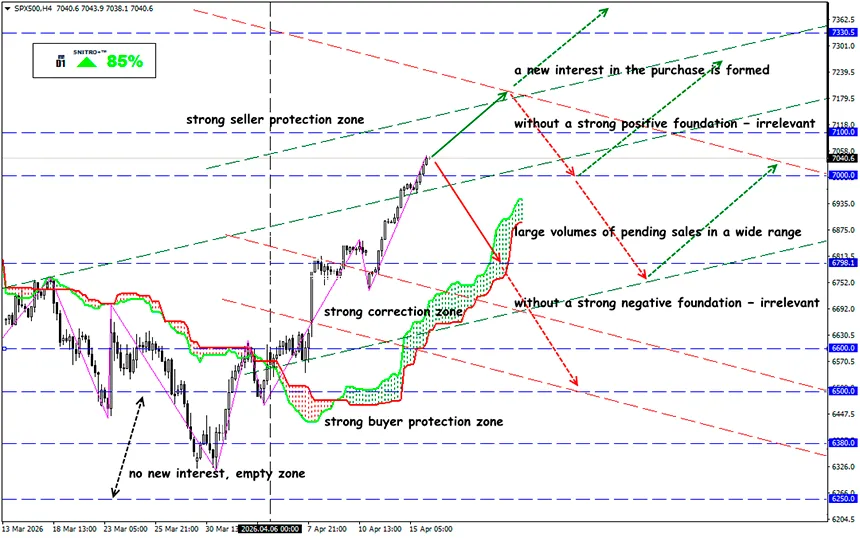
Key zone: 7,000 - 7,100
Buy: 7,150 (on a decisive break of the 7,100 level); target 7,350-7,400; StopLoss 7,100
Sell: 6,950 (on strong negative fundamentals); target 6,700-6,650; StopLoss 7,020
The S&P has broken above 7000: such a rally amid such a negative global backdrop has happened only once before — in 2000.
On April 15, the S&P 500 closed at 7022.95 — for the first time in history. The Nasdaq added nearly 1.6%, surpassing its record from October last year. From the March 30 low, the index has gained more than 10% in ten trading sessions — despite the blockade of the Strait of Hormuz and oil above $100.
Recall: a rapid rally in equity indices is almost the norm. A 10% rise in the S&P 500 over 10 trading days has occurred 21 times since 1950. But previously, this was a rebound after a sharp drawdown, and it was technically justified — the market is sinking, fear hits the bottom, and any good news turns into a bullish signal.
Now there is no such price “pit.” The S&P 500 has not even fallen 10% from its peak. And the current rally is highly uneven. Since the March 30 low, a basket of the seven largest tech companies has gained nearly 18%. All other 493 S&P 500 stocks — no more than 8%. This is not a broad recovery, but a narrow speculative momentum in the most expensive stocks.
The yield on 10-year U.S. Treasuries is 4.28%. Higher than at any point during the thirteen-year rally after the 2008 crisis. The alternative profit in bonds is very real.
History does not lie: moments when the market sets records amid a geopolitical crisis at record valuations tend to end badly for those who buy at the top.
Policymakers should be panicking and hedging risks while they still can.
- Obviously, it is too early to talk about the end of the Middle East conflict, but the timing factor for Trump — he does not have the authority to continue military operations for more than two months without Congressional approval — as well as his verbal interventions have shaken almost all sellers.
- According to Goldman Sachs, hedge funds were caught in the largest short positions in U.S. equities: after the announcement of a temporary truce with Iran, managers began aggressively covering short positions in macro products — indices and ETFs — at a pace not seen since the start of the 2020 pandemic. In just the past week, funds reduced shorts in equity ETFs by 11.5% — the strongest weekly short covering in more than a decade. This is why the upward move continues.
- Despite the so-called “Trump victory,” the consequences for the global economy will be long-lasting, and even more so for the U.S. The key risk factor is inflation. Oil prices will remain elevated for a long time. The Fed is not planning to cut rates or launch QE for now, so the liquidity shortage in the market persists. March inflation data released last Friday came in below expectations, but those expectations had been deliberately inflated so that trading algorithms would react to them.
- Another problem is speculation around AI. The U.S. is facing a significant reduction in potential investments from Middle Eastern countries, which had promised Trump tens of trillions of dollars last year. From 30% to 50% of the roughly 16 GW of data center capacity in the U.S. scheduled for launch in 2026 has already faced delays or cancellations. This will inevitably impact hardware manufacturers led by Nvidia and everything the market had priced in regarding continued growth of the AI sector.
The current situation in equity assets is not a sign of a healthy market capable of significant gains after updating historical highs. One must be prepared for the possibility that in the coming month the market may update not only this year’s highs, but also its lows. There are far more risk factors than positive ones.
So we act wisely and avoid unnecessary risks.
Profits to y’all!


