


















Oil war: analyzing the first losses

Who will pay for Trump’s “victory”
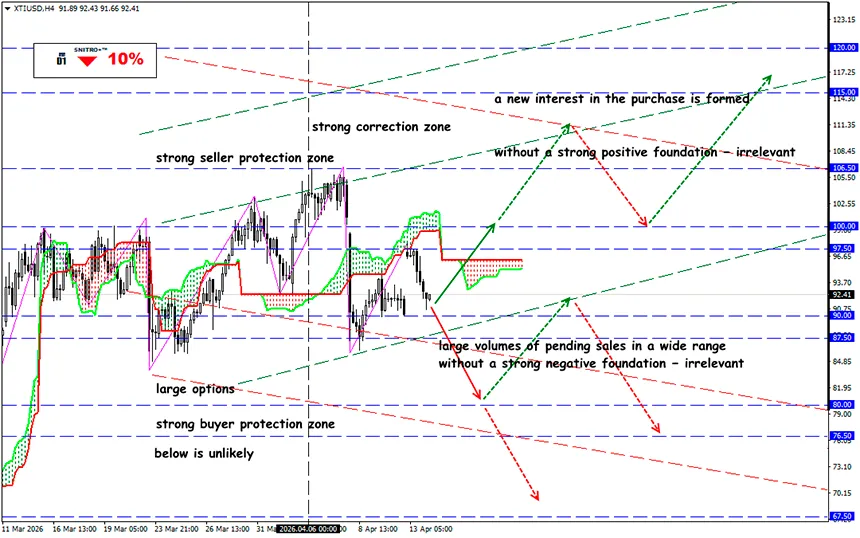
XTI/USD
Key zone: 91.00 - 95.00
Buy: 96.50 (after retesting 95.00); target 101.00-103.50; StopLoss 95.50
Sell: 90.00 (on strong negative fundamentals); target 86.50-85.50; StopLoss 91.00
Trump is actively promoting the blockade of the Strait of Hormuz as a “unique opportunity” for American oil and gas exporters. The attempt to strip Tehran of control over a key route has resulted in the loss of more than 2 million barrels per day of oil that Iran had been sending primarily to China.
Recall:
According to OPEC’s monthly report, oil production by Alliance countries dropped in March by a record 7.88 million barrels per day — the sharpest decline in the history of such statistics, dating back to the 1980s.
The collapse affected Iraq, Saudi Arabia, the UAE, Kuwait, and Qatar. OPEC lowered its global oil demand estimate for Q2 by 500 thousand barrels per day, while the annual forecast remained unchanged.
The larger the supply deficit in global markets, the higher the prices — from basic automotive fuel to industrial raw materials.
More than 20% of global oil and LNG supplies are already unavailable to consumers, forcing Japan, South Korea, and other Asian countries to seek alternatives to replenish reserves.
And the most transparent option is oil and LNG from the United States.
According to analysts at Kpler, about 70 VLCC-class supertankers (Very Large Crude Carrier), each capable of transporting around 2 million barrels of oil, are expected to arrive at ports along the Gulf Coast in April–May. By the end of April, exports could reach 5–7 million barrels per day.
Nevertheless, the U.S. continues to import oil (around 6.2 million barrels per day), mainly from Canada and Mexico, for processing at refineries designed for heavier grades. According to EIA data, last year imports averaged similar levels.
However, the ability to significantly increase domestic production (as Trump promises) raises serious doubts.
- The U.S. produces around 13 million barrels of oil per day, but most of this volume is already “sold” under long-term contracts.
- Four key export terminals in Texas and Louisiana can slightly increase tanker loading, but their spare capacity is limited.
- Enbridge is expanding capacity at the Ingleside terminal in South Texas by an additional 2.5 million barrels.
- The Port of Corpus Christi completed a $625 million upgrade last year, but there has been no significant increase in capacity yet.
- The Golden Pass project, implemented by Exxon Mobil jointly with QatarEnergy, is expected to eventually produce about 18 million tons of LNG per year.
- Cheniere Energy is considering postponing part of its maintenance work to increase supply volumes.
However, several major projects — Phillips 66, Enterprise Products Partners — have encountered regulatory and market constraints, as no one anticipated such aggressive actions from Trump.
As a result, fuel and basic petroleum product prices within the U.S. continue to rise. The average price of a gallon of Regular gasoline on Monday was $4.13 — 3 cents lower than a week earlier, but $1.15 higher than at the start of the war.
The announcement of the blockade pushed prices higher again: U.S. crude rose by 2.6% to $99.08 per barrel.
Export growth is not yet accompanied by increased production. Moreover, U.S. shale companies are not rushing to ramp up drilling, doubting the sustainability of current prices. This means inventories of oil and petroleum products will decline, increasing pressure on both wholesale and retail prices.
The market is trying to determine at what price level the “demand destruction” effect will emerge. A prolonged period of high energy prices could trigger a recession, which in itself would reduce consumption. According to the IEA, gasoline demand in the U.S. has already decreased by about 100 thousand barrels per day (-1.4%) over the past week.
This is currently beneficial for American exporters, who profit from tanker loading, and for oil traders betting on selling. But for retail consumers it is unfavorable, and for Trump it is крайне risky ahead of another “battle” for parliamentary loyalty.
Unfortunately, the idea of “victory” will soon have to be seriously revised — market forces do not obey presidents.
So we act wisely and avoid unnecessary risks.
Profits to y’all!


