















Oil: living between fear and reality
How the current crisis differs from the standard scenario
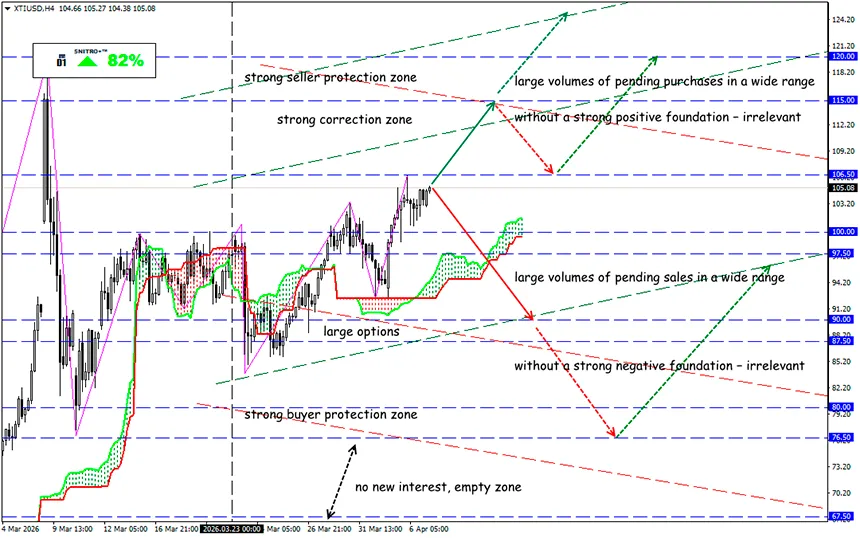
XTI/USD
Key zone: 102.00 - 107.00
Buy: 107.50 (after retesting the 105.00 level); target 112.50-115.00; StopLoss 106.50
Sell: 100.00 (on strong negative fundamentals); target 95.50-90.00; StopLoss 100.70
Trump continues to pressure the market: oil prices are rising amid the conflict in the Middle East. The escalation of military aggression makes the blockade of supply routes through the Strait of Hormuz a secondary issue.
Europe and the Persian Gulf countries have run out of political tools to contain the economic consequences of the war.
The oil shock has revealed a new vulnerability: the global economy has never faced a crisis of such scale accompanied by such a significant deficit and surge in energy costs.
Recall:
During the first oil crisis of the 1970s, the budget deficit in the US and other key countries was around 2% of GDP. Today, the average budget deficit has more than doubled, and the government debt of G7 countries has increased from 20% to over 100% of GDP.
Governments are trying to respond to the crisis in the same way as before: introducing price controls, implementing rationing schemes, and providing fuel subsidies. However, bond markets are warning about the risks of increased government spending.
Last year, global debt reached $348 trillion due to government borrowing, more than three times global GDP. Therefore, very few oil-consuming countries can now afford new stimulus measures.
Even if the oil shock slows the economy, central banks may be unable to act, as it will also lead to higher inflation. The most vulnerable countries are those with high public debt and budget deficits, as well as those where central banks are failing to meet inflation targets. In the developed world, this primarily includes the US and the UK, while among emerging markets — Brazil, Egypt, and Indonesia.
There are few relatively stable economies, and they are usually smaller countries such as Taiwan, Vietnam, and Sweden. In Sweden, despite a well-developed welfare system, the budget deficit is less than 2% of GDP.
The US, although protected from the oil shock due to energy independence, remains vulnerable to a prolonged conflict. Last year, the US budget deficit was the largest among developed countries, reaching nearly 6% of GDP.
This is why the current crisis in Iran differs significantly from previous ones — there are simply too few tools left to combat its consequences.
- OPEC+ has already warned: if energy infrastructure in the Middle East continues to be destroyed, restoring supply will require both time and significant costs. So far, the Alliance has formally approved an increase in production quotas in May by about 206K barrels per day, but this step is symbolic. Due to the war, supplies from the region are already constrained, and some routes are operating with disruptions.
- Iraq has informed Asian traders and refineries that they may resume oil loading, as vessels carrying Iraqi crude can now pass through the Strait of Hormuz. How realistic this is remains untested, but on Sunday the tanker Ocean Thunder carrying 1 million barrels of Iraqi oil has already crossed the narrow strait.
- Saudi Arabia has raised prices for its Arab Light grade for Asia to a record high (+$19.50) relative to regional benchmarks for refineries.
Prices moved higher again after Trump set a new deadline for Iran to reopen the strait. The market is operating in ожидание worst-case scenario mode, but it has not yet materialized. Prices are reacting to risks rather than actual shortages, and this is what makes the situation unstable. Any new statement or strike on Iranian infrastructure can quickly push quotes higher.
If the situation in the region cannot be stabilized, prices above $150 could be seen as early as next week, and to fully balance the market under a severe deficit, prices would need to rise above $200 per barrel.
However, not all market participants believe in this — so-called “smart money” is currently betting against such an extreme scenario.
So we act wisely and avoid unnecessary risks.
Profits to y’all!


