


















Oil in panic: politics is pressuring the trend
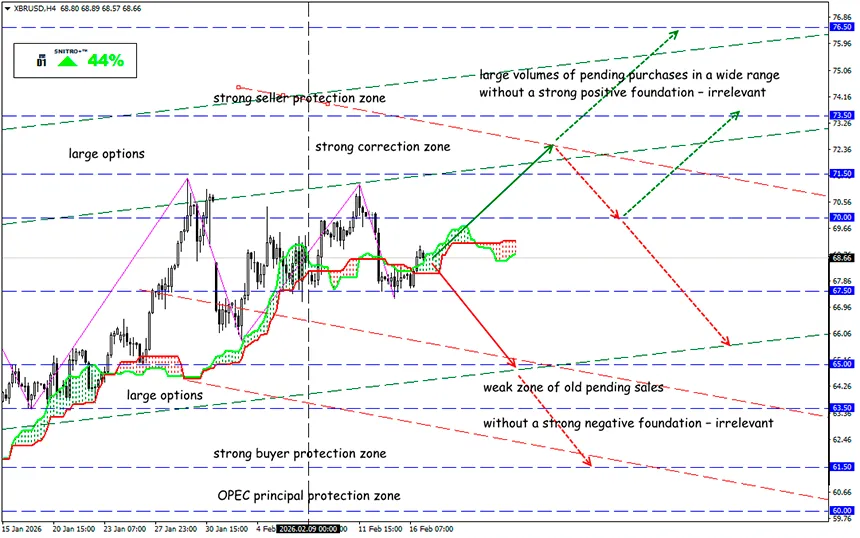
Oil prices break the base scenario
XBR/USD
Key zone: 67.50-69.50
Buy: 70.00(on a pullback after retesting the 68.50 level); target 71.50-73.50; StopLoss 69.30
Sell: 67.00(on strong negative fundamentals); target 65.00-63.50; StopLoss 67.70
During periods of crisis — financial or political — market sentiment always works more effectively than fundamental factors. Over the past two years, global oil supply has consistently exceeded demand.
According to the IEA, global inventories increased by a record 477 million barrels in 2025 due to higher production in the US, Brazil, other countries, and OPEC+. This is equivalent to 1.3 million barrels per day. At present, crude oil stocks in key regions of the world are declining, but still remain above last year’s levels and the five-year average.
In search of balance, the market had chosen a medium-term bearish scenario, but politics intervened.
Today, geopolitical risk premiums for major oil benchmarks are estimated at $5–10 per barrel. At the same time, geopolitics remains the main pricing driver in the commodity market.
If Trump manages to conclude a peace deal with Russia and a nuclear agreement with Iran, a drop in prices below $60 is guaranteed. But until that happens, the risk of supply disruptions due to sanctions against Russia or potential US military actions against Iran will continue to support higher prices.
Reminder:
Yesterday, Iran began military exercises in the Strait of Hormuz, while a second US aircraft carrier is heading to the Persian Gulf, indicating a high risk of any negotiations collapsing. The chance of a diplomatic agreement still exists, but looks minimal.
Bloomberg even considers a scenario where Brent jumps to $108 per barrel if Iran blocks the Strait of Hormuz. Stronger sanctions against Russia are forcing buyers of its oil to seek alternatives. Rising demand for other crude grades is also pushing prices higher.
Let’s highlight several factors:
- In February, China plans to buy a record volume of Russian oil — a result of redirected discounted flows from India, which sharply reduced purchases after a deal with the US.
- Independent Chinese refineries are the world’s largest consumers of crude from Russia, Iran, and Venezuela — supplies from all these regions are becoming more complicated. Currently, Russia’s ESPO blend for March delivery is trading at a $8–9 discount to Brent, while a similar Iranian blend is discounted by $10–11.
- Saudi oil sales to China increased in March after the Kingdom cut prices for its flagship grade, Arab Light, to the lowest level in five years due to concerns about global oversupply. Saudi Aramco will supply 56–57 million barrels, 8 million more than in February. Indian, South Korean, and Japanese refineries will also receive more oil under long-term contracts.
- Saudi oil has virtually eliminated its competitors in the Asian spot market.
- Iraqi oil exports may also rise next month. Iraq uses a different sales model compared to Saudi Arabia: Saudi oil is sold only via long-term contracts, while Iraq and other countries sell part of their exports on the spot market.
- Venezuelan oil sales are now controlled by the US and carried out through major international traders Vitol and Trafigura, which has reduced discounts to Brent. However, existing large shipments to China must still be fulfilled — Trump does not need serious international conflicts.
- OPEC+ is ready to take advantage of the favorable situation and start increasing production from April after a pause in the first quarter. Kpler expects the remaining voluntary cuts of 1.66 million bpd to be eliminated within six months.
The most realistic political scenario suggests that agreements with Iran and on Russia–Ukraine will not be reached before June this year. Therefore, it is reasonable to get used to Brent prices in the $60–62 range and WTI slightly above $63, as well as to a decline in diesel and gasoline margins by $5–7.
So we act wisely and avoid unnecessary risks.
Profits to y’all!


