


















Learn the theory, or how leverage destroys your money
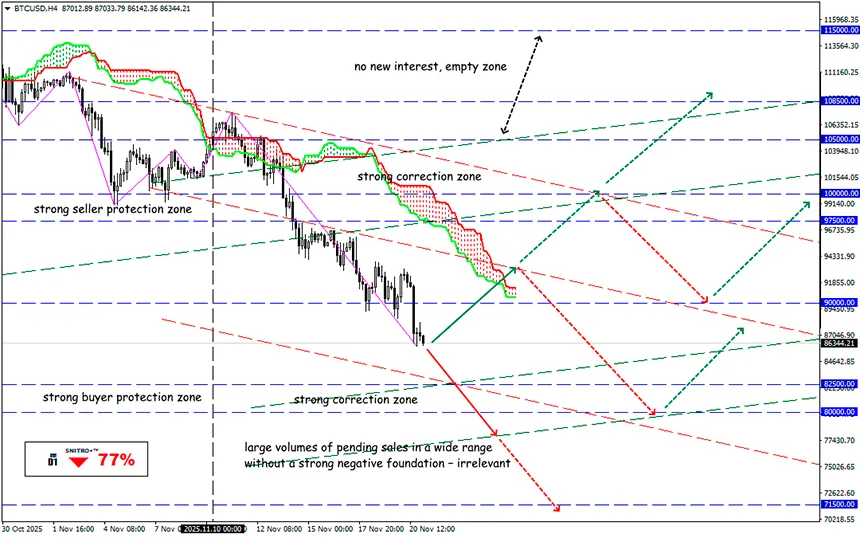
BTC/USD
Key zone: 87,500 - 90,000
Buy: 91,500 (on a confident breakout of the 90,000 level) ; target 93,500-95,500; StopLoss 90,500
Sell: 85,000 (on strong negative fundamentals) ; target 82,500-80,000; StopLoss 86,000
The current crypto rally is supported exclusively by borrowed money: traders use leverage in pursuit of fast profits. But once again the market has proven that high-leverage strategies are extremely dangerous for any deposit. And the threat works in both directions
Reminder: trading platforms allow leverage from 100:1 to 5000:1, and if the market moves in your direction, such trades generate super-profits. But if the market goes against you, any market impulse, large order, or fundamental factor will wipe out your position faster than a candle can appear on the chart.
In this case, speculative leverage became the catalyst for the sell-off.
In October, the average daily volume of crypto liquidations reached fantastic levels. It is believed that the first trigger this year was Trump’s tariffs against China, but the technical need for a downward correction formed much earlier. In April the market reversed, and exchange algorithms began mass-closing losing positions.
A sharp drop in price “eats” capital not only from retail traders but also from companies aggressively investing in crypto. For example, Strategy shares of Michael Saylor fell by 29% in a month, BitMine Immersion Technologies dropped 35%, while Bitcoin lost 13% over the same period.
In addition to standard leveraged trades, options, futures, “treasury shares” schemes and similar instruments are actively used. For example, Coinbase launched perpetual crypto futures with 10:1 leverage this summer, and CBOE is preparing perpetual futures for BTC and ETH with a 10-year maturity.
Crypto lending — one of the key drivers of the 2021 boom — is also returning: some depositors provide assets, while others receive loans at higher interest rates. But rates here are far higher than in banks. In 2022 many lenders collapsed when the market crashed. According to Galaxy Digital, the volume of outstanding loans in the crypto sector reached a record $74 billion by the end of September 2025.
There is an additional risk — the “depth” of the crypto pool. Major exchanges use automatic deleveraging (ADL) mechanisms. When too many losing leveraged positions accumulate, some profitable opposite positions are forcibly closed to preserve liquidity.
This triggers a “domino effect”: liquidations cause new liquidations, and price accelerates its movement against an over-leveraged market. That is how sudden downward impulses appear without obvious reasons.
Conclusion: right now leverage does not work as a factor of profit or position optimization. It is an instrument of self-destruction. Under HFT trading, unstable liquidity, and market-maker dominance, leverage above 5–10x turns any position into an instant casino.
The strategy of an experienced crypto trader is not chasing super-profits, but surviving. Minimizing leverage, controlling the fundamental background, hedging with options, taking profit in parts, and analyzing open interest structure allows navigating high-volatility phases without catastrophe.
So we act wisely and avoid unnecessary risks.
Profits to y’all!


