


















Where Japan Found the Money for Interventions to Support the Yen
The Yen Is Sick: The Old Medicine No Longer Works
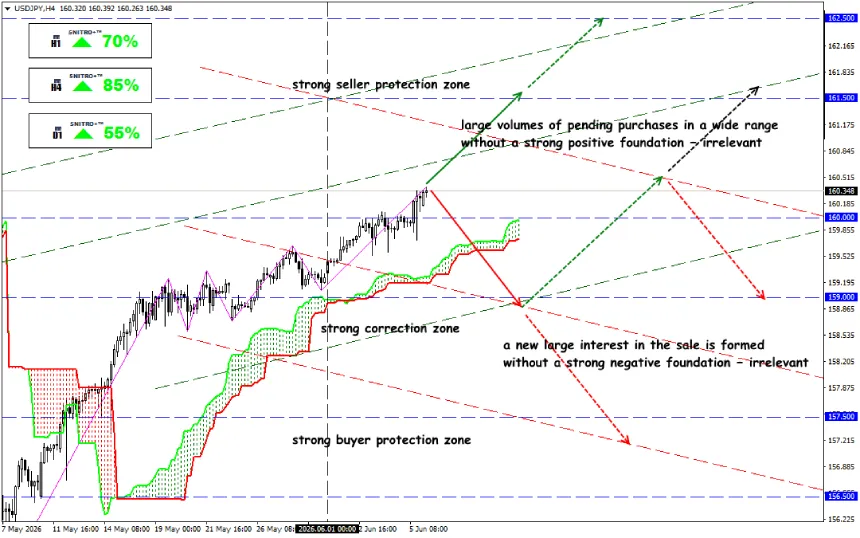
USD/JPY
Key zone: 159.50 - 160.50
Buy: 161.00 (on a pullback after retesting 160.00); target 162.50-163.50; StopLoss 160.40
Sell: 159.00 (on a confident break of 160.00); target 157.50-156.50; StopLoss 159.60
The volume of foreign securities in Japan’s reserves decreased by $75.6 billion — roughly matching the record spending on several operations aimed at supporting the yen. The fundamental reason is that the yield spread between two-year U.S. and Japanese government bonds increased from 2.12% to 2.60% since the beginning of February, making long-dollar positions against the yen attractive.
An official representative of Japan’s Ministry of Finance acknowledged that foreign-exchange interventions became one of the key factors behind the sharp reduction in foreign exchange reserves, and that this decline was the largest in history.
Let us recall:
Tokyo is using investments in foreign securities, including U.S. Treasury bonds, to finance record currency interventions carried out last month. Trump is unlikely to appreciate such a strategy for addressing Japan’s internal financial imbalance.
The sale of securities to support the Japanese currency does not sit well with the United States — the Trump administration is concerned about the stability of the government bond market.
Nevertheless, Japan decided to undertake the largest currency intervention in its history, and under completely different macroeconomic conditions. The key feature of 2026 is that financing did not come through the budget or through the Bank of Japan. As before, a special government vehicle, the Foreign Exchange Fund Special Account, was used.
At the same time, the yen was pressured by:
- a new surge in oil prices;
- an escalation of the conflict in the Middle East;
- growing demand for the U.S. dollar as a safe-haven asset;
- rising energy import costs for Japan;
- persistently higher yields on U.S. bonds.
The market began aggressively increasing short positions against the yen. According to Reuters estimates, speculative short positions approached $9 billion.
- Washington has not yet openly objected to Tokyo’s attempts to support the yen. Bessent even publicly expressed confidence in Bank of Japan Governor Kazuo Ueda, hinting that the United States expects interest-rate increases in Japan.
- Japan’s foreign exchange reserves declined to $1.09 trillion by the end of May. This is more than sufficient for additional interventions if they become necessary. The volume of foreign-currency deposits, another source of funds, remained virtually unchanged at $162 billion.
- The sale of U.S. securities is not yet considered critical. It would be worse if Japan were selling 10-year bonds, disrupting the balance of supply and demand in the debt market. In effect, Tokyo acknowledges that further sales of Treasuries are becoming not only a currency issue but also a factor in global financial stability.
- It is expected that the Bank of Japan’s leadership will discuss a possible rate hike at its June 15–16 meeting. However, despite the market assigning a 92% probability to a June rate increase, the yen continues to fluctuate near the levels at which interventions were previously conducted. Incidentally, at the end of June, the U.S. Treasury Department will publish its semiannual currency policy report — Japan remains on the list of 10 economies under close observation.
And what is the result?
The effectiveness of interventions is declining. The war involving the United States and Israel against Iran has added further pressure on the yen. Japan imports nearly all of its energy, with more than 95% of its oil imports coming from the Middle East. Rising oil prices mean that Japan must pay more dollars for energy imports, increasing demand for foreign currency at the expense of the yen.
After spending ¥11.7 trillion, the market returned rather quickly to the levels that had triggered intervention. This means that fundamental capital flows remain stronger than government actions. The market saw that even $73 billion failed to change the yen’s long-term trend. This is an extremely dangerous signal for Japan’s Ministry of Finance: each subsequent round of interventions requires an ever-larger amount of capital to achieve the same effect.
So we act wisely and avoid unnecessary risks.
Profits to y’all!


