


















IPO as a stress test for Wall Street
SpaceX is selling the “Smart Future”
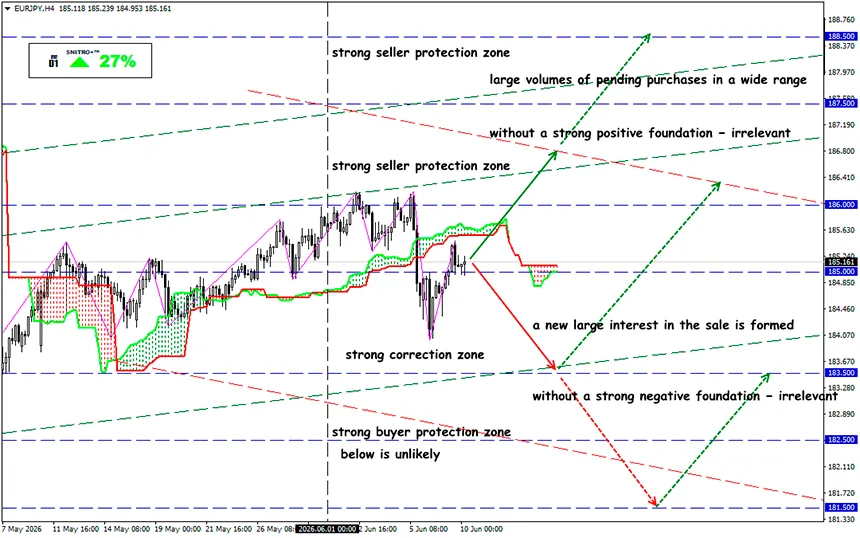
EUR/JPY
Key zone: 184.00 185.50
Buy: 186.00 - ; target 187.50-188.00; StopLoss 185.30
Sell: 183.80 (on a decisive break of 185.50) ; target 182.50-182.00; StopLoss 184.50
The largest technology IPOs — SpaceX, OpenAI, and Anthropic — are offering us three attractive narratives about artificial intelligence, space, and the infrastructure of the future. But does the market have enough capital and patience to cope with inflated expectations and hidden risks?
Let us recall:
The issue of leadership within this “team” is unsettling the market. Musk was among the founders of OpenAI in 2015 but left its board of directors in 2018. In May, he lost a legal dispute against the developer of ChatGPT, clearing the company’s path to the stock market. Dario Amodei left OpenAI in 2020 and founded Anthropic in 2021. Anthropic unexpectedly filed for an IPO on June 1. OpenAI is expected to do the same in the near future. Both listings are anticipated this autumn.
History shows that companies going public later within the same industry wave often achieve less favorable results. The wave is usually launched by stronger and higher-quality players. Market capital is not unlimited, and companies must deal with investor appetite that has already been partially exhausted.
SpaceX will begin trading on Nasdaq this Friday, June 12. Its market capitalization could reach $1.77 trillion, while proceeds are expected to total at least $75 billion. If the underwriting banks exercise their option to sell additional shares, the total IPO size could increase to $86 billion.
- SpaceX announced a fixed offering price of $135 per share in advance. The shrewd Musk deliberately removed the bargaining element from the process — a signal that demand is so strong that the company, not the market, dictates the terms. In other words, the formula is “take it or leave it.”
- SpaceX has plenty to show investors. By the end of 2025, the company’s revenue had increased by 33% to $18.67 billion, largely thanks to Starlink. The satellite internet service became the company’s primary financial asset, generating approximately $11.4 billion in revenue and $4.4 billion in operating profit during the year.
- The rocket business also looks convincing: the company has effectively monopolized the space launch market, accounting for more than 80% of the total mass sent into orbit annually. The failure of Jeff Bezos’s Blue Origin only strengthened SpaceX’s position.
- Nevertheless, space ambitions have gradually moved into the background, while grand AI plans are raising concerns and continue to generate enormous losses. The acquisition of xAI dramatically changed SpaceX’s profile. Last year, xAI lost $6.4 billion on revenue of $3.2 billion, and in the first quarter of 2026 it lost another $2.5 billion on revenue of $818 million. The company is burning approximately $1 billion per month on computing infrastructure.
- SpaceX intends to monetize excess computing capacity. Anthropic is expected to pay the company $1.25 billion per month for leasing the Colossus and Colossus II data centers in Tennessee through May 2029. That is, of course, assuming Musk does not change his mind and terminate the deal with a competitor.
And what is the result?
The main problem is an excessively inflated valuation. With a target market capitalization of $1.77 trillion and revenue of $18.67 billion in 2025, the P/S ratio would reach 93.7x. For comparison, the average ratio for the S&P 500 is 3.38x, while Tesla’s is 16.73x.
Musk’s critics are convinced that the fair value of SpaceX is no more than $780 billion and question the prospects of its AI business.
For example, the Danish pension fund AkademikerPension has placed SpaceX on its blacklist due to what it calls a “critically dangerous” corporate governance structure. Investors are being offered Class A shares with one vote per share. Musk, meanwhile, will retain 5.5 billion Class B shares, the so-called super-voting shares, each carrying ten votes. This represents approximately 94% of all Class B shares and about 85% of control over the company. In other words, public shareholders provide the company with capital but receive virtually no influence.
Objectively, the risks of failing to meet expectations in the SpaceX IPO remain significant. Businesses still cannot reasonably assess the risks associated with AI project implementation. In addition, the market is under pressure from an oversupply of low-cost AI products from Chinese laboratories such as DeepSeek. Competition is intensifying as Nvidia, Cohere, Reflection, and Mistral develop more affordable alternatives to Anthropic and OpenAI solutions.
Ambitious stories perform well in private funding rounds, but they do not always withstand the test of the market.
So we act wisely and avoid unnecessary risks.
Profits to y’all!


