














Germany Is Saving Europe Again
The Euro Searches for Military Optimism
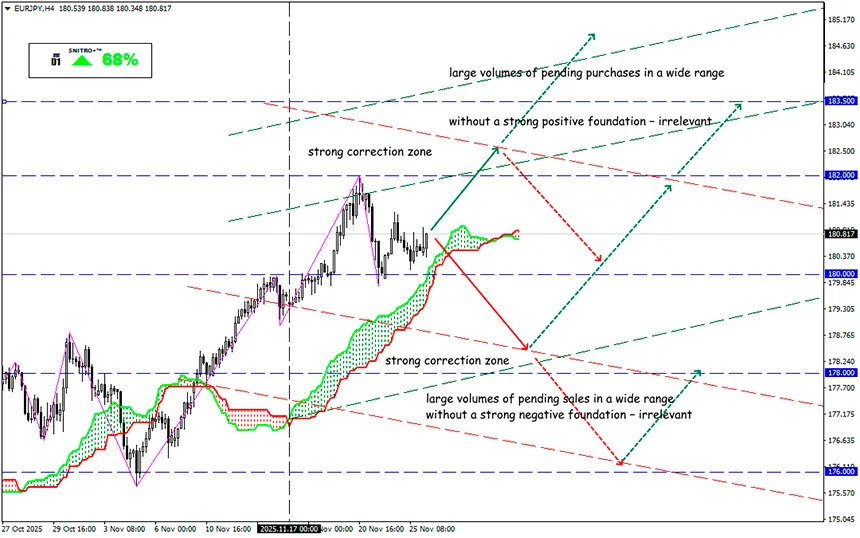
EUR/JPY
Key zone: 180.00 - 181.00
Buy: 181.20 (after retesting the 180.50 level) ; target 183.00-183.50; StopLoss 180.60
Sell: 179.50 (on a pullback after retesting the 180.00 level) ; target 178.00; StopLoss 180.20
Current data shows that the German economy did not grow in the third quarter. Compared to the strong GDP expansion in the United States, Germany’s +0.3% YoY looks weak. But compared to the recession of 2023–2024, the latest numbers appear surprisingly optimistic. Germany is even allowing the euro to go on the offensive against the dollar.
- Exports and weak consumer demand continue to drag the country down — U.S. tariffs and soft global demand are applying pressure.
- Investment in machinery and equipment showed positive dynamics, partially supporting GDP.
- Headline inflation is close to target, but core price pressures in services and rising wages limit the ECB’s ability to accelerate rate cuts.
- Unemployment: around 6.3% in September–October 2025, slightly above expectations.
- The ifo Business Climate Index rose to 88.4 in October from 87.7 in September — a one-year high in expectations, while the current assessment remains weak.
- The DAX is trading near 23,000 points at the end of November, and the 2025 YTD return for the ETF tracking it (Global X DAX Germany ETF) stands around +35–37%.
The war factor — a positive driver for the economy
A major rotation is underway inside the German equity market: after rallying earlier this year, several defense stocks are undergoing a repricing as ceasefire negotiations in Ukraine continue.
Germany’s key defense contractors — Rheinmetall, Hensoldt, Airbus, Thyssenkrupp Marine Systems — are reporting double-digit revenue growth, rising margins, and long-term order books supported by structural increases in defense budgets across Europe.
The accumulated defense deficit is not going away: the German defense sector is forming a long-term “fiscal anchor” of demand, independent of the conflict’s current phase. Defense spending is becoming quasi-permanent; much of the future revenue is already secured, including cyber-security contracts.
Chancellor Merz’s coalition expects German GDP to accelerate from 0.2% in 2025 to 1.3% in 2026 and 1.4% in 2027. The government is relying on large-scale fiscal stimulus, but as the Bundesbank correctly noted, this is insufficient. Reforms are needed to create a supportive environment for business.
A reminder: in Q3 and throughout the first nine months of 2025, the euro has depended more on U.S. rate dynamics than on German macro data. The strategy “buy euro vs. dollar on dips as long as political balance holds” remains valid, but it is extremely sensitive to Fed news.
For those avoiding speculation, we recommend buying the euro through major cross-pairs — they are calmer, though the yen factor must be considered. Remember: the final two days of the trading week will pass without U.S. capital flows, and speculators will use the low liquidity. As a result, Monday’s market open may shift key levels toward more euro-positive zones.
So we act wisely and avoid unnecessary risks.
Profits to y’all!


