


















Europe Is Losing the Tariff War
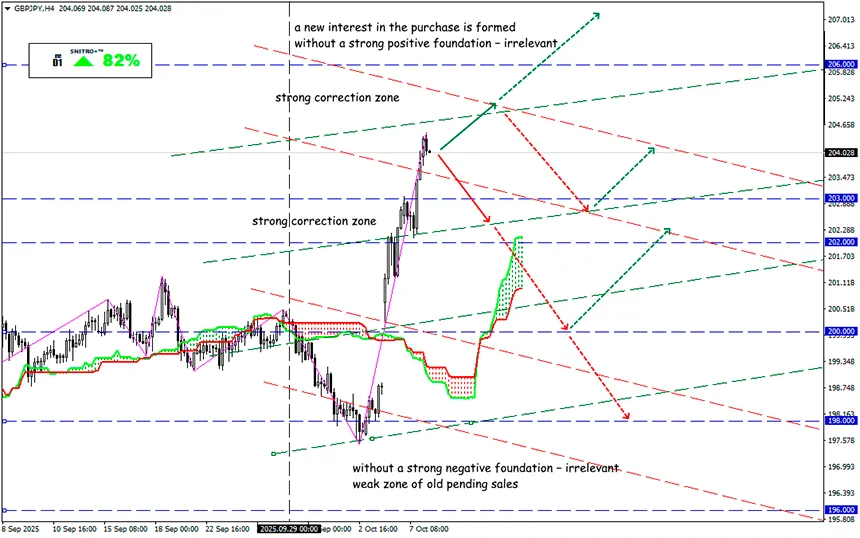
GBP/JPY
Key zone: 203.50 - 205.00
Buy: 204.50 (on a strong positive foundation); target 206.50; StopLoss 203.80
Sell: 202.00 (after a retest of 203.00) ; target 200.00-198.00; StopLoss 202.80
Even with trade deals signed, Trump’s tariffs continue to blackmail Europe and introduce new layers of economic risk. The European Union effectively lost the trade war against the United States when Ursula von der Leyen agreed to a crippling—and frankly illogical—deal with Trump. Against China, the EU is also losing ground due to the weakness of the yuan.
For several months now, Christine Lagarde has been warning—almost weekly—about the excessive strength of the euro. The ECB’s interest rate remains a favorite but opaque topic for market manipulation. A strong euro is disadvantageous for both the EU and the ECB, yet it cannot be too weak either—otherwise, confidence in the currency would collapse.
The two traditional engines of the EU—Germany and France—are no longer capable of resolving the bloc’s deep structural issues.
Let’s recall: France and Germany together account for half of the EU’s GDP. If these two economies are struggling, the entire bloc is in trouble.
Trump’s tariffs have sharply reduced export volumes to the U.S., dealing a severe blow to German and French manufacturers, as the American market remains the world’s largest. Declining external demand forces production cuts, which in turn lead to falling revenues, layoffs, reduced investment, and a general economic slowdown. The stronger the euro, the weaker the demand for European goods—even within the internal market.
Meanwhile, China is rapidly increasing its exports to the EU, making European products less competitive. The euro has gained 16% against the yuan over the past three years, further boosting the attractiveness of Chinese goods.
The ECB has already begun intervening to stabilize the euro’s exchange rate, although no official confirmations have been provided—especially since currency targeting is implicitly prohibited. Switzerland, for example, resumed interventions and immediately drew criticism from Washington.
The confrontation with Trump continues, and Europe’s resistance is slowly eroding.
Let’s emphasize once again: the euro and the pound are rising not because they are strong, but because the dollar is weak. This trend is already fragile and unstable.
For speculators, a more reliable opportunity lies in cross-trading with the yen, where the gap remains open. A technical pullback is necessary, but so far the correction signal is weak. Above the upper boundary of the range, new buy volumes are accumulating—but fresh entries should only follow a thorough fundamental analysis of USD/JPY and strict risk control.
So we act wisely and avoid unnecessary risks.
Profits to y’all!


