
















Europe Gets a Chance to Survive
#EURUSD
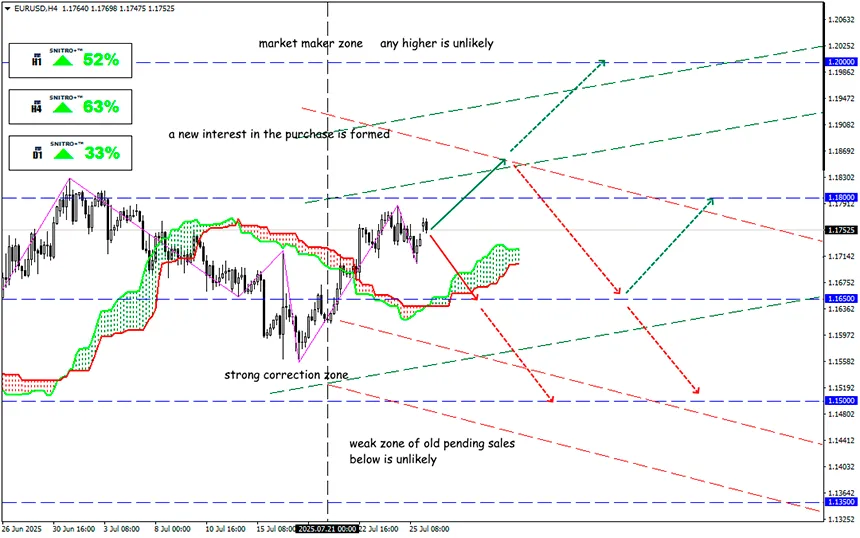
Key zone: 1.1700 - 1.1800
Buy: 1.1800 (on a strong positive foundation); target 1.1950; StopLoss 1.1720
Sell: 1.1680 (on a strong breakdown of 1.17); target 1.1550-1.1500; StopLoss 1.1750
Let’s be clear: the euro is rising not because the EU–US deal benefits Europe — on the contrary, the agreement is bold and predatory — but because the business sector now has at least temporary clarity on new rules and boundaries. This is a short-term effect.
So, Trump created a problem out of nothing, then reversed it and declared it a “victory.”
Key points from the EU trade deal:
• The European Union commits to purchasing U.S. energy resources worth $750 billion and investing another $600 billion in the U.S. economy.
• The EU will buy U.S. weapons worth hundreds of billions of dollars (no precise figure has been disclosed).
• The U.S. will lower tariffs for the EU from 40% to 15%, while the EU will impose mirror 15% tariffs on automobiles, chips, and pharmaceuticals.
• The EU had aimed for a 15% tariff on steel and aluminum, but the 50% duties remain in place for now, with hopes to revisit this later.
P.S. The energy promises are unrealistic: the EU cannot purchase that much energy within 3 years.
From Trump’s statements:
• The EU will open its market to us, and our products will be sold there without tariffs.
• The EU must purchase $1 trillion in U.S. energy.
• We agreed on a 15% tariff for the EU, including automobiles.
• This agreement will unite us with the EU and bring stability.
The deal details have only been outlined broadly and contain contradictions — each side is trying to exaggerate the benefits it has secured.
• Ursula von der Leyen calls the deal “very good,” but persistently avoids revealing any details.
• French President Macron described the agreement as “stabilizing” — understandably, because if 30–50% tariffs remained, the euro-dollar rate would have already fallen below parity.
• Italian Prime Minister Meloni sees the deal as positive, but demands transparency.
Unfortunately, there’s nothing positive in the deal for the Eurozone or the euro. German industrial output may fall by up to 15%. At the very least, the outcome on steel and aluminum is a serious failure, and the loss is difficult to quantify.
Reminder: if the U.S. Supreme Court cancels Trump’s reciprocal tariffs (hearings begin Thursday!), the markets may drop significantly — but not for long. Trump still retains the right to impose tariffs by industry, and that authority cannot be revoked. He can pressure the global economy with sectoral tariffs, forcing countries to sign trade deals regardless.
For now, we need to monitor how the euro behaves ahead of the dollar’s potential drop following the Fed meeting and the release of fresh U.S. data.
So we act wisely and avoid unnecessary risks.
Profits to y’all!


