


















Another local flash crash: drawing conclusions

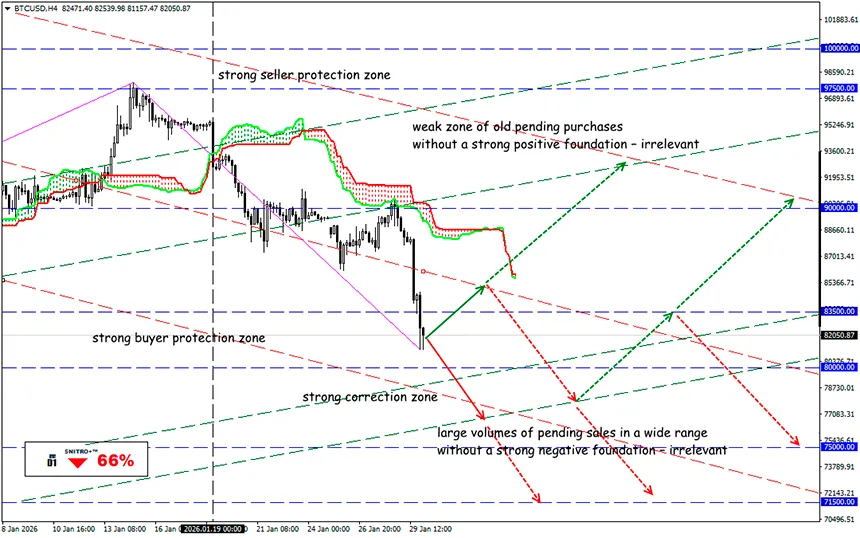
Global sell-off broke the short-term trend
BTC/USD
Key zone: 81,500 - 85,000
Buy: 86,500 (on strong positive fundamentals) ; target 90,000-91,500; StopLoss 85,500
Sell: 80,000 (on a pullback after retesting the 82,500 level) ; target 76,500-75,000; StopLoss 81,500
For too long the market had been in a state of euphoria and missed the moment when the insane rally simply ran out of capital. On January 29, a sharp volume imbalance triggered a массовый exit of investors from risky assets: gold — both physical and “digital” — disappointed its clients.
What do you do when nobody wants to buy anymore? Right — you sell, and as fast as possible.
The first signs of a liquidity crisis appeared a couple of weeks ago. Market optimists found themselves trapped in excessively large bets, and the market was forced to correct.
A rare but extremely dangerous situation occurred in the market: large-scale de-leveraging. Hedge funds and large private players holding massive long positions began to sharply reduce leverage, thereby additionally fueling a chain reaction of liquidations.
No matter how technical analysis fans try to convince us otherwise, the key catalyst for the sell-off was the actions and statements of the US president: threats of new tariffs, escalation of tensions in the Middle East, the introduction of a state of emergency regarding Cuba, as well as expectations of a change in the Fed chair forced investors to save their capital.
- Panic in the oil market adds anxiety and volatility. Brent rose above $70 per barrel. As a result, markets got a mixed picture: precious metals were falling, while oil was rising. Any talk about tariffs means higher costs, pressure on the economy and potential acceleration of inflation, which is immediately reflected in stocks, commodities and cryptocurrencies.
- The collapse in the tech sector occurred due to reports from major corporations (for example, Microsoft fell by 12%, and SAP by 16%), and these reports cannot be called “weak” — they simply failed to meet expectations. One of the most concrete corporate drivers of the day was the sharp drop in Microsoft by about -10% due to concerns about Azure growth and the scale of spending on AI infrastructure.
- During the day, the S&P 500 lost up to 1.5%, Nasdaq fell more due to pressure on the tech sector, and Dow Jones also moved into negative territory. Volatility increased sharply, and investors began to reduce positions, primarily in the most expensive and overheated stocks. Today, all 11 US sectors are in the red.
- The crypto market decline was accompanied by mass liquidations. Within 24 hours, positions of about 270,000 traders were forcibly closed, and the total volume of liquidations reached $1.7 billion. Almost all of them were long positions in Bitcoin and ETH. As a result, total market capitalization decreased by about $200 billion in just 24 hours.
- Expectations of a more aggressive Fed policy, fluctuations around rates and rising bond yields forced investors to reduce positions in risky assets. In such conditions, mass selling is triggered automatically.
By the way, another market myth has been dispelled — that when the growth potential of precious metals is exhausted, capital will move into cryptocurrencies. Nothing of the kind is happening.
Gold assets collapsed within 10–15 minutes without any clear signals at all, silver lost more than 12% of its capitalization, and cryptocurrencies at the moment fell on average by 5–7%. Similar dynamics were observed in copper and platinum. However, silver and gold have already corrected about 60% of their drop, while cryptocurrencies intend to fall further. So Bitcoin is only falling together with metals, but is not going to rise synchronously.
Large capital temporarily moved into bonds and other more secure assets. Even assets that are usually considered defensive — gold and crypto — failed to fully perform this role.
Yesterday’s panic sell-off is not yet a crisis. The market is simply charging participants a “risk premium” — capital will not ignore geopolitics, tariff wars and financial blackmail. As long as politics remains a source of instability, volatility will remain uncontrolled, and the next flash crash may become a real catastrophe.
So we act wisely and avoid unnecessary risks.
Profits to y’all!


