


















US labor market under Trump’s scenario
What wartime NFP is screaming about
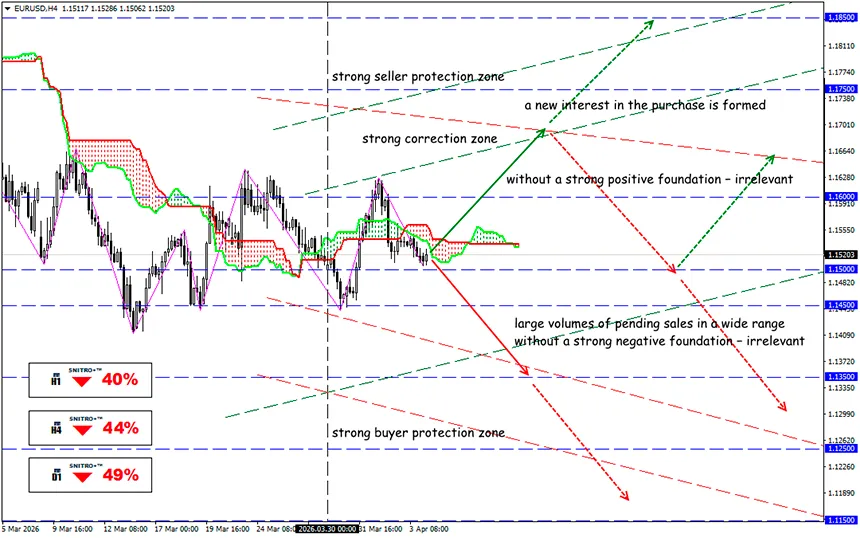
EUR/USD
Key zone: 1.1500 - 1.1600
Buy: 1.1650 (on strong positive fundamentals) ; target 1.1800-1.1850; StopLoss 1.1580
Sell: 1.1450 (after retesting the 1.1550 level) ; target 1.1350-1.1250; StopLoss 1.1520
Last week, the market witnessed a rare phenomenon: the release of a strong March NFP caused no movement whatsoever. Nevertheless, it is precisely the labor market that will allow Jerome Powell to complete his term as Fed Chair in May without any remorse, as the risks of rising inflation clearly outweigh the threat of a collapse in the US labor market.
Signs of stagflation are becoming harder to hide.
- The number of new jobs in March was strikingly strong (+178K vs. +65K expected, −92K prior), but the structure of the data is deteriorating. This is the largest increase in new jobs since December 2024 (the era of harmless Biden).
- The revision of jobs for the previous two months totaled -7K: January was revised to +160K from +126K previously, February revised to -133K from -92K. The impact on the current result is minimal.
- Unemployment: 4.3% (vs. 4.4% expected, 4.4% prior). A clear recovery after a weak February is visible.
- Labor force participation: 61.9% vs. 62.0% previously.
- Wage growth: 0.2% m/m, 3.5% y/y vs. 0.4% m/m, 3.8% y/y previously.
- Average workweek: 34.2 vs. 34.3 previously.
- Services PMI fell below 50 for the first time in 3 years.
A serious issue in the report is the decline in labor force participation, as this indicator artificially lowered the U3 unemployment rate amid a slowing labor market.
This means:
- employment is growing significantly faster than expected;
- the unemployment rate has decreased;
- risks of a sharp economic slowdown are not yet confirmed.
The key parameter for the Federal Reserve is the U3 unemployment rate (it is part of the Fed’s mandate), and its decline to 4.3% will bring relief to Fed members. This is a signal toward a more hawkish stance: no one will cut rates, especially amid inflation risks.
But if labor force participation had not fallen from 62.5% to 61.9% over two months, the U3 unemployment rate would have been significantly above the critical 4.5% level.
The March NFP helps avoid solving one of the most difficult problems. This week, Powell stated that the war has created the possibility of a more serious trade-off between inflation and the labor market, but noted that the Fed is not currently facing this issue.
The decline in unemployment alongside the easing of February’s sharp downturn suggests that the labor market may be in better shape than previously thought, at least before the war began. This may embolden those Fed members who, over the past two meetings, insisted on keeping rates unchanged and argued that interest rates are already much closer to neutral.
Trump clearly does not like these figures — Donny will definitely fire the Secretary of Labor along with the Secretary of Commerce.
At this stage, one thing is clear: Iran is the main topic of the week, markets are waiting for de-escalation, and Trump has no time for domestic economic issues — bargaining with Tehran for political victories is far more important.
Monitoring Hormuz is more important than fighting Powell. Trump urgently needs a peace deal or at least its appearance — quick wins are necessary to avoid impeachment next year.
Today, low liquidity due to closed European markets led to an accumulation of pending volumes on both sides of the market, but they are unlikely to be executed during the US session.
So we act wisely and avoid unnecessary risks.
Profits to y’all!


