


















UK Budget: Where Will the Money Come From?
How the New Policy Will Affect GBP
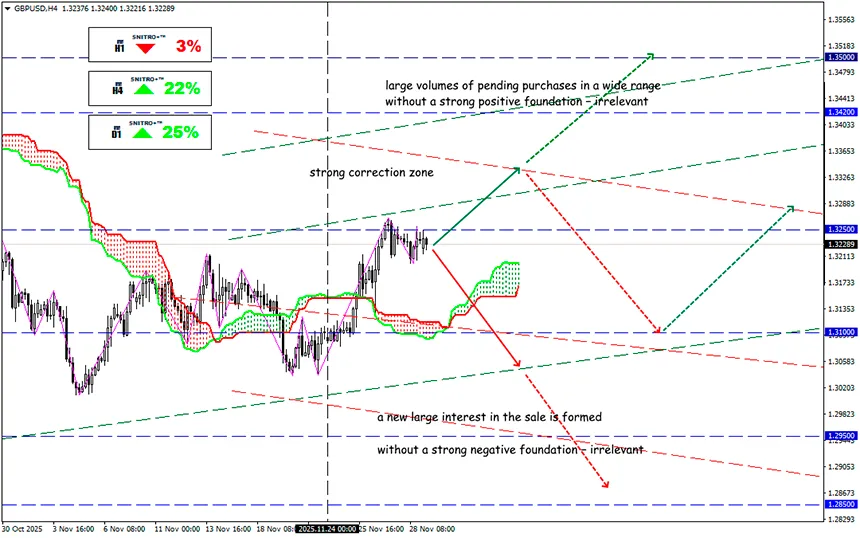
GBP/USD
Key zone: 1.3180 - 1.3280
Buy: 1.3300 (on strong positive fundamentals) ; target 1.3450-1.3500; StopLoss 1.3230
Sell: 1.3150 (after retesting the 1.3250 level) ; target 1.2950; StopLoss 1.3230
Chancellor of the Exchequer Rachel Reeves has presented a provocative budget proposal designed to stabilize public finances while simultaneously providing additional economic support. Against the backdrop of weak productivity and mounting pressure on household incomes, the government is prioritizing tax increases over spending cuts.
The first market reaction has already passed. Let’s examine why the debates turned out so aggressive.
The project anticipates £26 billion in additional tax revenues through tighter tax policy and the extension of “stealth taxes” (fiscal drag).
Key sources of budget revenue (through 2030):
- Maintaining the current income tax thresholds until 2031 — expected to generate about £23 billion in 2030/31.
- Restricting pension contribution relief: amounts above £2K become taxable for both employers and employees (≈£4.7 billion in 2029/30 and ≈£2.6 billion in 2030/31).
- Additional property tax on residential real estate: homes worth £2–2.5 million — £2,500 per year; above £5 million — £7,500 (≈£0.4 billion annually starting 2028/29).
- Taxes on capital income and wealth: higher rates and changed rules for dividends, savings income, rental income, ISA adjustments and pension-related benefits.
- Sector-specific taxes and fees, including gambling tax reform, a tourism levy in England, a private-aviation passenger duty, excise on electric vehicles, etc.
At the same time, spending is expected to grow significantly (removal of the two-child benefit cap, easing disability-support reforms, cooling demand for luxury property — especially in London, etc.). The net tightening is moderate, but the tax structure is shifting.
A rise in the National Living Wage (NLW to £12.71 in 2026) increases labor costs for retail, hospitality, and small businesses. Analysts view the budget as positive overall, but conflict-prone and unreliable in its tax design.
The project improves debt-sustainability dynamics but does not solve the low-growth problem — crucial for GBP’s long-term trajectory.
An early leak of the document to the media triggered a nervous yet overall positive market reaction. Investors concluded that despite tax hikes and weak income growth, fiscal discipline is present, making a repeat of Liz Truss’s mini-budget collapse unlikely.
The proposal gives the BOE additional arguments to cut rates as soon as the next meeting, although inflation is expected to return sustainably to target only in 2026. Political noise around accusations against Reeves (“misleading voters”, possible FCA inquiries) has not yet turned into an explicit currency risk premium.
The pound will likely remain in the upper part of its current ranges against major currencies, with a mild upward bias (GBP/USD most likely 1.33–1.37; potential correction zone 1.3550–1.3600), provided that no new political shock emerges around the Reeves/Starmer tandem and global risk appetite remains intact.
Reminder: the UK budget is not yet approved — amendments and compromises remain possible. There is still no confirmed date for the final vote on the Finance Bill 2025; it may take place in mid-December 2025 or January 2026. If debates, objections or substantial resistance arise, final approval could shift to late Q1.
So we act wisely and avoid unnecessary risks.
Profits to y’all!


