


















Echo of Davos: the global market on the edge of collapse
The global monetary order is no longer effective
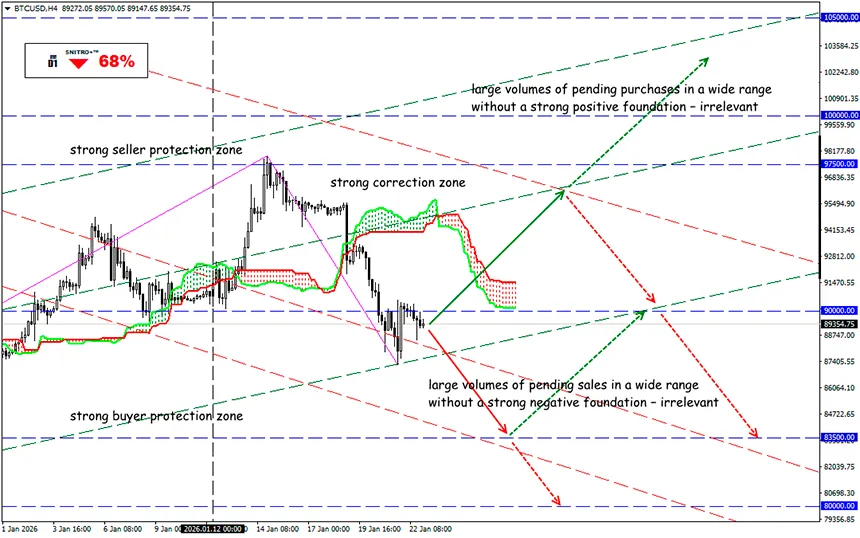
BTC/USD
Key zone: 94,000 - 97,000
Buy: 97,500 (on strong positive fundamentals) ; target 100,000-102,500; StopLoss 96,500
Sell: 93,500 (on a pullback after retesting the 96,000 level) ; target 90,000-85,500; StopLoss 94,500
Speaking at the World Economic Forum in Davos, Bridgewater founder Ray Dalio stated that the monetary order is breaking down, driven by the declining ability of governments to manage debt and maintain financial balance.
Rejecting all authorities, Dalio openly points to the growing collapse of trust between the United States and its major creditors. Both politicians and large capital no longer view Treasuries and fiat instruments as safe assets. At the same time, Washington continues issuing Treasuries, while international appetite for absorbing this supply is gradually fading. Dalio called this situation a “loop of mutual discomfort.”
As an example: Trump’s threats of new tariffs against the EU, amid U.S. territorial claims to Greenland, were (temporarily!) halted precisely by financial rather than political means.
That is why last year’s favorites turned out to be gold and cryptocurrencies, while central banks are attempting to move away from fiat currencies and sovereign debt.
Diversification of dollar-dependence risk
Dalio believes that investors of any capital size must diversify their funds and hold 5–15% in gold within a balanced portfolio. Large capital has long been using Bitcoin as a digital alternative to gold, and the hedging method is changing — investors no longer wait for the next crisis, but consider this a mandatory process.
As the ETF market grows and spreads decline, Bitcoin has moved closer to characteristics acceptable to central banks.
Monetary regulators are ready to form crypto reserves, but mass inclusion of digital assets into official reserves remains extremely limited: in most countries there are no полноценные legal and financial mechanisms for this.
The most notable precedent was the initiative of the Czech National Bank (ČNB): its governor publicly announced plans to invest part of the reserves (up to ~5%) in Bitcoin as a way to diversify and reduce dependence on dollar assets. There is insider information that such test purchases have already been executed and a multifactor analysis of the results is underway.
In March 2025, a proposal appeared in the U.S. to create a Strategic Bitcoin Reserve and a “Digital Asset Stockpile” for other digital assets. This is not yet a classical inclusion into official reserves, but a strong signal that U.S. state institutions view BTC as an element of financial strategy.
Moreover, in countries subject to various sanctions, cryptocurrencies have long been used to bypass the dollar financial infrastructure. An example is the use of stablecoins such as Tether for cross-border payments. Only a few steps remain before official recognition of this process.
And what is the result?
Even a small shift toward crypto assets signals a potential long-term decentralization of dollar dominance. If even a few major central banks begin real reserving of Bitcoin or other digital assets, this will:
- reduce systemic demand for Treasuries,
- increase the premium for dollar risk,
- strengthen the share of alternatives in intergovernmental settlements.
Growing participation of state players may:
- increase institutional liquidity of crypto markets,
- reduce volatility in spot markets due to “deeper” large orders,
- lead to the emergence of new reserve assets beyond popular coins.
But most importantly, any real acquisition by central banks provides a powerful bullish signal — not speculative, but sufficiently sustainable. And the corresponding fundamental information must be closely monitored.
So we act wisely and avoid unnecessary risks.
Profits to y’all!


