


















Oil prefers not to take risks for now
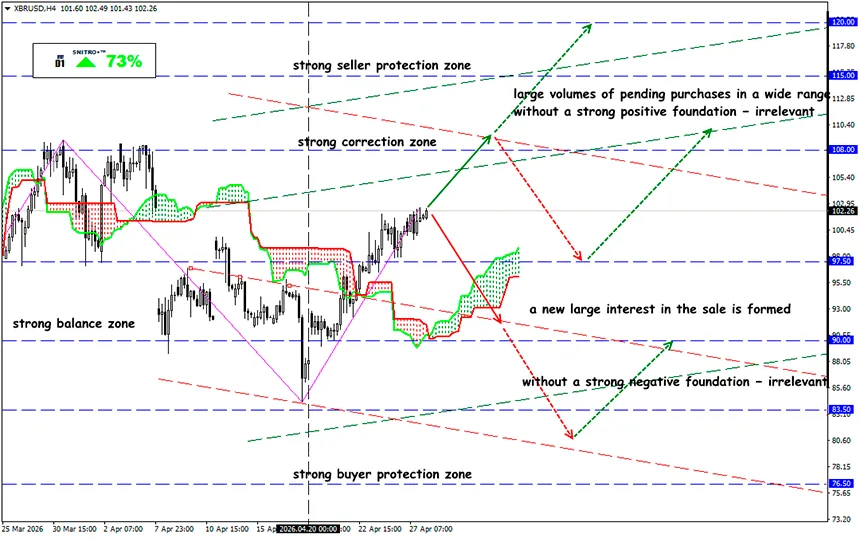
The situation in the Middle East does not stimulate buying
XBR/USD
Key zone: 100.00 - 103.00
Buy: 104.00 (upon a decisive break of 103.50); target 106.50-107.00; StopLoss 103.30
Sell: 98.50 (on strong negative fundamentals); target 96.50-95.00; StopLoss 99.20
The Strait of Hormuz remains largely paralyzed. Brent crude continued its rise, gaining 3% and exceeding the $111 level — a monthly closing high. However, there are some nuances.
The U.S. dollar strengthened on the back of rising oil prices and doubts that the Federal Reserve will tighten policy. Brent and WTI extended their rally after the U.S. rejected Iran’s proposal to unblock the Strait of Hormuz.
According to the White House, Tehran would still retain control over the key oil artery, which is unacceptable for Trump. The upside potential for Brent is estimated at up to $130 per barrel in Q2 if flows remain disrupted through the end of June.
Prices for major benchmarks are easing slightly on reports that the UAE will leave OPEC starting May 1 and will no longer comply with production quotas. Such a move by a major participant — which, despite internal disagreements, had supported the cartel’s overall policy — could significantly weaken OPEC’s influence on the commodities market.
In the U.S., this decision by the UAE is being called a “major victory” for Trump, who had previously accused OPEC of speculation through artificially (from the U.S. perspective, of course) inflating oil prices.
P.S. For now, this is the only “victory” for the U.S. in the current Middle East conflict.
So far, the market reaction is muted, as the UAE had previously been dissatisfied with excessive OPEC restrictions, and now cannot increase oil exports while the Strait of Hormuz remains blocked. Potentially, this is a bearish factor for oil — but only in the long term.
- Iran, once the second-largest producer in OPEC, has already cut output by 2.5 million barrels per day. The country is rapidly exhausting its spare oil storage capacity: currently, unused storage will last only 12–22 days, according to Kpler analysts. This threatens further and even larger production cuts — by another 1.5 million barrels per day as early as mid-May.
- Recall: Iranian oil typically takes about two months to reach certain Chinese ports — its main destination. Buyers then have another two months to complete settlements, according to Kpler. Therefore, the U.S. naval blockade will not immediately impact Iran’s revenues — the effect will be delayed by 3–4 months.
- Interestingly, short-term favorites among speculators have been currencies of oil-exporting countries. Analysts at JP Morgan and Deutsche Bank recommend buying NOK and AUD against the Japanese yen and Swiss franc, as well as currencies of Kazakhstan, Brazil, and Nigeria against a basket of the U.S. dollar and euro. However, such “exotic” trades come with highly unstable volatility.
As a result, this market mix of passive central banks and an oil rally may play in favor of the U.S. dollar. Pressure on it as a safe-haven asset comes from record highs in equity indices. However, when opening new long oil positions, extreme caution is required — political actions defy logical analysis.
So we act wisely and avoid unnecessary risks.
Profits to y’all!


