


















Oil is looking for new routes
The market is nervous about a double blockade in the Middle East
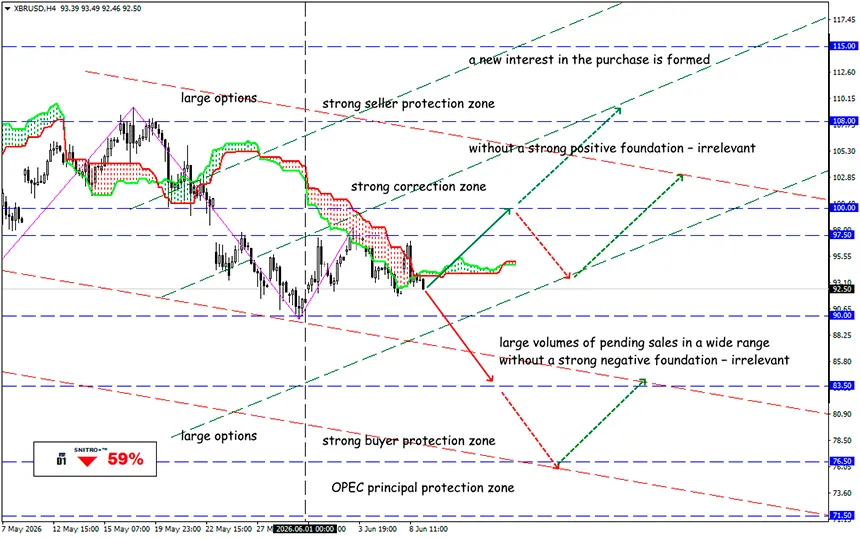
XBR/USD
Key zone: 91.00 - 95.00
Buy: 96.50 (on a pullback following a retest of 95); target 98.50-100; StopLoss 95.80
Sell: 90.00 (on strong negative fundamentals); target 87.50-86.50; StopLoss 90.70
The escalation of the conflict between Iran and Israel over the past weekend demonstrated how illusory hopes for a peace agreement have become. A new risk can no longer be ignored: a possible blockade of the Bab el-Mandeb Strait — the last remaining route for Saudi oil.
Let us recall:
Iran closed the Strait of Hormuz more than three months ago, and since then only three factors have prevented prices from reaching new record highs: China’s massive inventories (more than 1.2 billion barrels), the large volume of oil already loaded onto tankers, and Saudi Arabia’s resources for maintaining exports bypassing Hormuz. But if Iran’s allies in Yemen — the Houthis — decide to block the Bab el-Mandeb Strait, the oil market will face a new catastrophe.
- Traffic through Bab el-Mandeb had already been restricted since 2023 — at that time, most commercial vessels preferred the alternative route around the Cape of Good Hope, which extends the journey from Asia to Europe by 1.5–2 weeks. By 2025, tensions had eased, but traffic never returned to pre-crisis levels.
- Exports of Saudi oil (especially the benchmark Arab Light grade) from the Red Sea port of Yanbu surged when the kingdom utilized the East-West Pipeline at full capacity. In its first-quarter report, energy giant Saudi Aramco confirmed that throughput via this pipeline reached a historical maximum.
- Iraq and the UAE are accelerating the development of alternative pipelines to reduce dependence on the Strait of Hormuz. The route through Kurdistan to the Turkish Mediterranean port of Ceyhan is expected to support the Iraqi economy. However, this route is also under threat: in April, Iran attacked the Saudi East-West pipeline and the port of Fujairah, disrupting export operations.
- The alternative option used by China is unavailable to most consumers. In May, China sharply reduced oil purchases on foreign markets: import volumes fell to their lowest level in more than eight years.
- Beijing is deliberately refraining from aggressive purchases and adapting to the loss of most supplies from the Persian Gulf through three tools: export restrictions, lower refinery utilization rates, and the use of accumulated inventories. China is unlikely to increase imports for several more months and will probably emerge from the current crisis as the strongest player.
And what is the result?
At this point, it would be enough for the Houthis to attack several tankers off the coast of Yemen to trigger a collapse in traffic through Bab el-Mandeb due to fears of further strikes. The market would lose several more million barrels per day of exclusive heavy Arab crude. This would push both the war and prices to new levels.
Such a scenario would sharply reduce oil availability on the spot market and significantly increase costs: freight rates and fuel consumption would rise. In addition, market efficiency would decline because fully loaded VLCC supertankers are technically unable to pass through the Suez Canal.
Developing new routes requires not only substantial investment but also time and international agreements if pipelines pass through several countries. Price dynamics for major benchmarks remain unstable and speculatively dangerous.
So we act wisely and avoid unnecessary risks.
Profits to y’all!


