







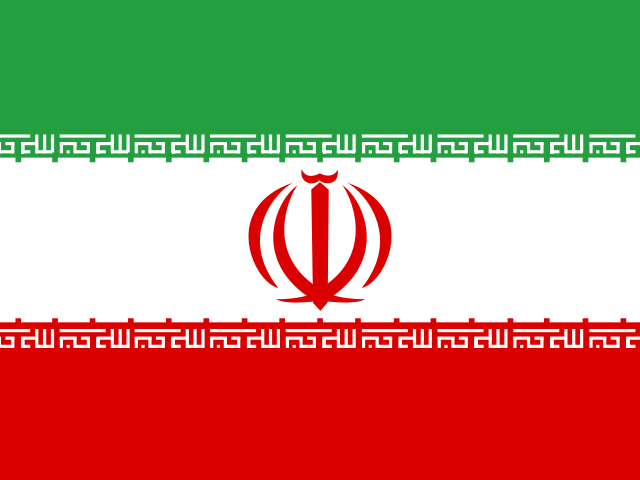










Oil does not trust Trump
How the United States is “Consuming” SPR resources
XTI/USD
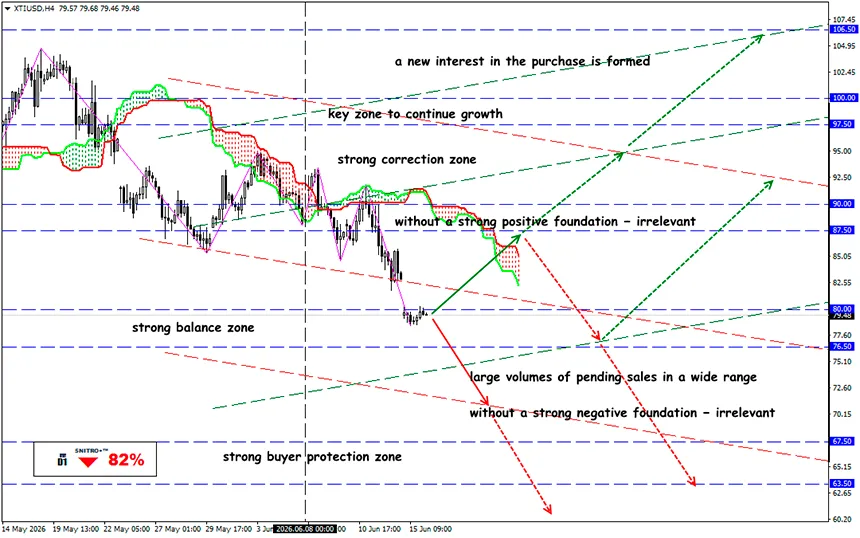
Key zone: 80.00 - 83.50
Buy: 85.00 (on strong positive fundamentals); target 87.50-90.00; StopLoss 84.30
Sell: 78.50 (after retesting 86.50); target 75.00; StopLoss 79.20
Logistical problems in the Strait of Hormuz have affected the entire global economy: disruptions in oil, gas, and other commodity supplies are pushing market prices significantly above pre-war levels. The concept of “strategic reserves” is gradually being transformed into “emergency reserves.”
The U.S. Strategic Petroleum Reserve (SPR) decreased by another 8.9 million barrels (to 340.3 million barrels), marking the third-largest reduction on record. The decline is part of the planned release of 172 million barrels announced by the Trump administration in March.
The reserve release was coordinated with other countries less than two weeks after the United States and Israel carried out strikes against Iran.
Let us recall:
The reserve drawdown is taking place amid a temporary peace agreement between the United States and Iran on resuming navigation through the Strait of Hormuz and efforts to end the 15-week war. On June 15, the United States and Iran announced an interim deal, while a formal agreement is expected to be signed on June 19.
- The news was received with cautious optimism in energy and shipping markets, as key questions — namely how exactly the strait will be reopened and what rules will govern logistics — remain unanswered. In addition to energy products, the strait is a bottleneck for commodities such as aluminum, fertilizers, and even helium used in semiconductor manufacturing.
- The war also exposed an old problem — global trade cannot remain so dependent on a single transportation route. Security risks have become so high that most shipowners have stopped sending vessels through Hormuz.
- Incidentally, the U.S. military organized dozens of covert ship-to-ship oil transfer operations to facilitate temporary energy exports from the Persian Gulf. Unmanned aerial vehicles, underwater drones, and helicopters were used to escort convoys to waiting tankers.
- In the United States, the use of SPR reserves has not proven to be a particularly successful attempt to contain rising fuel prices. Trump's team argues that the government is legally releasing oil through an exchange program under which companies “borrow barrels” and are required to return them with interest.
- The repayment rate has reached approximately 26%, which, according to a Department of Energy representative, has saved taxpayers more than $3 billion.
The Department plans to replenish the reserve by approximately 20% more than the volume spent within the next year. The future price per barrel at the time of repayment and the overall cost of such reserve management operations have not yet been discussed.
And what is the result?
Neither the United States nor Iran has provided specific details, while Tehran has stated that the deal will not be implemented until it is formally signed.
Even if the agreement announced by Trump is properly formalized, it is unlikely to result in the immediate restoration of regular pre-war traffic. Shipowners will need confidence that vessels sent into the Persian Gulf can safely return without prolonged delays or new transit fees. Clearing the backlog of more than 600 vessels waiting for passage may also take weeks.
So far, since the start of the week, prices for both major oil benchmarks have fallen by 5%, but no significant selling volumes have appeared in the market. Meanwhile, the diplomatic games continue.
So we act wisely and avoid unnecessary risks.
Profits to y’all!


