














Japan and China Are Getting Rid of U.S. Debt Assets
Asia Sells U.S. Debt
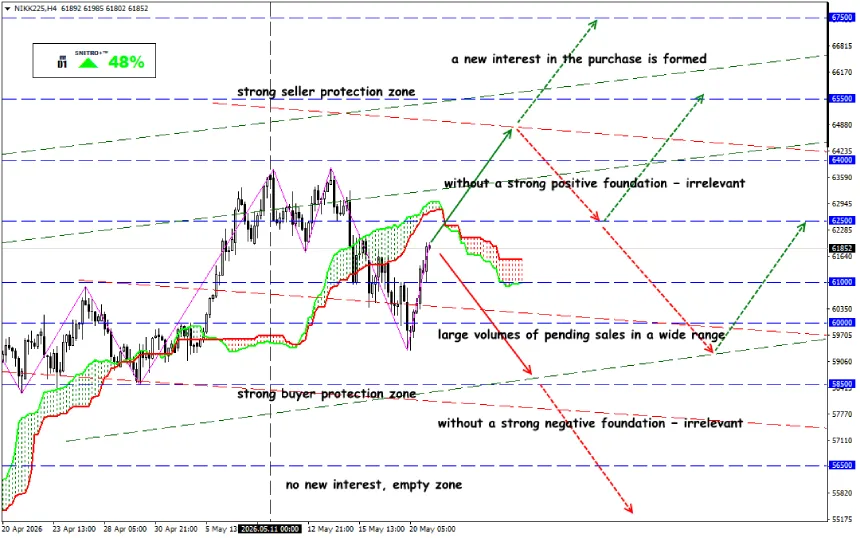
NIKK225
Key zone: 61,000 - 62,000
Buy: 62,500 (on strong positive fundamentals); target 64,000; StopLoss 62,000
Sell: 60,000 (on a confident break of 61,000); target 58,500-57,500; StopLoss 60,500
A troubling signal has emerged in the financial market: foreign governments have been actively reducing their holdings of U.S. Treasury bonds. The war in the Middle East forced central banks to sell dollar reserves in order to protect their currencies from the energy crisis that triggered a sharp decline in exchange rates.
According to the U.S. Department of the Treasury, in March China reduced its investment in U.S. government debt to $652.3 billion, approximately 6% lower than in February — the lowest level since September 2008. Japan reduced its reserves by approximately $47 billion, to $1.191 trillion. In recent weeks, Washington has been actively interested in whether Tokyo will use long-term Treasury bonds to finance interventions in the foreign exchange market.
The asset selloff began after the start of the U.S.-Iran conflict, when crude oil prices rose sharply. Regional economies dependent on oil imports from Persian Gulf countries faced the largest energy shock in decades. In response, policymakers decided to sell part of their dollar assets in order to finance currency interventions.
Now the market is closely watching whether this is turning into a long-term retreat by the largest creditors of the United States from dollar-denominated debt.
Reminder:
Treasury bonds came under heavy pressure due to a sharp rise in yields. The Middle East conflict intensified inflation concerns and forced investors to demand higher compensation for holding U.S. debt.
The selloff of foreign assets also contributed to declining bond prices. In March alone, foreign investors incurred losses of $142.1 billion on long-term Treasury securities.
China began selling U.S. securities approximately one month before Trump’s visit and effectively reduced its portfolio by nearly half.
What is behind this strategy:
- geopolitical confrontation between the U.S. and China;
- fear of sanctions risks and the possible freezing of reserves;
- rising U.S. debt burden;
- diversification of reserves into gold, commodity assets, and non-dollar instruments;
- the desire to reduce dependence on the dollar system.
Take note: this is not a “panic selloff.” Consolidated data reflect not only net purchases/sales, but also portfolio revaluations, and may be distorted by asset custody through financial centers. For example, China is selling Treasuries not because “the dollar will collapse tomorrow,” but because the world is gradually moving from a unipolar dollar model toward a more fragmented financial system.
Nevertheless, the trend appears significant. China has been consistently reducing the share of Treasuries amid geopolitical risks, reserve diversification, and efforts to reduce dependence on the dollar system. Japan, meanwhile, is balancing support for the yen, U.S. bond yields, and domestic liquidity needs.
The market is already pricing in a higher risk premium: the yield on 10-year Treasuries is holding near 4.6%, while total U.S. public debt is approaching $39 trillion.
What traders should do
- Monitor 10-year Treasury yields: a rise above 4.7–5.0% could intensify pressure on growth stocks and the crypto market.
- Watch the DXY dollar index: declining demand for Treasuries does not always hit the dollar immediately, but it increases volatility.
- Consider correction risks in Nasdaq and the S&P 500 if yields surge again.
- Control leverage in crypto: rising yields usually worsen risk appetite.
- Monitor central bank gold purchases.
If external demand for U.S. debt continues to decline, the United States will have to retain investors through higher yields. And that means pressure on growth stocks, the crypto market, and real estate. In such an environment, gold and defensive assets may outperform the market. But it is still too early to talk about a total flight from the dollar.
So we act wisely and avoid unnecessary risks.
Profits to y’all!


