


















Inflation is breaking equity multiples
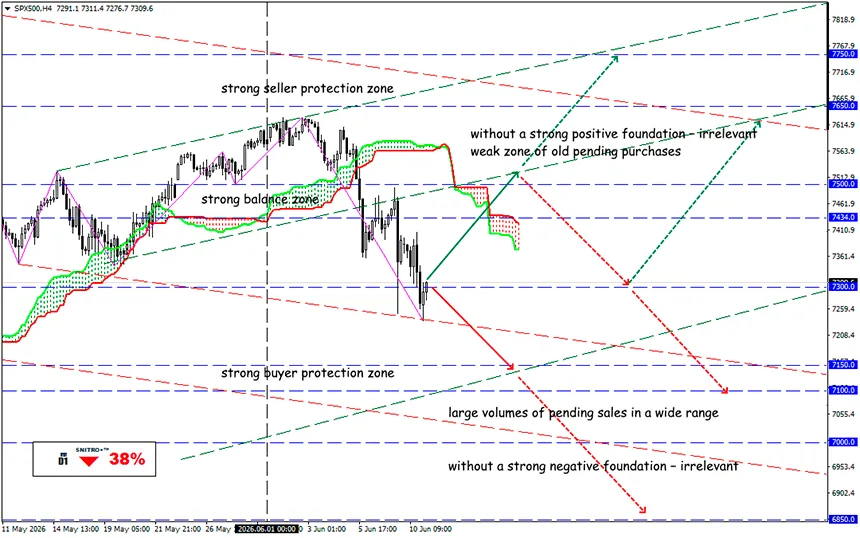
The S&P 500 sell-off did not scare investors
SP500
Key zone: 7,200 - 7,300
Buy: 7,400 (on a decisive break of 7,350); target 7,650; StopLoss 7,330
Sell: 7,150 (on strong negative fundamentals); target 6,900; StopLoss 7,220
The release of the May Consumer Price Index (CPI) showed annual inflation accelerating to 4.2%, the highest level since April 2023. At first glance, such data would imply the need for higher interest rates and lower fair valuations for equities. However, the market reaction proved to be more complex.
Let us recall:
Inflation reached 4.2%, but the core measure looks much calmer. According to U.S. Bureau of Labor Statistics (BLS) data, CPI rose by 0.5% month-over-month in May, while annual inflation accelerated from 3.8% to 4.2%. This marked the third consecutive acceleration in monthly inflation and the highest annual reading since April 2023. At the same time, the figures fully matched analysts’ forecasts.
The S&P 500 Index remained stuck around the 7,350-point level, falling approximately 0.7%, or 52 points, after the release of the highest inflation reading in the past three years. At the same time, the market is trying to react to a geopolitical factor — the renewed military confrontation between the United States and Iran.
Global indices followed their “big brother”:
- The Nasdaq Composite came under significant pressure, losing around 1.6% (approximately 411 points), as technology companies and semiconductor manufacturers continued the sell-off trend that has defined the first ten trading days of June.
- The Dow Jones Industrial Average appeared more resilient, declining by approximately 0.45% (about 230 points), supported by demand for defensive sectors such as consumer staples, telecommunications, and energy.
- The Russell 2000 was the only major index in positive territory, gaining around 0.4%, marking an unexpected shift in favor of small-cap companies after several years of mega-cap dominance.
As a result, the market experienced a controlled correction rather than a panic sell-off. The VIX Volatility Index rose approximately 6.5% to 20.15 points — a moderately elevated level.
The gap between headline inflation (4.2%) and core inflation (2.9%) is roughly 130 basis points, which represents an unusually large divergence.
For the market, this is an important signal: inflationary pressure remains concentrated primarily in the energy sector and has not yet spread to the broader economy.
Meanwhile, categories that typically signal structural inflation looked relatively favorable:
- Core goods prices declined by 0.1%;
- Tariff-related pressure remains limited;
- Companies are not yet passing additional costs on to consumers.
At the same time, the technology sector remains the primary source of pressure. Weakness continues to be concentrated in large technology companies and semiconductor manufacturers. Among the biggest decliners were Nvidia (-1.4%), Broadcom (-1.3%), and Micron (-2.0%).
Super Micro Computer was hit particularly hard, with its shares plunging approximately 12% after announcing capital-raising transactions totaling around $7 billion.
Defensive sectors and small-cap companies continue to support the market, and there are still no signs of a mass exodus from equities. Among the top gainers were Coca-Cola (+1.5%), Verizon (+1.5%), and Chevron (+1.2%).
And what is the result?
According to market participants, if oil prices stabilize or continue to decline, inflation may reach its peak as early as this quarter and begin slowing during the second half of the year.
Such a scenario would allow the Federal Reserve to maintain its current policy stance without further tightening.
The futures market is already pricing in the possibility of a Federal Reserve rate increase in December: the probability of rates remaining within the current 3.5%–3.75% range is currently estimated at approximately 96.3%.
The market reacted negatively to inflation accelerating to 4.2%, but there is no panic because the primary driver of price growth remains energy, while core inflation remains relatively moderate. Following the strong employment report and accelerating inflation, expectations have shifted from potential rate cuts toward the possibility of additional policy tightening.
It is precisely inflation, oil prices, and developments surrounding Iran that will remain the key factors determining the direction of the U.S. stock market ahead of the Federal Reserve meeting on June 17.
So we act wisely and avoid unnecessary risks.
Profits to y’all!


