


















Canada: a new threat with zero result
Trump is once again waving the tariff club
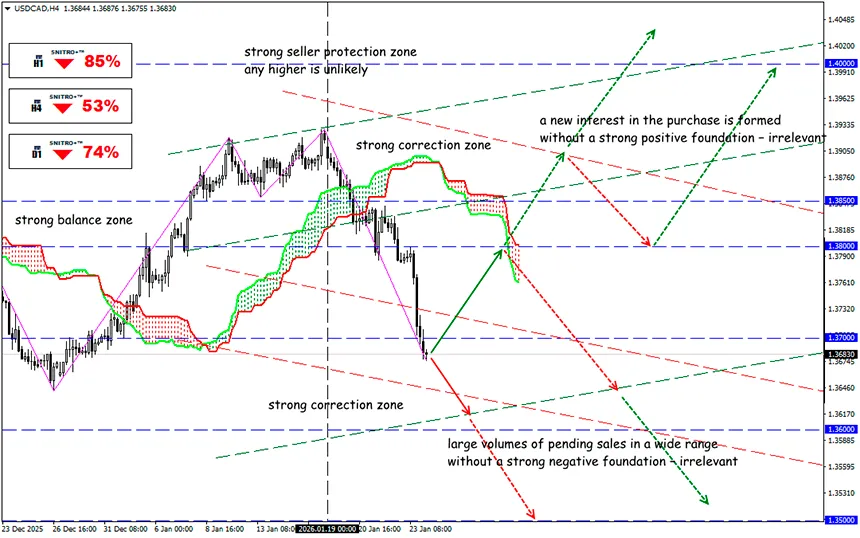
USD/CAD
Key zone: 1.3600- 1.3750
Buy: 1.3800 (on strong positive fundamentals) ; target 1.3950; StopLoss 1.3740
Sell: 1.3600 (after correction to 1.3650) ; target 1.3450; StopLoss 1.3670
The final trading week of January may pass with elevated volatility. In focus are U.S. macro data, the Fed meeting, technology earnings, and new U.S. threats toward its neighbors.
In the morning, the S&P 500 futures opened with a 0.75% drop to 6,850 — the market failed to compensate for Trump’s shift in rhetoric on Greenland. Instead, Donnie is again escalating the trade agenda with Canada. The topic becomes especially relevant ahead of the next Bank of Canada interest-rate decision.
On Saturday, Trump said he is ready to impose tariffs of up to 100% on Canadian goods if Ottawa continues implementing a new arrangement with China, which Washington interprets as a risk of “circumventing” U.S. restrictions and subsequent dumping on the U.S. market.
Trump stated that Canada is turning into China’s “transit zone,” but his latest negativity is largely tied to disagreements and the Davos speech by Canadian Prime Minister Mark Carney. In July, a revision of the USMCA trade agreement between the U.S. and Canada is expected.
Carney responded that Canada does not plan a free trade agreement with China, and that the current talks are a correction of parameters of existing arrangements and the settlement of trade disputes. This concerns reducing tariffs on Chinese electric vehicles from 100% to 6.1% and reciprocal easing of tariffs on Canadian agricultural products.
The U.S. remains Canada’s largest export market — more than 70%.
The negative impact is spreading to the export sector of raw materials and industrial goods such as auto components, metals, lumber, and logistics. For certain U.S. producers, an import substitution effect is possible, but overall across supply chains this most often means higher costs and pressure on margins.
Key triggers to monitor:
- Public information from the White House and the U.S. Treasury, especially on the list of goods that may be affected and on various procedures (exemptions, special tariffs, transition periods).
- Comments from the Bank of Canada, as well as any details on Canada–China tariff/quota parameters. The more legal specificity in re-export controls, the lower the probability of the harsh 100% scenario and the faster the market will “sell volatility.”
- The Canadian dollar is a commodity currency and often moves together with oil, silver, and other risk assets. If tariff rhetoric coincides with a WTI correction or a deterioration in global risk, the effect may be extremely speculative. In the U.S. equity market, the reaction may appear through the auto sector (competition with Chinese EVs), carriers, and retail, where any rise in import costs accelerates cost inflation.
What matters for a trader?
- In the tariff conflict with Canada, the market reacts not to the fact of imposing duties, but to the probability of such policy and the speed of escalation. The 100% tariff threat is the upper bound of pressure, intended to force Canada either to narrow the scope of the deal or to strengthen controls over origin and re-exports in order to truly exclude the “transit” of Chinese goods through its territory — especially as Canada is actively trying to diversify foreign trade amid U.S. protectionism.
- An additional risk is that the CAD exchange rate is sensitive to any threats of worsening trade conditions with the U.S. Rising uncertainty usually widens the USDCAD range and increases the cost of option hedges (implied vol).
For now, the new conflict remains at the level of verbal threats. If words turn into real measures, the risk of a slowdown in Canadian exports and investment will sharply increase, which may strengthen expectations for a more dovish Bank of Canada policy path.
So we act wisely and avoid unnecessary risks.
Profits to y’all!


