


















Bitcoin as a weapon of retribution
The crypto market crash has left millions of users impoverished
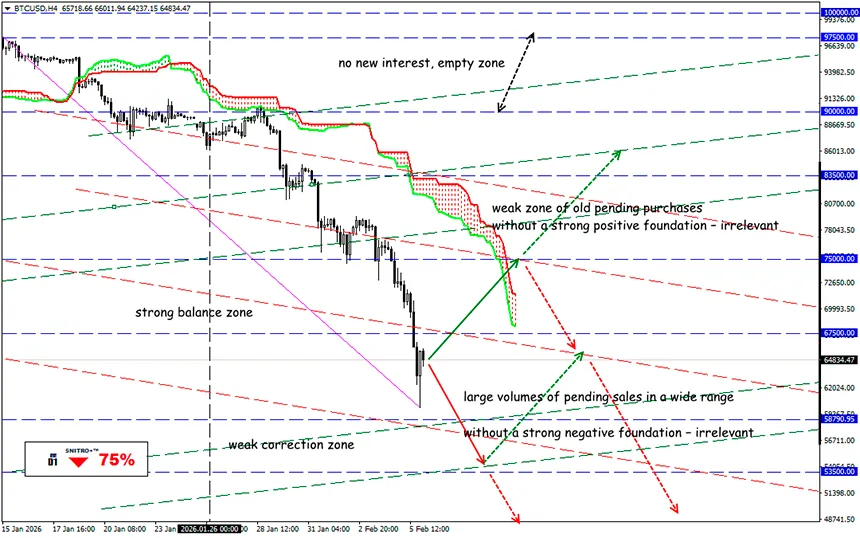
BTC/USD
Key zone: 63,500 - 67,500
Buy: 67,500 (on strong positive fundamentals) ; target 71,500-75,000; StopLoss 66,500
Sell: 63,000 (on a confident breakout of the 64,000 level) ; target 58,500-53,500; StopLoss 64,000
None of Wall Street’s trading strategies managed to save the crypto market from disaster. BTC recorded its largest single-day drop since the 2022 collapse. Over the past 24 hours, the volume of liquidated crypto positions exceeded $1 million, resulting in losses of about $980 million from leveraged bullish bets.
Traders are massively closing positions they can no longer maintain due to falling prices.
Michael Saylor’s Strategy posted losses of $3.8 billion ($777 million in 24 hours) due to the decline in Bitcoin, mainly from long positions. Under accounting rules, Strategy must value its digital assets at current market prices. As a result of revaluation, the company recorded a total unrealized “paper” loss of $17.4 billion. Over the past year, Strategy shares have fallen by 68%. After the earnings report, the stock lost another 3.1% in after-hours trading.
Reminder:
Strategy owns 713,502 BTC, acquired for about $54.3 billion at an average price of around $76,000 per coin. MSTR shares have fallen more than 70% from their peak in July 2025 and 15% since the beginning of 2026.
In 2024 and 2025, hundreds of companies rushed to copy Strategy’s approach, and institutional investors such as pension funds began viewing cryptocurrencies as potential investments.
11 US state pension funds own nearly 1.8 million shares of MSTR and are now going down with Saylor’s ship: these funds bought the stock as reserves at prices higher than the current market after the global crash. Ten of them have lost nearly 60% on this position.
- All crypto treasuries themselves pose a threat both to private investment portfolios and to the crypto market as a whole, since tokens can instantly move from storage to selling. The crypto market has never seen so many “time bombs.”
- The emergence of spot ETFs has strengthened the speculative nature of BTC and increased its correlation with stock markets. Recently, Bitcoin’s correlation with the S&P 500 has approached 0.50. Since the end of November, BTC ETFs have seen some of the largest one-day outflows, three of which occurred in the last 10 days of January. The next stage of the decline will lead to bankruptcies among Bitcoin miners.
- The wave of crypto enthusiasm triggered by Trump’s policies has faded, and investors have shifted to precious metals as long-term assets, leading to record price growth for gold and silver. This year, work on key legislation regulating the crypto industry in the US has also stalled.
- Bitcoin continues to fall, negatively affecting broader markets such as gold and silver, as corporate treasuries and speculators were forced to reduce risk by selling profitable positions in tokenized gold and silver futures.
The decline is accelerating due to shrinking liquidity and the exit of institutional investors from the derivatives market. There is almost no hope that the Trump administration will be able to stabilize the situation.
The current market has once again proven that both speculation and accumulating Bitcoin as reserves are extremely dangerous strategies. Operations with an unsecured digital currency have ended in collapse.
According to forecasts by Kalshi, a market prediction platform, the probability of BTC falling below $60,000 is about 75%.
We hope that our readers, thanks to sound money management, went through this situation with minimal losses. The optimal position right now is to stay out of the market.
So we act wisely and avoid unnecessary risks.
Profits to y’all!


