

















The Horror of inflation is stronger than the fear of war
The conflict in iran is triggering the threat of global inflation
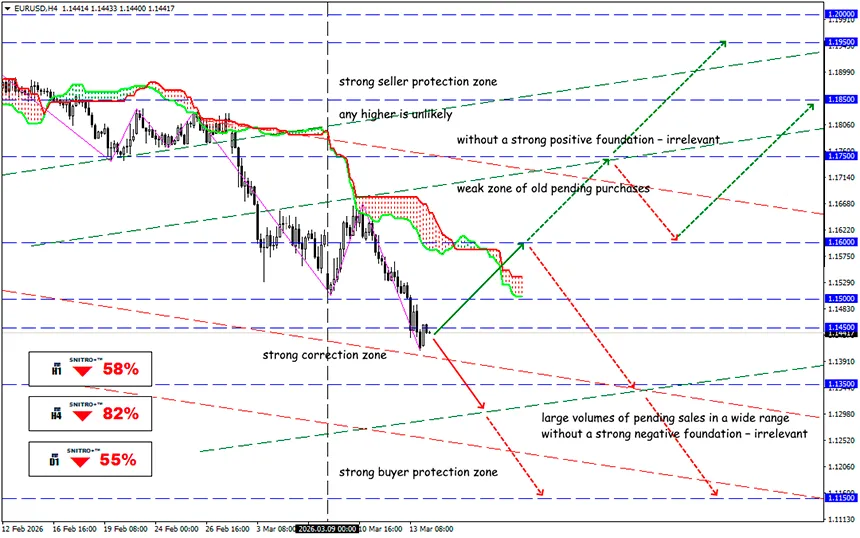
EUR/USD
Key zone: 1.1400 - 1.1500
Buy: 1.1520 (on strong positive fundamentals) ; target 1.1650; StopLoss 1.1450
Sell: 1.1380 (upon a decisive break above the 1.1400 level) ; target 1.1250-1.1200; StopLoss 1.1450
The situation around the Strait of Hormuz worsened after the U.S. attack on Iran’s Khark Island. For three days, not a single vessel passed through the strait. Strangely enough, Trump expected that the destruction of military targets on Khark Island, along with the threat of further strikes against the island’s oil infrastructure, would force Iran to reopen the Strait of Hormuz, but that did not happen.
If Trump ultimately bombs Khark Island completely, the world could lose nearly 20% of global oil transported through the Strait of Hormuz, not to mention numerous oil storage facilities in the region that could be destroyed.
Both scenarios would push oil prices into the $200 per barrel range.
Shocked by this failure, Donny stated that China must resolve the problem of the Strait of Hormuz, otherwise he will cancel his summit with Xi Jinping scheduled for March 31 – April 2. However, such blackmail works against the United States.
Trump also stated that NATO should deploy its forces to patrol and ensure security in the Strait of Hormuz. NATO has remained silent so far, and Macron’s nervous remarks can be disregarded.
But there is a problem far more complex than the potential shortage of energy resources.
Concerns about a possible resurgence of inflation are restraining hopes for interest rate cuts in the world’s leading economies this year. The Federal Reserve, the EU, the United Kingdom, Canada, and the central banks of other countries are ready for the first time since the COVID-19 pandemic to issue official assessments regarding the threats associated with the conflict around Iran.
Four years ago inflation was already rising as the economy recovered after lockdowns, households had accumulated savings, and supply chains were disrupted. In 2022, monetary policy remained stimulative with low or negative interest rates. Now policy is neutral or restrictive, and budget deficits have sharply decreased.
The situation is complicated by elevated consumer inflation expectations, as people still feel the effects of the sharp rise in prices over the past five years. In the United Kingdom and the EU, consumer prices have increased by about 20% compared with the end of 2021. According to the Financial Times, food and non-alcoholic beverage prices have risen by more than 30% in the EU and the UK and by 18% in the United States.
The current economic situation differs noticeably from the one that led to double-digit inflation in many countries starting in 2021 after the pandemic and the beginning of the conflict in Ukraine. The labor market has weakened, monetary policy has tightened, and inflation has been declining for three consecutive years.
- Banking sector analysts have once again started raising their inflation forecasts while lowering expectations for economic growth.
- A survey conducted by Consensus Economics on Thursday showed that analysts raised their inflation forecasts for 2026 for the G7 countries and Western Europe. Economists now expect inflation in the eurozone to average 2.1% this year, slightly above the ECB’s 2% target.
- According to the survey, inflation forecasts for the United Kingdom in 2026 stand at 2.6%, higher than the previous estimate of 2.5%.
- In the United States, prices are expected to rise by 2.7%, which is 0.1 percentage points higher than the February forecast.
Traders are pricing in at least one ECB rate hike by the end of the year and assume that the Bank of England will also raise rates. On the eve of the U.S. and Israeli attacks on Iran, traders expected two rate cuts by the Bank of England from 3.75% and no change from the ECB.
The Federal Reserve, the ECB, the Bank of England, and the Bank of Canada are expected to leave their policies unchanged this week. However, oil prices near $100 per barrel, a sharp rise in gas prices in Europe and Asia, and the potential shortage of fertilizers have led to a revision of market expectations regarding interest rates at the end of the year.
So we act wisely and avoid unnecessary risks.
Profits to y’all!


