















The first anniversary of Trump’s trade war

U.S. tariff aggression: risks and conclusions
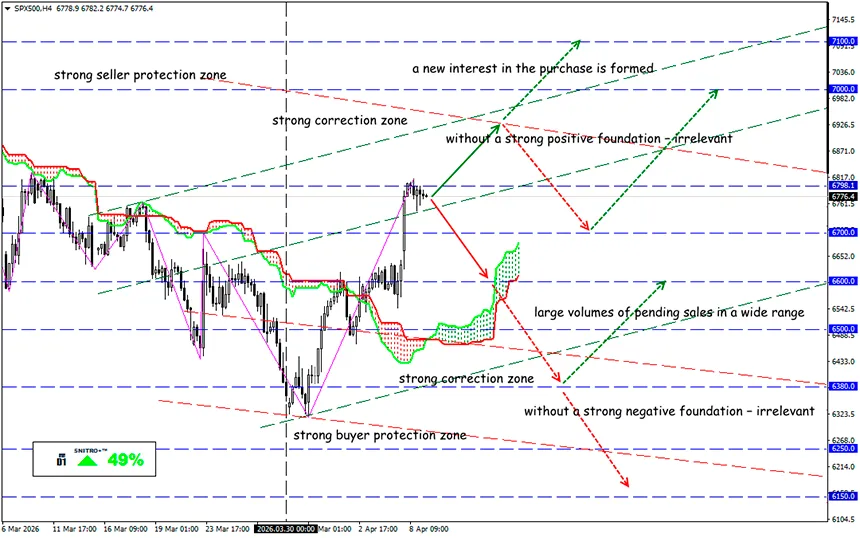
SP500
Key zone: 6,700 - 6,800
Buy: 6,850 (on a pullback following a retest of 6,750); target 7,100; StopLoss 6,780
Sell: 6,650 (on strong negative fundamentals); target 6,400; StopLoss 6,720
Since April 2025, the United States has shifted from episodic tariff hikes to a full-scale trade war. Over the year, Trump’s policy has broken global trade and moved it into a mode of bilateral business deals. This means tariffs have become not just an import tax, but a key macro factor influencing currencies, commodities, and global risk appetite.
Trump continues to manipulate the “chance of tariff cancellation” (which are already legally suspended) within broader strategic goals. Notably, another increase in pharmaceutical tariffs to 200% has been announced for this summer — the next major sector-specific risk.
Reminder:
Since April 2, 2025, Trump has been implementing a “reciprocal tariffs” policy, justifying it by an “extraordinary” economic situation due to chronic U.S. trade deficits in goods. The scheme is simple: first maximum threat, then blackmail with tariff cancellation in exchange for loyalty (including political!), resulting in bilateral tariff deals. In effect, the U.S. has begun dismantling the WTO in favor of trade protectionism.
Following the February ruling by the U.S. Supreme Court declaring the new tariffs unlawful, the Trump administration quickly moved to new legal grounds to maintain tariff pressure.
In the second half of 2025, the tariff war shifted into a “personal deal” mode; agreements have been recorded with the EU, China, South Korea, India, Taiwan, Southeast Asia, and Latin America. Agreed tariffs remain in the 10–40% range, with stricter conditions in certain sectors (e.g., industrial metals).
Over the past year, it has become clear that Trump’s goal was far broader than simply boosting budget revenues.
- Tariffs function not as a “tax,” but as a tool of coercive negotiation.
- The market did not collapse — it changed format. Global trade grew faster than GDP despite extreme U.S. tariffs.
- AI-related goods (chips, servers, networking equipment) became a strong market driver — over 30% of total trade growth, with Taiwan, South Korea, and Southeast Asia as key suppliers.
- China lost, but not as Trump expected. U.S. imports from China fell by 27% in the first 10 months of 2025, yet the U.S.-China deficit only shrank to $202 billion, with the rest “shifting” to Vietnam and Taiwan, where bilateral deficits reached record levels.
- A legal conflict between the president and the U.S. Supreme Court, to which Trump responded by imposing a 10% tariff under Section 122 to address balance-of-payments deficits.
High tariffs were supposed to support the dollar by reducing imports and increasing domestic prices.
However, in spring 2025, Trump’s tariffs were perceived by the market primarily as a blow to U.S. growth and U.S. assets. During the initial waves of escalation, the dollar weakened against the franc and the yen, while demand shifted into traditional safe-haven assets. On the April 2, 2025 shock, the dollar declined rather than strengthened.
At the same time, the 2025 U.S.-China truce worked in reverse: the dollar strengthened and risk appetite recovered, because the market viewed not tariff levels but the threat of a global crisis as the main driver.
And what is the result?
Trump’s tariff war has changed pricing mechanisms for currency and commodity markets:
- the dollar is no longer an unconditional beneficiary of growth;
- gold is once again receiving a stable political premium;
- commodities decline when the risk of global slowdown rises;
- industrial metals respond not only to macro factors but also to specific tariff formulas from Washington.
Trump’s tariff war continues: it has moved from a shock phase into a confrontation phase with large capital — both domestic and foreign — and this situation may last for years. Ignoring tariff aggression means ignoring one of the key drivers of the modern market. Adaptation will be necessary.
So we act wisely and avoid unnecessary risks.
Profits to y’all!


