


















The Federal Reserve Chooses the Pace: Two Main Scenarios
What to Expect from the Fed
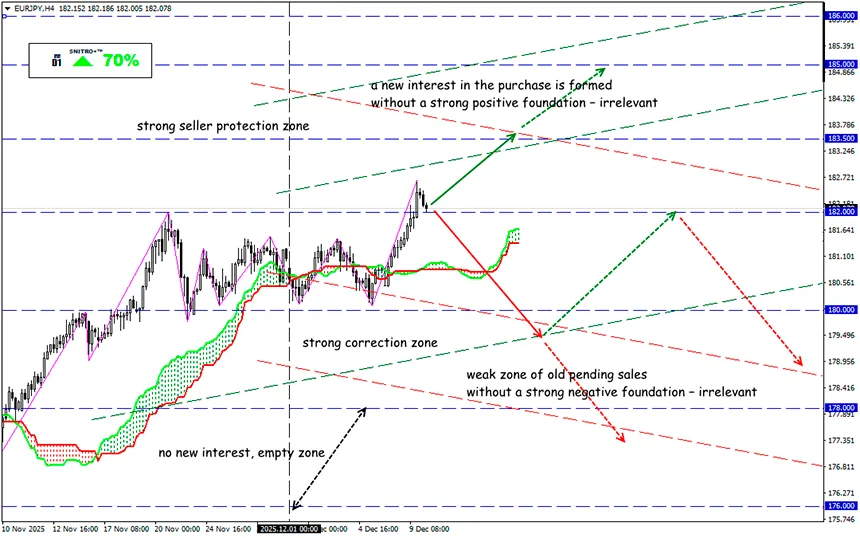
EUR/JPY
Key zone: 181.50 - 183.00
Buy: 183.00 (on strong positive fundamentals) ; target 184.50-185.50; StopLoss 182.30
Sell: 181.00 (on a confident breakout of the 181.50 level) ; target 180.00-178.50; StopLoss 181.70
The American monetary regulator is finalizing the results of the last meeting of 2025; this decision will shape the trajectory of the US dollar for several months ahead.
Amid internal disagreements, the Fed must determine the pace of further monetary easing.
Because statistical data was not collected during the shutdown, the Fed has no clear picture of the actual state of inflation or the labor market. The labor situation is even worse than inflation: stricter immigration restrictions are shrinking labor supply, while import tariffs are not helping to improve the “quality” of employment. As a result, unemployment is expected to continue rising in 2026.
In reality, the outcome of the December meeting is predetermined: according to CME FedWatch, the probability of a 25 bps rate cut is 97%. The market has no doubt about the rate cut; it will react only to the details of the statement and Powell’s tone.
This is where opinions diverge. The outlook for further monetary easing remains unclear, at least for the first quarter of next year.
The Fed has only two options: cut rates to support the labor market, or keep them unchanged to fight inflation. Each side has strong macroeconomic arguments.
On the optimistic side:
- the ISM manufacturing index fell to 48.2;
- retail sales rose only 0.2%;
- consumer confidence hit a minimal 88.7;
- a contradictory (and likely incorrect) labor market report showed unemployment climbing to 4.4%.
On the moderate pessimistic side is inflation. Though still relatively high, its key indicators are either slowing or stagnating.
The September CPI report (the latest available) showed slower headline inflation (3.0% vs. 3.1% expected) and a deceleration in core inflation (3.0% after 3.1% in August). In addition, the new orders component in November dropped significantly from 56.2 to 52.9.
If the Fed starts cutting rates aggressively, the BOE, ECB, and Bank of Canada will be forced to follow to protect their exporters.
The Fed is unlikely to explicitly signal another rate cut but will focus on labor market weakening and softer economic data.
And remember: Trump intends to force the Fed to lower rates to 1% at any cost and accelerate the US economy before the end of his term. Political pressure on the Fed will intensify, and the specific identity of the next Fed chair will not change this dynamic.
What happens afterward—uncontrolled inflation or a double recession—does not matter to Trump.
So we act wisely and avoid unnecessary risks.
Profits to y’all!


