


















The dollar is strengthening: the euro has almost no chance
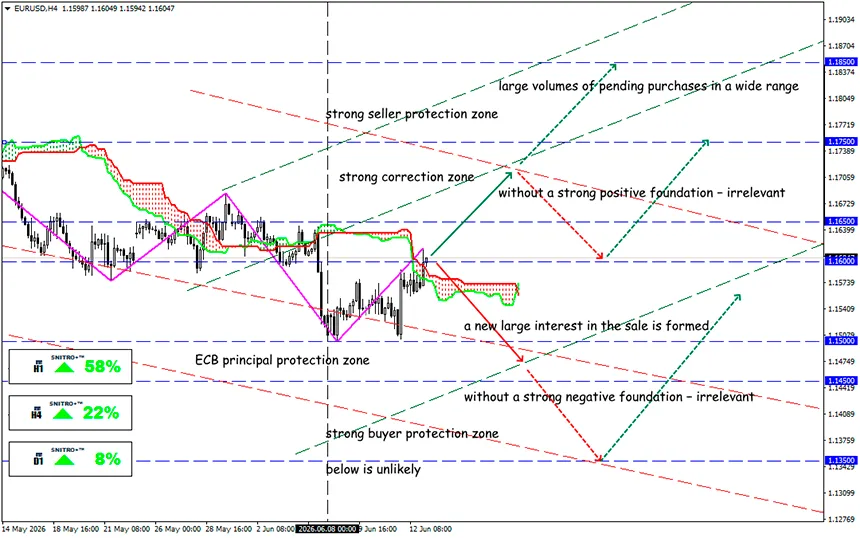
The Market is suffering from the monetary policies of the Fed and the ECB
EUR/USD
Key zone: 1.1550 - 1.1620
Buy: 1.1650 (on strong positive fundamentals) ; target 1.1780-1.1850; StopLoss 1.1580
Sell: 1.1500 (on a pullback following a retest of 1.1600) ; target 1.1350; StopLoss 1.1570
Trader optimism toward the U.S. dollar has reached its highest level in more than a year amid the ongoing war in the Middle East, which is increasing demand for the U.S. currency as a safe-haven asset.
Of course, a confirmed peace agreement reopening key maritime routes could lower energy prices, reduce inflationary pressure, and remove some urgency from both central banks. In such a scenario, the U.S. dollar could weaken, giving the euro an opportunity to recover.
However, no one believes Trump's stories about ending the conflict anymore.
Markets are now pricing in a significantly higher probability of Federal Reserve rate hikes — this figure has risen sharply compared to a month ago. Since the Fed remains firmly committed to a “higher rates for longer” policy, and its benchmark rate is already significantly above the European level, the U.S. dollar continues to enjoy strong demand.
Let us recall:
The ECB raised key interest rates by 25 basis points — the first rate increase in three years after a prolonged period of substantially lower rates. The deposit rate now stands at 2.25%, while the main refinancing rate has been raised to 2.4%. ECB President Christine Lagarde directly identified energy inflation as the key reason behind the decision.
Unfortunately, this move does little to narrow the gap with the Fed. Both regulators are now raising rates, but the United States started from a much higher level and may continue tightening, while the ECB currently lacks similar room for maneuver. This persistent gap continues to act as a ceiling on euro appreciation.
- The ECB was forced to acknowledge that inflationary pressure is no longer confined to energy alone.
- The World Bank lowered its global growth forecast to 2.5%, the weakest reading since the 2020 pandemic.
- Expensive oil is filtering into all prices. Even AI technologies have become a source of inflation — software and computer components have risen by a record 14.5% year-over-year.
- Massive demand for AI equipment is stimulating exports from China and South Korea — this also puts pressure on the euro.
Governments and monetary regulators have lost flexibility: cheap money and large deficits have consumed almost the entire reserve of monetary and currency-policy tools.
The Middle East conflict has pushed the global economy into a situation where central banks cannot make any move, even a logical one: prices are rising while economic growth is slowing. This combination deprives them of their main policy instrument, since rates can no longer simply be cut to support the economy. Inflation must remain under strict control.
And what is the result?
At the moment, the market is slightly optimistic. The proposed agreement between the United States and Iran is increasing risk appetite — the S&P 500 Index is only 2% below its all-time high. Analysts expect a new impulse for the global stock market rally, including in Europe. Lower energy prices are expected to reduce inflationary pressure and ease pressure on the Fed regarding interest-rate hikes. However, real trading signals are still far away.
Despite the momentum at the start of the week, the euro remains under pressure against the U.S. dollar, as the two major central banks continue to diverge in both the pace and direction of monetary policy, keeping the U.S. dollar in a dominant position. Let's hear what Kevin Warsh has to say about it.
So we act wisely and avoid unnecessary risks.
Profits to y’all!


