


















Saylor Is Ready to Sell Bitcoin: Is a Disaster Near?
Strategy Is Preparing to Sell Its Assets
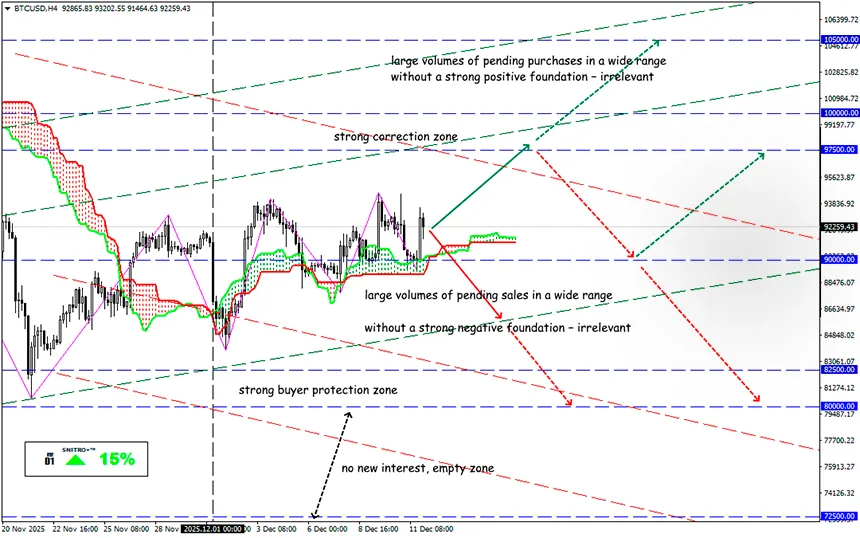
BTC/USD
Key zone: 88,500 - 91,500
Buy: 93,500 (on strong positive fundamentals) ; target 98,500-100,000; StopLoss 92,500
Sell: 87,500 (on a confident breakout of the 90,000 level) ; target 83,500; StopLoss 88,500
The market clearly remembers Michael Saylor’s promise to “never sell the crypto” accumulated on Strategy’s balance sheet. However, this week the largest public BTC holder stated that it will not sell tokens until… 2065. The date is strange, and of course it can be changed at any moment.
Why did the company abandon its eternal hodl pledge, and what changed in its financial model?
Let’s recall:
The Digital Asset Treasuries (DAT) model was created by Saylor. The idea is that a private company uses its corporate balance sheet to purchase cryptocurrency while its stock price grows faster than the token price. This appears to be an ideal mechanism for boosting capitalization, and from late 2023 to mid-2025 more than one hundred companies in the US and Canada adopted this model.
In the first half of 2025, DAT companies experienced true euphoria. For example, SharpLink Gaming shares rose by 2600% in price!
But then it became clear that digital assets do not generate real cash flow, and almost all DAT companies bought crypto using debt. And when the crypto market began to “storm,” companies became unable to service their obligations.
The average decline in DAT-company stocks was 43%, and some fell by 90%–99%.
The idea of a corporate BTC treasury stopped being a pure growth trade. It became dependent on debt load, asset-management quality, and the ability to raise capital. The $1.44 billion reserve fund created by Strategy to service its debt only solves the problem for the next couple of years, which is why Strategy’s CEO Phong Le for the first time acknowledged the possibility of selling BTC from the corporate balance.
Despite Saylor’s ambitions, the market now demands transparency and financial backing. Strategy can no longer promise an infinite holding period for several reasons:
- debt requires regular cash payments;
- the market is more mature and no longer believes in hype without real capital;
- a specific date helps the company preserve its reputation.
The proposed sale date — 2065 — emerged as a legal and psychological tool to stabilize expectations among shareholders and creditors. But the short-term reaction was the opposite: project participants began to panic.
The stability of Strategy is a key factor for BTC’s short-term price. If the mNAV ratio (currently 1.13) falls below 1, the market will start pricing in the risk of forced BTC liquidations. This could trigger cascade selling and negatively impact the entire sector.
But if the company manages to avoid selling, the market will receive a signal of resilience.
How successfully Strategy adapts to economic conditions, debt obligations, and investor expectations will define BTC’s behavior in the near term and will influence the entire digital-asset industry.
So we act wisely and avoid unnecessary risks.
Profits to y’all!


