


















Crisis under control: no need to change rates
The Fed, ECB, and BOE are not ready for serious decisions
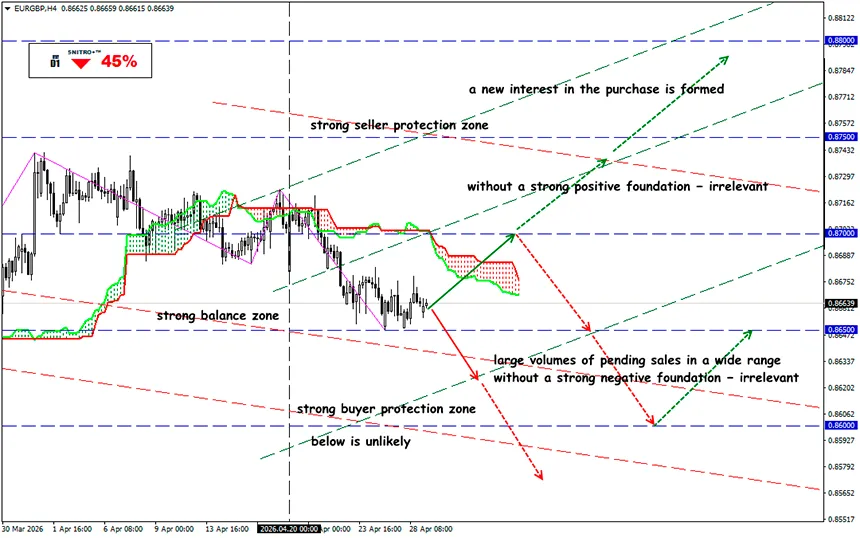
EUR/GBP
Key zone: 0.8620 - 0.8680
Buy: 0.8700 (on a decisive break of 0.8670); target 0.8820; StopLoss 0.8650
Sell: 0.8630 (on strong negative fundamentals) ; target 0.8500; StopLoss 0.8680
Markets are awaiting the Federal Reserve’s official statement, but will react primarily to the tone of Powell’s final speech as Fed Chair.
The U.S. dollar has moved into consolidation ahead of the Fed and ECB meetings and amid a lull in the Middle East. Central banks intend to take a wait-and-see approach amid geopolitical uncertainty.
The Fed’s passivity is driven by the intention to assess how the Middle East conflict will impact the U.S. The post-pandemic recovery, the consequences of the outbreak of the armed conflict in Ukraine, and tariffs had only temporary effects. However, the PCE index has remained above the 2% target for a prolonged period, which risks undermining confidence in the central bank.
Investors are also concerned about Powell’s decision—whether he will remain on the FOMC until 2028 or step down after his term as Chair ends. Jay’s departure from the Fed would allow Trump to strengthen his position and bring forward the timing of rate cuts. It would also ease Kevin Warsh’s efforts to restructure the Fed.
Recall:
In 2008 and 2011, the ECB raised rates in direct response to accelerating inflation, only to cut them sharply a few months later to rescue the EU economy. In 2022, the regulator delayed tightening for too long, allowing inflation to accelerate into double digits. Today, the desire to avoid repeating such mistakes forces the ECB to maintain aggressive rhetoric without rushing into actual tightening.
Christine Lagarde has given hints about a possible rate hike in June. If these signals appear insufficiently convincing to investors, EUR/USD risks declining.
Europe has another “headache” — a new EU budget of €1.8 trillion.
EU leaders held their first substantive discussion on another controversial issue — the next seven-year budget of the bloc. This budget will govern EU spending from 2028 to 2034. The discussion has intensified disputes over spending priorities and who should bear the costs. Previously, the burden largely fell on Germany, but the country is clearly not ready for that now.
The key stumbling block remains the distribution of financial responsibility.
- Wealthier EU countries, which contribute more to the budget than they receive, have renewed criticism of the proposed budget size. Donor countries express concerns about excessive spending and demand stronger justification for planned expenditures.
- Discussions in Cyprus have only highlighted deep divisions among EU member states regarding the bloc’s financial future.
- The European Commission insists on the need for significant investment to address urgent challenges such as climate change, digital transformation, and security issues.
- Another sensitive issue is the proposal to raise funds through EU-level levies to finance the repayment of bonds issued during the post-COVID recovery period.
So the fight over EU finances will be intense.
The EUR/GBP pair has found strong support in the 0.8650–0.8655 area, indicating a possible formation of a “Double Bottom” pattern.
The euro is attempting to strengthen against GBP but remains within the weekly range. Rebalancing of pending volumes in key zones increases the likelihood of a trend shift as investors prepare for monetary policy decisions from the ECB and the Bank of England.
Both central banks intend to keep rates unchanged, as they seek additional data to more accurately assess the impact of the Middle East war on economic growth and inflation.
Bank of England Governor Andrew Bailey stated earlier in April that there is no need to change policy due to a weak labor market and the lack of pricing power among corporations, which may provide some support to the euro.
So we act wisely and avoid unnecessary risks.
Profits to y’all!


