













A Tax on slavery: who benefits?
The U.S. proposes tariff "Penalties" against forced labor
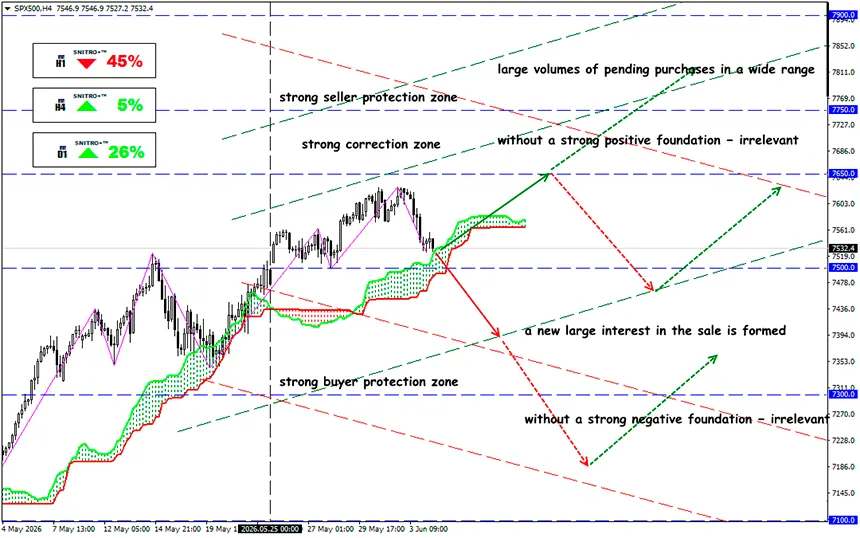
SP500
Key zone: 7,500 - 7,600
Buy: 7,680 (on a decisive break above 7,650); target 7,900; StopLoss 7,600
Sell: 7,450 (against a strong negative fundamental backdrop); target 7,350-7,200; StopLoss 7,530
The Trump administration has proposed introducing new import tariffs on goods from 60 countries for the use of forced labor. It is assumed that the United States' major trading partners — from the EU to India — have failed to prevent goods produced using forced labor from entering global supply chains.
The key legal argument is not that each of these countries has been proven to use forced labor across all export sectors, but rather that their laws, policies, and practices related to preventing and/or effectively enforcing bans on the import of such goods are considered "insufficient."
The U.S. believes that the inability to address this type of imports forces American workers to compete on an "uneven playing field." This move adds a new layer of trade risk at a time when the S&P 500 has closed at a new record high.
Let us recall:
The new tariffs are based on investigations conducted under Section 301 of the Trade Act of 1974 — a powerful instrument that will likely be difficult to reverse later. The Office of the United States Trade Representative has proposed additional duties of 10% or 12.5%. As a temporary measure, Trump previously imposed a global 10% levy under Section 122, but it expires in July. The introduction of the new "labor" tariffs will coincide with the expiration of these temporary measures.
For the United States as a whole, the measure is simultaneously moral and geoeconomic.
Economies that fully or partially prohibit imports of goods produced with forced labor are expected to face additional tariffs. Thus, for example, Canada, Mexico, Taiwan, and the United Kingdom would pay a 10% "penalty," while China, Japan, India, South Korea, Brazil, and Switzerland would face a 12.5% tariff.
- Economically, this appears to be an attempt to transform the existing U.S. system for combating forced labor from a mechanism blocking the entry of "tainted" goods into a universal tariff tool against trading partners.
- This initiative is part of Trump's efforts to restore his tariff policy after the Supreme Court ruled in February that he had exceeded his authority by using emergency powers to impose broad tariffs.
- The United States is also collecting public comments regarding the creation of a new "U.S.-China Trade Council," agreed upon after Trump's meeting with Chinese President Xi Jinping. The council would be able to identify products that are not sensitive to tariffs and may receive preferential treatment even if broader tariffs remain in place.
For Trump personally, the political balance is twofold. This is a rare case where tariffs can simultaneously be presented as protection of jobs, pressure on China, a fight against slave labor, and an effort to restore order in customs enforcement. Such a combination appeals to voters in industrial states.
The proposal includes several exemptions:
- Quotas on clothing and textiles from certain countries will be linked to the volume of U.S. textile exports to those countries.
- Beef, tomatoes, bananas, coffee, orange juice, and other food products are fully exempt from the tariffs.
- Metals (already subject to other duties), as well as certain fuels and chemicals, are excluded.
And what is the result?
Companies with global supply chains may face higher duties, increased documentation requirements, and new pressure to prove the absence of forced labor throughout their supply chains.
The initiative will become a stress test for the United States' largest trading partners. This step also raises questions about the stability of the truce with China reached at the summit with Xi Jinping in May.
Let us state immediately: this is only a proposal. The new tariffs will not take effect immediately. A period of public consultation is предусмотрed, during which amendments may be made. Written comments are being accepted until July 6, and public hearings of the Section 301 committee will begin on July 7.
So we act wisely and avoid unnecessary risks.
Profits to y’all!


