

















One Latte vs. One Coffee CFD: Micro-Economics of a Trade


Did you know that the familiar morning coffee is a strategic exchange-traded product? CFD contracts on coffee beans will unlock the full profit potential hidden in a flavorful cup of latte: all you need are confident trading skills and a proper understanding of risk.
A financial deal instead of a cup of coffee
You don't have to load bags of coffee beans - thanks to CFD contracts (contracts for difference) you can make a profit without buying the goods themselves.
Recall:
CFD, or contract for difference, is an agreement between a broker and a trader to pay the difference in the price of an asset between the opening and closing of a transaction. It allows you to profit from price changes without actually owning the market asset - currency, commodity or stock. You can see more details here.
!!! CFD on coffee (coffee beans) is a derivative financial instrument linked to the price of a real futures contract.
CFD or futures: what is the difference?
Both CFDs and futures allow traders to profit from asset price movements without actually owning the asset, but there are a number of key differences between them:
Legal status
- CFDs: over-the-counter (OTC) contracts concluded exclusively between a trader and a broker; the form and terms of the contract are determined by the broker.
- Futures: exchange-traded contracts, transactions are conducted on regulated exchanges (CME, NYMEX, etc.) according to strict standards - strictly defined: volume, execution date, asset, etc.
Expiration date
- CFDs: do not have a fixed closing date, the transaction can be "held" indefinitely (until the position is closed or margin call).
- Futures: always have an expiration date (month, quarter), after which the contract is in any case closed or O
Asset relationship
- CFD: no commodity (or other asset) is actually delivered, the transaction relates only to the difference in price.
- Futures: can be deliverable (commodity) or settlement. For example, a coffee futures contract is physically delivered if the contract is not closed before expiration.
Leverage
- CFDs: brokers offer high leverage, which allows you to make trades with minimal investment.
- Futures: margin requirements are higher and leverage is limited by exchange conditions.
Spreads/Commissions
- CFDs: the broker charges a spread (sometimes a commission) and swap (can be negative) for carrying a position to the next trading day.
- Futures: the trader pays the exchange commission and the broker's commission, no swaps, but there is a risk of roll-over costs when rolling over to the next contract.
Investment level
- CFDs: available to retail traders with small capital (from $1), you can make transactions in fractional lots.
- Futures: designed for large investors or experienced traders, the volume of contracts is standardized, which requires more capital to enter the market.
!!! Some brokers offer futures with more loyal requirements, so-called E-mini and Micro futures, which allow traders with small capital ($500-$2,000) to get full access to the liquidity of CME Group and other major exchanges.
Let's find out where the profit comes from in such stock trades using the example of an ordinary cup of coffee.
CFD: How is it done?
If you are confident that the price of an asset will rise, you buy a CFD contract at the current price ("long position").
- If you believe that the price of the asset is declining, you open a CFD sale ("short position").
- Если считаете, что цена актива снижается, то открываете продажу CFD (short – "короткая позиция").
Profit/loss on the transaction:
The difference between the price of the asset at the time of opening and the price at the time of closing the trade, multiplied by the number of contracts.
For profit:
- for a buy transaction, the Close price must be greater (higher) than the Open price;
- for a deal to sell an asset the Close price must be lower than the price at the time of entering the deal.
!!! CFD contract does not imply buying or selling of real asset - you work only with information about prices
Coffee as an exchange-traded commodity
Coffee is one of the most popular and therefore highly liquid agricultural commodities. The main varieties of beans traded on the exchange:
- Coffea arabica – more than 60% of the world market.
- Coffea robusta – about 37%;
- Coffea liberica –1-2%;
- Several types of mixed coffee blends are traded on private and regional markets
!!! Coffee beans are priced either in cents per pound (¢/lb) or in USD per ton.
In the real market nobody trades in kilograms (or pounds) of coffee. For this purpose there is a larger unit - a "bag" (a bag of coffee) or an even larger unit - a lot of coffee, which are used in the calculation of real (delivery) futures. A standard "bag" is a 60 kg package = 132.28 lbs (1 kg = 2.20462 lbs (lb)). Then for Arabica variety in international shipments from Brazil, Colombia, Vietnam: Bag price ($) = (Price in ¢/lb × 132.28) ÷ 100.
For example, for a quote of 305.27 ¢/lb (as of 18-07-25),
Bag price = (305.27¢/lb × 132.28) ÷ 100 = $403.81.
For Robusta at $3322/ton or ($3,322/kg), Bag price = $3,322 × 60 = $199.62.
Large transactions are in "a lot of coffee" or 1 lot = 37,500 lb = 625 bags of 60 kg.
One contract can correspond to 37,500 lb, but CFDs at a retail broker are often highly fractionated - down to 1 bag, 1 lot or 1 kilogram.
!!! Be sure to check the lot size of the contract with your broker - this is key to a correct calculation.
The main sites for the coffee trade:
| Sort | Exchange / Platform | Ticker | Contract | Currency / Unit |
|---|---|---|---|---|
| Arabica | ICE U.S. (NYBOT/NYMEX) | KC | 37 500 lb (250 bags) |
¢/lb |
| Robusta | ICE Europe (LIFFE) | RC / RM | 10 tons (167 bags) |
$/ton |
| Arabica | ICE U.S. (NYBOT/NYMEX) | KC | 37 500 lb | ¢/lb |
| Robusta | ICE Europe (LIFFE) | RC / RM | 10 tons | $/ton |
| Robusta | SICOM (Singapore Commodity Exchange, SGX) | – | Lot 5 tons | $/ton |
| Arabica | BM&F (Brazilia) | ICF/ KFE | 6 tons (10 bags) | ¢/lb |
| Arabica | TGE (Tokyo) | AC | 5 tons | ¥/кг |
| Any | JSE (South Africa) | QCFF | 112000 lb | ¢/lb (ZAR/kg) |
Stable liquidity is important for any commodity, and the ICE exchange is the most active market for coffee and is considered the benchmark. Regional venues like SICOM or TGE reflect specific local conditions and are used by local traders.
Example of a trade: coffee vs a cup of latte
As a reminder, in CFDs:
- you do not transport real beans or rent a warehouse - you speculate on the price;
- you can trade both up (buy, long) and down (sell, short);
- a CFD transaction can be held indefinitely and closed at the most convenient moment for you.
Let's say you decide to make a minimal investment - the cost of a cup of coffee. For example, a large serving of Starbucks' famous coffee costs in the range of $4.50-4.75.
So, you invest $4.50 - (the cost of a "large latte") - in a CFD on Coffee Arabica coffee beans.
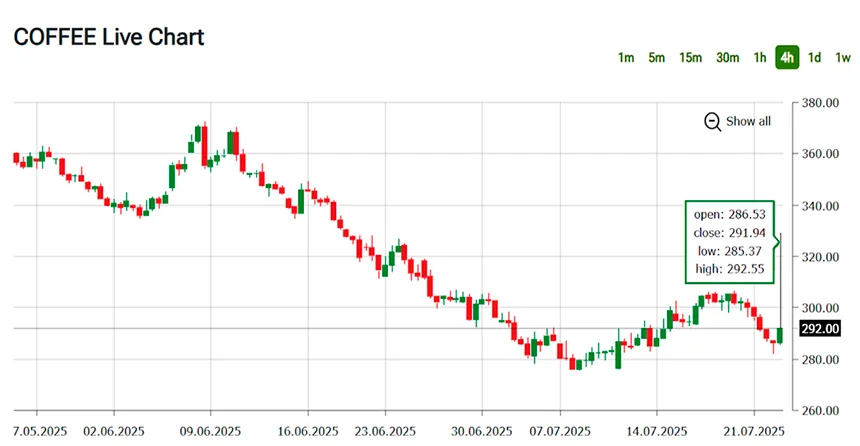
For ease of calculation, let's assume that you plan to enter a BUY trade at a market price of 300 ¢/lb (or $3 per pound) with a small (reasonable) leverage of 1:10.
With this leverage, investing only $3 in the trade (don't open for the full $4.50 at once!), you can operate in the market with 10 times that amount - $30 and a volume of 10 pounds.
Recall:
For each trade, there are two prices: PriceOpen (market entry) and PriceClose (market exit), and the resulting:
Trade Result = (PriceClose - PriceOpen) × contract size × volume
!!! Please note: broker's commission/spread is not taken into account yet - to simplify the calculation.
Suppose that after entering the market, the price rose by 10 ¢ (or 1000 points)
- New price: 310 ¢/lb.
- The result of the trade: (310 -300) ¢ × 10 lb = 10¢ × 10 lb = +$1 (profit).
- The actual investment amount is $3, the profit is $1, meaning the return on the deal is about 33% on the capital invested.
But if you make a mistake with the direction of the deal, the reverse scenario is possible:
If, after opening a buy trade, the price decreased by 10 ¢:
- New price: 290 ¢/lb.
- The result of the trade: (290-300) ¢ × 10 lb = -10¢ × 10 lb = -$1 (loss).
- The real investment amount is $3, the loss is $1, i.e., the same 33% on the invested capital.
For reference:
- Current price: about 297-300 ¢/lb (~$2.97-$3.00 per pound) as of 25-07-25, down about 2.5% over the last month, but the annualized gain is still about +29%.
- Volatility over the period: over the past two years, the price has ranged from ~266 ¢/lb to ~535 ¢/lb (including extremes).
- The highest point is around 535 ¢/lb and the lowest point is around 266 ¢/lb (based on a 52 week range).
Why you should trade CFDs on coffee
- Low market entry threshold - a few dollars is enough ($100 is optimal).
- Flexibility - you can make money on both rising and falling prices.
- No real supply: no need to think about storage, transportation, licenses.
- High liquidity - there is always large capital in the market.
- Leveraged transactions are available (from 1:10).
- Sufficient information - commodity characteristics, market news, trading statistics.
- Assets are available at most brokers, in mobile and desktop applications.
Risks of trading CFDs on coffee
Trading CFDs on coffee is exciting, affordable and profitable, but the standard trading risk is not eliminated. The market can turn at any time and your profit can quickly turn out to be a loss. You need to control the following factors:
- Leverage: brokers offer a wide range (from 1:2 to 1:1000), but the wrong scale leads to quick losses.
- Volatility: depends on seasonality, geopolitics, natural anomalies, USDA reporting and other fundamental factors.
- Risk of negative balance: changes in broker's margin requirements in case of strong gaps or spread widening may lead to closing a position without your participation.
In addition, you need to be prepared for standard trading costs such as spread, swap, commissions, trading account inactivity fees, which also reduce your profit.
!!! A stable risk management system, including the right choice of broker, optimal leverage, StopLoss setting rules, should be a mandatory element of your trading strategy. You should create and test it on a demo account before you start real trading.
A few practical remarks
Seasonality
Coffee, or rather its production, is extremely dependent on weather conditions. Two main periods are distinguished:
- Summer (July-September): production uses old stocks and the outcome of the new harvest is still uncertain.
- Winter (January-March): increased volatility due to weather risks.
!!! During these periods, the trading strategy can be different in terms of dynamics and risk level
The price of CFD contracts on coffee seriously depends on external conditions, such as climate - prolonged drought or pest infestation in producing countries (Brazil, Vietnam), logistical problems (delivery through the Panama Canal), demand growth (Asia), tariff and political risks lead to a decrease in harvest and world stocks, which causes speculative price growth.
In 2022 2024, there is a critical shortage in the coffee market: consumption outpaces production, creating pressure on prices. For example, in 2024, Arabica rose in price by about 70% in one year, Robusta by about 55%. In early 2025, prices rose to historic highs, with arabica reaching $4/lb (~412 ¢/lb) and US retail ground coffee prices at $7+/lb (up 75% from 2020).
CFD or futures: which to choose?
The type of market asset always depends not only on your level of capital and experience, but also on your trading objectives.
- If your goal is short-term speculation with small capital and you prefer technical analysis for making trading decisions, CFD is the best choice.
- If you need to hedge risks, or are interested in real trading contracts, and you are ready to hold at least medium-term transactions, then you need futures.
!!! The right choice of strategy and type of trading asset reduces risks and increases the chances of success. But we recommend starting with CFDs.
Conclusions
CFD on coffee is an effective exchange asset with high volatility and transparent trading logic. You can enter such a deal with minimal investment - at the level of the price of a cup of latte - and get stable profitability. The main thing is to understand the market mechanics, have strong technical analysis skills and the right attitude to risk.
Profits to y’all!


