


















Bitcoin and oil: correlation without formulas

How energy prices are putting pressure on the crypto market
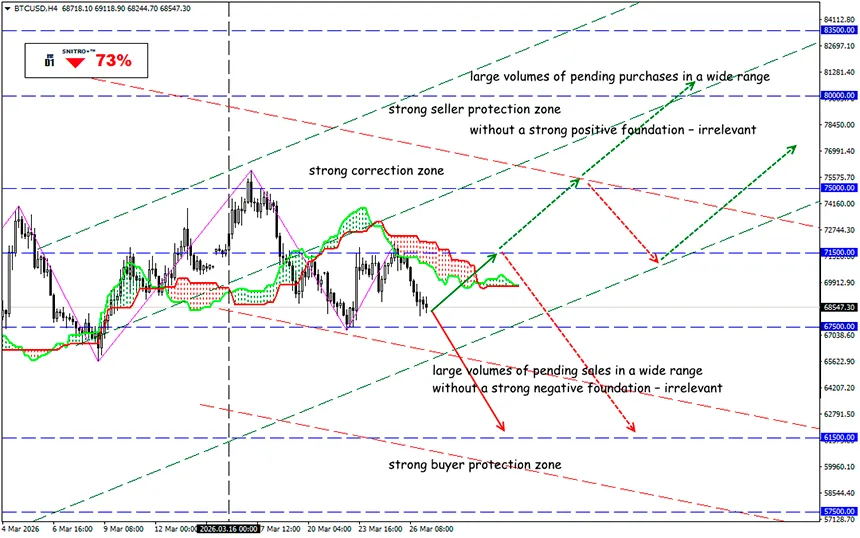
BTC/USD
Key zone: 67,500 - 71,000
Buy: 71,500 (upon a decisive break of the 70,000 level); target 73,500-74,000; StopLoss 70,500
Sell: 67,500 (against a strong negative backdrop) ; target 63,500; StopLoss 68,500
Hidden, “dark” intermarket links have become the main trend since the beginning of the year. The conflict in the Middle East is destroying the usual logic and pushing energy prices higher, and the financial market is forced to react. Cryptocurrencies have also fallen into this trap.
Using standard methods, it is almost impossible to evaluate the correlation between oil prices and Bitcoin — under different market conditions they can move both in sync and in opposite directions.
Oil, like other energy resources, is not a direct driver of cryptocurrencies. It works as a market trigger.
Let us recall:
Sharp movements in oil prices are always driven by geopolitics — conflicts, sanctions, natural force majeure — anything that can disrupt supply volumes and dynamics and trigger a chain of changes in the global economy. In this scheme, BTC reacts not to the price of oil, but to the processes it launches:
- expensive energy provokes higher inflation;
- high inflation means stricter central bank policy;
- tighter monetary policy reduces market liquidity — the main “fuel” for risky assets.
So speaking about a clear correlation — direct or inverse — is not entirely correct.
The real connection between oil and Bitcoin is expressed not through abstract liquidity, but through inflation expectations. Inflation requires rate adjustments: investors begin to price in a longer period of tight Fed policy or even the cancellation of rate cuts.
That is when you can catch synchronous movement between crypto and the commodity market. For example, when oil rose above $100 per barrel, Bitcoin moved in sync with Nasdaq because investors perceived crypto as a defensive asset.
This once again confirms that in the short term Bitcoin remains a risk-off strategy.
There is an additional effect: rising energy prices are often accompanied by a stronger dollar, which reduces global liquidity and puts pressure on the crypto market. And keep in mind: expensive energy increases miners’ costs, which may increase the supply of BTC on the market because miners need to cover expenses.
By the way, there is an opinion circulating in the crypto community that Iran could have been accumulating and selling significant volumes of Bitcoin for years using cheap energy. In other words, BTC mining with extremely low costs could have created constant hidden pressure on the market. After strikes on energy infrastructure, this channel allegedly disappeared, but there is no direct proof of this.
If high energy prices persist, the situation changes. Expensive oil begins to slow the economy: business costs rise, consumer demand falls, and production slows. At some point the market starts pricing in not inflation, but recession.
And then the behavior of cryptocurrencies changes: the reaction shifts to expectations of policy easing — that is, to the return of liquidity. In other words, the same oil shock that initially pressured Bitcoin creates conditions for its recovery.
However, such a reversal usually takes 2–3 months.
And what is the result?
Bitcoin still does not have a clear role in the global financial system. Sometimes it behaves like a risky asset and falls together with stocks, but as soon as overall trust in traditional finance declines, crypto starts attracting investment capital.
So an apparently standard oil shock can produce the opposite effect in different periods.
For example, every military conflict in which the United States was involved eventually ended with an expansion of the money supply. And then energy crises create an opportunity to profit from non-traditional assets.
What matters is not how and where oil is moving, but how long the market reaction lasts and what measures monetary regulators take.
As long as Bitcoin balances between two roles — a risky asset and a market alternative — its reaction to such events will continue to change. But this correlation can definitely be caught and used.
So we act wisely and avoid unnecessary risks.
Profits to y’all!


