
















Iran loses focus of attention
The market awaits change
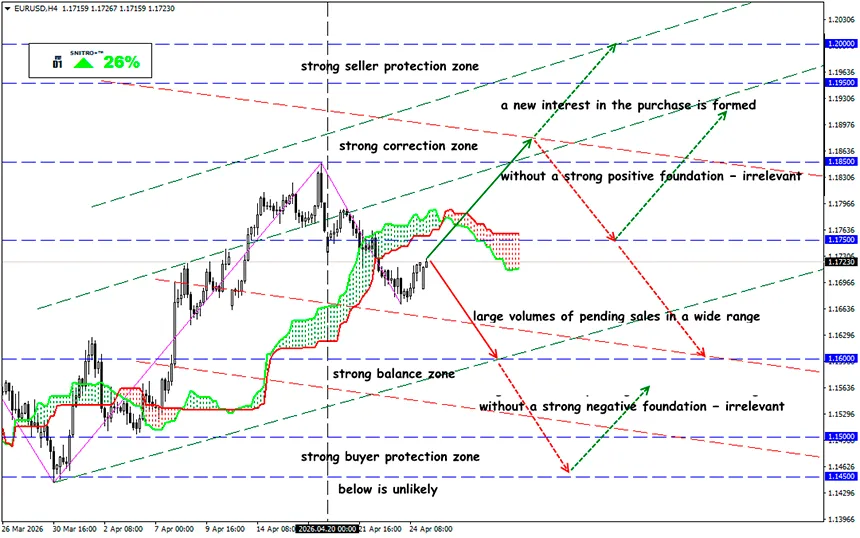
EUR/USD
Key zone: 1.1700 - 1.1800
Buy: 1.1750 (on strong positive fundamentals) ; target 1.1870-1.1920; StopLoss 1.1680
Sell: 1.1680 (on a decisive break above 1.1750) ; target 1.1500; StopLoss 1.1750
For the first time in two months, the key driver of the week may not be the political or military situation in the Middle East, but fundamental economic factors caused by the consequences of the conflict. It is expected that the Federal Reserve, the ECB, as well as monetary regulators in the UK, Canada, and Japan will not risk changing interest rates.
Against the backdrop of rising inflation, which, incidentally, turned out to be less severe than many economists initially expected, a shift of capital from riskier assets into traditional “safe haven” instruments is anticipated.
On April 29, the 60-day period during which the United States can conduct military operations without Congressional approval expires. And no matter how Trump boasts about supposed “victories,” the risk that Parliament will demand the cessation of U.S. involvement in the Middle East conflict is very high. Or, at the very least, it will require the president to provide serious justification for such actions and a clear plan.
- Historically, U.S. presidents have exited such situations relatively easily, as formal military-trade blockades are not subject to such restrictions, being considered a method of defense rather than aggression.
- Trump’s strong argument will be economic: the blockade of the key transport artery — the Strait of Hormuz — gives the U.S. an undeniable advantage, while competitors suffer: China, Europe, Japan. Donny uses this blockade to pressure other countries into influencing Iran, while he himself waits for more favorable offers.
- The problem is that Trump has almost no time left to continue the war: he needs to be in a stronger position ahead of the meeting with Xi Jinping on May 14–15. Moreover, the start of the active election campaign requires visible victories, and in the war with Iran, victory can only be declared if enriched uranium stockpiles are removed and Iran’s peaceful nuclear program is restricted for decades.
- Tehran has proposed a three-stage negotiation plan with the U.S.: the first stage focuses only on ending the war in the region, the second on Hormuz, and only the third on Iran’s uranium. Trump is dissatisfied but is willing to negotiate by phone.
- At the same time, Washington is taking certain measures against Iran — from revoking visas for Iranian citizens to freezing $344 million in cryptocurrency linked to Iranian wallets.
On Thursday, the Senate Banking Committee will approve Kevin Warsh’s appointment as Fed Chair, making this meeting the last for Powell. Against this tense backdrop, an important personnel event took place in Washington — the Department of Justice has dropped its investigation into the Fed Chair.
- This removes part of the political pressure within the financial bloc, allowing the regulator to focus on fighting inflation without looking back at legal disputes.
- Republican Senator Tillis stated that Powell may remain on the Fed’s Board of Governors until Trump files an appeal regarding misuse of funds for Fed building construction, but Trump needs this seat — and an appeal is not guaranteed.
- The market may react to Fed members’ rate forecasts, although it is obvious that with Warsh’s arrival, the internal balance within the Fed will change, and price growth also depends on the duration of the Hormuz blockade.
Meanwhile, Wall Street, despite the shadow of war, continues to celebrate the technological revolution. Nvidia shares closed at an all-time high, pushing the company’s capitalization above the incredible $5 trillion mark. The U.S. stock market is demonstrating remarkable resilience, as if attempting to filter out Middle East news.
However, ahead lies a “parade of giants,” and if tech leaders confirm their positions, the market may ignore geopolitics for some time, pushing Nasdaq and S&P 500 to new highs.
But if data from Alphabet, Microsoft, or Meta disappoint investors, the “war premium” and high Fed rates will instantly become the dominant theme, turning recent growth into unjustified euphoria.
So we act wisely and avoid unnecessary risks.
Profits to y’all!


