


















ETFs take priority: investors push back against tradition

Why capital is leaving individual stocks
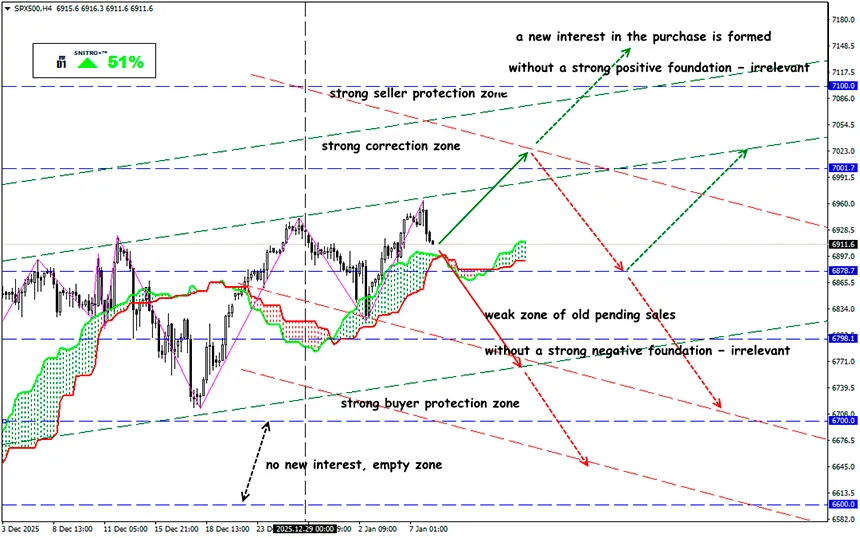
SP500
Key zone: 6,850 - 6,950
Buy: 7,000 (on strong positive fundamentals); target 7,100-7,150; StopLoss 6,950
Sell: 6,850(on a confident breakout of the 6,870 level); target 6,750-6,700; StopLoss 6,900
Bank of America reported that in 2025 its clients purchased ETFs totaling $55 bln, while selling individual stocks worth $96 bln. Outflows from equities slowed compared to the previous year, but capital inflows into ETFs continue to accelerate.
This data only confirms a new trend: investors are increasingly selling individual stocks and instead buying ETFs – ready-made “baskets” of assets that trade like a single stock. This does not mean a “flight from the market”: capital is simply shifting from individual securities into a more convenient format.
Let us recall the advantages of ETFs:
- Simpler and cheaper: one ETF immediately provides broad diversification (dozens or hundreds of stocks).
- A mistake in a single stock cannot wipe out the entire investment amount.
- Fast risk management: ETFs can be bought and sold intraday.
- Psychology: for beginners, it is easier to hold “the market as a whole” than to try to pick winners.
Why Interest in Gold and Silver ETFs Has Increased
- Gold/silver ETFs backed by physical metal allow investors to add “protection” to a portfolio without storing bullion.
- Gold held via ETFs is more reliable than spot gold during periods of uncertainty.
- Silver is more volatile – it can rise more sharply, but also falls faster.
- Silver is easier to analyze because it has a higher share of industrial demand.
Which Stocks Are Currently Losing Investor Capital Most Actively
Based on fund flows and sector ETFs in 2025, the most affected sectors were:
- Healthcare (healthcare/biotechnology) – investors exited due to uncertainty and weak expectations.
- Consumer Discretionary (cyclical consumption) – highly sensitive to interest rates and household income.
- Financials (financial sector) – in critical moments these assets often become a “liquidity donor” (they are sold to quickly reduce risk).
Note: free capital more often remained in large-cap companies, while small- and mid-cap firms received less attention.
Below are several ETFs suitable for medium-term trades (several weeks to months) under current market conditions. All of them trade on U.S. exchanges and have sufficient – and, importantly, stable – liquidity:
- SPY – SPDR S&P 500 ETF Trust: exposure to 500 large U.S. companies.
- QQQ – Invesco QQQ Trust: ETF tracking the NASDAQ 100 index.
- VTI – Vanguard Total Stock Market ETF: exposure to the entire U.S. market (large-, mid-, and small-cap companies).
- XLY – Consumer Discretionary Select Sector SPDR Fund: cyclical consumer sector.
- XLF – Financial Select Sector SPDR Fund: financial sector (banks and capital services).
- XLK – Technology Select Sector SPDR Fund: technology sector (growth stocks).
- GLD – SPDR Gold Shares: the largest gold ETF, tracking gold prices via physical holdings.
- IAU – iShares Gold Trust: an alternative to GLD with slightly lower expenses, also backed by physical gold.
- SLV – iShares Silver Trust: a silver ETF (holds physical metal), suitable for aggressive trend-based trading.
And What Is the Result?
- Modern ETFs are a convenient way to control market exposure and adjust risk regimes.
- ETFs have become the main “transport” of capital: investors reduce risks associated with analyzing and selecting individual stocks.
- Buying gold/silver via ETFs is a popular way to add an additional defensive hedge.
- In certain sectors (healthcare, cyclical consumption, financials), the risk of sell-offs is higher, especially in nervous markets.
The optimal ETF investment strategy for medium-term trades: 60% in broad market ETFs, 20% in sector ETFs, and 20% in defensive assets such as gold/silver. Silver (especially now!) requires extremely strict risk discipline.
So we act wisely and avoid unnecessary risks.
Profits to y’all!


