


















Europe is trying to survive
Europe is trying to survive
EUR/GBP
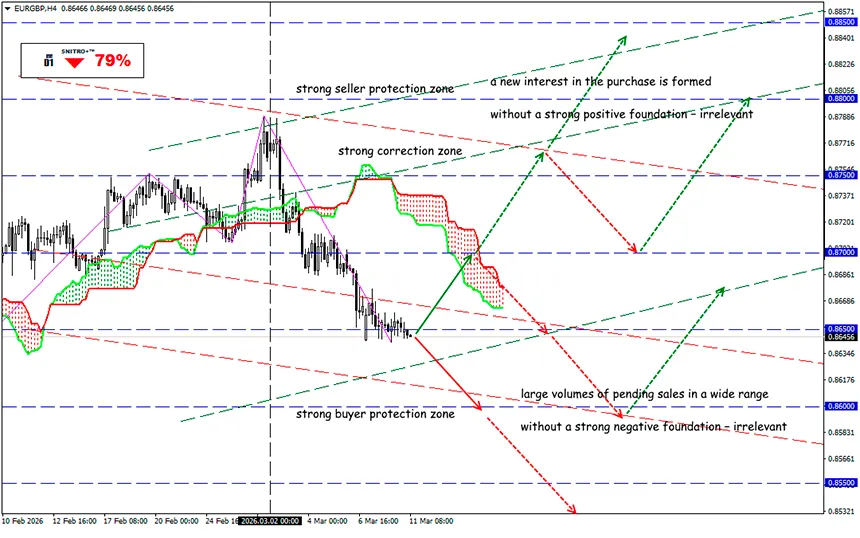
Key zone: 0.8630 - 0.8670
Buy: 0.8700 (on strong positive fundamentals) ; target 0.8820; StopLoss 0.8640
Sell: 0.8600 (on a pullback after retesting 0.8650) ; target 0.8450; StopLoss 0.8660
Despite the fact that the economic and political situation in the United States remains complicated, practically every piece of news worked against the pound and in favor of the dollar. Meanwhile, the data that supported growth of the pair was often ignored by the market due to the geopolitical factor.
Thus, the war in the Middle East became the final chord in the suffering of the British currency.
The pound received temporary support amid a revision of market expectations regarding the policy of the Bank of England after recent volatility in the oil market. BOE analysts link market dynamics with a reassessment of yields and the continuing uncertainty surrounding the duration of the energy crisis.
Recall:
- The yield curve for the British pound has undergone one of the most significant repricings caused by the oil shock.
- Inflation in the United Kingdom already significantly exceeds the monetary regulator’s target and stands at 3%, while the Bank of England has a sufficient number of supporters of a strict policy who could potentially stop the current easing cycle.
- The key factor for further developments remains the duration of the oil shock: if it drags on, the discussion about monetary policy will intensify.
- The risk of possible pressure on government bonds is increasing due to government measures aimed at mitigating the consequences of the energy shock for households, although it is emphasized that the government still has time to respond.
Let us note another important point of the British market: the schedule for the formation of utility bills. They are formed during the period from February to May, while consumers will receive their bills in July. Therefore, the main reaction is still ahead.
Let us note another important point of the British market: the schedule for the formation of utility bills. They are formed during the period from February to May, while consumers will receive their bills in July. Therefore, the main reaction is still ahead.
It is necessary to:
- Closely monitor signals from the Bank of England — the composition of votes and possible changes in interest rate forecasts, since the presence of “hawkish” votes increases the probability of pausing the easing cycle.
- Track gas and electricity prices and government statements regarding energy limits and subsidies — fiscal measures may create pressure on bonds and the currency.
And what is the result?
The recent strengthening of the pound sterling against the euro appears to be partly due to a more hawkish revision of rates in the United Kingdom and relatively resilient stock markets.
However, the decline of the EUR/GBP rate since the beginning of the Middle East conflict appears somewhat excessive, and a drop in oil prices below $90 could trigger a corrective rebound in EUR/GBP, making a return to the 0.870 level more likely than continued decline toward 0.860.
So we act wisely and avoid unnecessary risks.
Profits to y’all!


