

















China Proposes a Futures Market for AI Tokens
AI Futures: A New Commodity Base for the Digital Economy
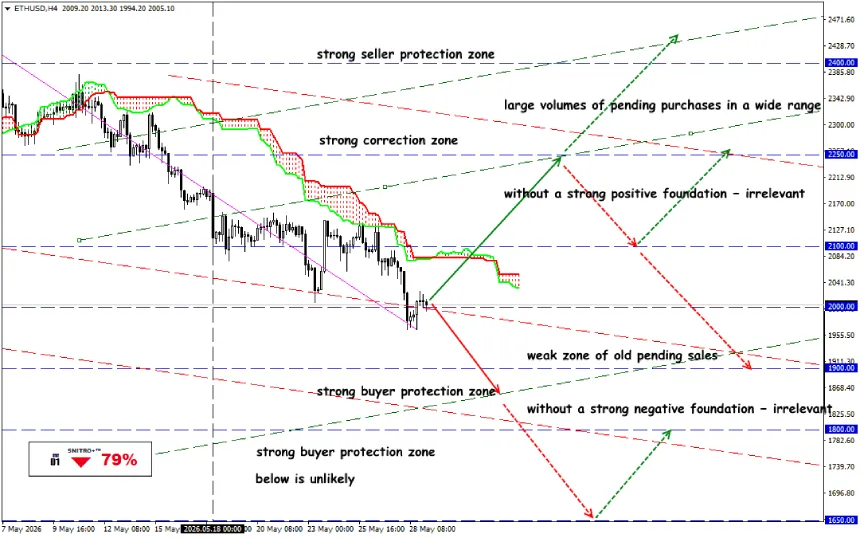
ETH/USD
Key zone: 1,950.00 - 2,100.00
Buy: 2,100.00 (on a strong positive foundation); target 2,250-2,400; StopLoss 2,030.00
Sell: 1,900.00 (on a pullback following a retest of 2,000.00); target 1,700-1,650; StopLoss 1,970.00
Daily token usage in China reached 140 trillion by March 2026. Chinese experts insist on launching token futures in order to compete with the United States in AI technologies and finance.
China is developing a new futures market for digital assets. The country intends to take a different approach from American exchanges: CME Group and ICE are preparing to launch futures on the use of graphics processing units (GPUs), whose value is linked to the rental price of computing power for AI.
- The United States dominates the upper layer of the AI value chain through chips, GPU clusters, hyperscale cloud infrastructure, and companies such as Nvidia, Microsoft, Google, Amazon, and OpenAI.
- This is not about cryptocurrency tokens in the usual sense, blockchain utility tokens, or speculative AI coins.
- The Shanghai Exchange is developing futures contracts for so-called AI tokens — the minimum unit of information processed by AI models.
- These tokens serve as a measure of computing resource consumption and may become a standard pricing unit for AI services.
- China has already published computing-capacity indices that could later serve as benchmark references for futures contracts.
Let us recall:
At this stage, this remains only a potential project of the Shanghai Futures Exchange. No official public announcement regarding the launch of AI-token futures has yet been released.
It also remains unclear whether AI tokens will function solely as units of AI consumption measurement or evolve into fully tradable digital assets suitable for speculation and hedging.
AI-token futures could create an entirely new asset class.
- An AI-token future is essentially an attempt to convert computing workload into a tradable financial risk.
- If standardized successfully, the token could become a benchmark for pricing AI usage across industries.
- Futures contracts would allow companies to hedge future AI-related costs.
- The futures curve could provide insight into expected future demand for computing power.
- Contango could indicate expected capacity shortages, while backwardation could signal temporary demand overheating or supply disruptions.
And what is the result?
Politically, this represents another step toward digital sovereignty. AI tokens could become for the digital economy what oil futures became for energy markets, electricity futures for power systems, and freight indices for global logistics.
For traders and investors, the key question is whether a new liquid underlying asset will emerge that allows market participants to hedge computing costs, evaluate future AI infrastructure demand, and build entirely new cross-market strategies.
So we act wisely and avoid unnecessary risks.
Profits to y’all!


