

















Yuan: salvation or catastrophe?
What to expect if the yuan appreciates
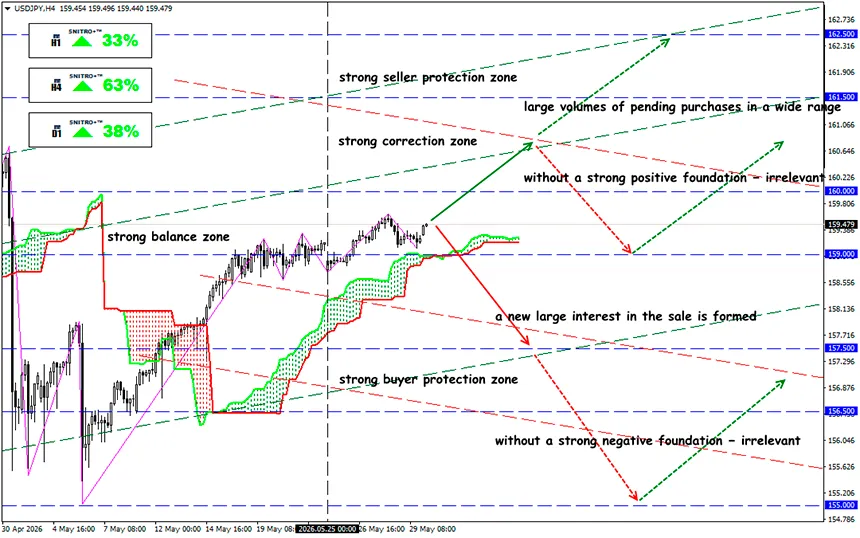
USD/JPY
Key zone: 159.00 - 160.00
Buy: 160.50 (on a confident break of 160) ; target 162.00-162.50; StopLoss 159.80
Sell: 158.50 (on strong negative fundamentals) ; target 157.00; StopLoss 159.20
A rise of the yuan to 5.0 per dollar does not appear to be the base-case scenario, but such a situation is entirely realistic. The consequences for the global economy would be significant — from the redistribution of trade flows and changes in commodity prices to the strengthening of China’s role in international settlements.
At present, one USD can buy approximately 6.7 yuan. A rise to 5.00 would mean an appreciation of the yuan by more than 25% — and the consequences would be felt by far more people than just Chinese consumers going shopping.
China’s economy is still considered a developing one, and the yuan’s share of global trade does not exceed 3%; technically, this would resemble a local story with long-term consequences.
However, there is a nuance: China produces about 20% of global GDP, is the world’s largest exporter of goods, and the largest importer of many raw materials. This means that any significant change in the value of the Chinese currency will inevitably affect the country’s international purchasing power and trigger a chain reaction in trade flows and capital movements worldwide.
Let us recall:
In 2025, China exported goods worth 26.99 trillion yuan and imported goods worth 18.48 trillion yuan, meaning the country sold roughly 50% more abroad than it purchased. For an economy with such a structure, a strong currency always creates mixed effects: exporters lose part of their competitive advantage because their products become more expensive overseas, while importers benefit, as goods become cheaper when converted into the national currency.
However, there are several specific features.
- China mainly purchases raw materials and equipment while exporting finished products with higher added value. This means that for import-oriented manufacturers, cheaper imports may partially offset losses caused by a stronger yuan.
- In 2025, China recorded a record trade surplus of nearly $1.2 trillion. This factor has remained one of the main causes of Beijing’s trade conflicts with the United States and Europe for many years. A stronger yuan could theoretically reduce this imbalance, especially if the appreciation proves sustainable.
- China remains the world’s largest importer of oil, iron ore, copper, and many other raw materials, but a stronger yuan does not automatically mean that Beijing will begin purchasing more oil or copper.
- Chinese consumers would generally benefit. Imported goods would become cheaper for them, while inflationary pressure would decline, including through lower production costs for domestically produced goods.
- Yuan appreciation could change the behavior of Chinese companies. Cheaper imported resources would allow them to replenish inventories more actively, invest in processing capacity, and increase purchases during favorable periods.
- Chinese companies with foreign-currency debt would breathe more easily, as servicing that debt would become cheaper.
- Consumers in developed countries who have become accustomed to inexpensive Chinese imports could also find themselves among the losers. They would either have to accept rising prices or shift to alternative suppliers.
And what is the result?
A significant rise in the yuan’s exchange rate is unlikely to become an event on the scale of a global financial crisis or the collapse of the Bretton Woods system. Although an appreciation of the dollar or euro by 25% would produce less dramatic consequences. A yuan at 5 is possible, but it is more of a stress scenario that demonstrates how sharply the Chinese currency could strengthen if several China-favorable factors occur simultaneously.
In any case, because of the Asian Dragon’s global role in the world economy, the effects of such a move would not be limited to the foreign exchange market. It would trigger a long chain of changes — from trade and commodity markets to the structure of international settlements — and these consequences would unfold gradually over many years. We should adapt in advance.
So we act wisely and avoid unnecessary risks.
Profits to y’all!


