

















The Fed is setting a trap for the dollar
The Market is betting on a rate hike
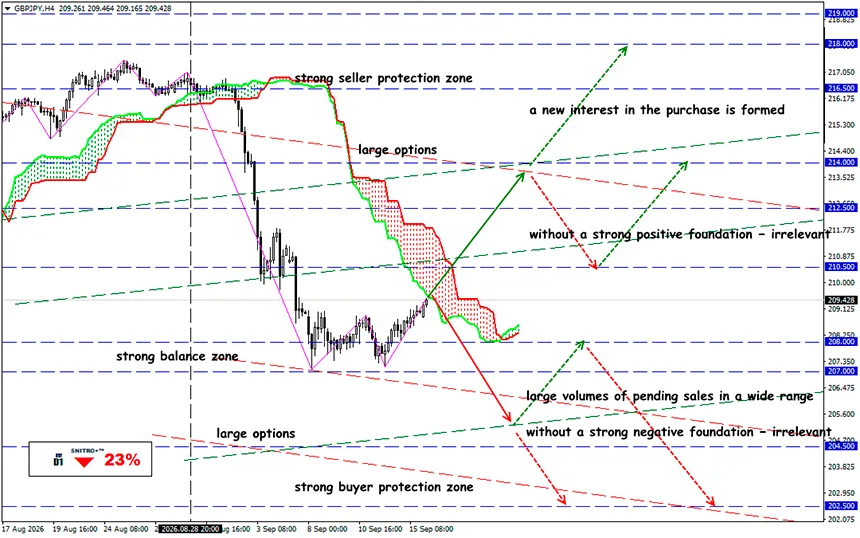
GBP/JPY
Key zone: 208.00 - 210.00
Buy: 210.50 (on a confident break above 210.00); target 213.50-215.00; StopLoss 209.80
Sell: 208.00 (on strong negative fundamentals) ; target 204.50; StopLoss 208.70
A 25 bp hike is practically priced in: currencies will react to the Fed’s projections. The monetary regulator approaches the September 16 meeting with inflation at 3.4%, rising Treasury yields, and an almost 90% probability of a rate hike. For the FX market, Kevin Warsh’s signal about the future path of rates will be decisive.
There is increasingly little doubt ahead of the meeting — the rate will be raised for the first time since the summer of 2023.
The market is practically demanding a rate hike from the regulator despite signs of a moderate labor market. The main argument in favor of tightening has been inflation, intensified by the energy shock.
The probability of keeping the 3.50–3.75% range is only 10.2%. A week earlier, the market estimated the probability of a hike at just 58.4%.
A reminder:
- On Friday, the August inflation report showed that core inflation excluding food and energy was a significantly more moderate 2.4% y/y. 2.4% in the “excluding gasoline” expenditure category. Core inflation has not been this low since the spring of 2021.
- U.S. CPI rose by 0.4% m/m and 3.4% y/y in August. The source of the acceleration is particularly important: gasoline rose by 3.9% over the month and accounted for more than one-third of the monthly increase in headline CPI. At the same time
- PPI gives an even more alarming signal: producer prices rose by 0.4% m/m and 5.4% y/y in August. This increases the risk that higher corporate costs will be passed through to consumer prices.
The Fed is effectively facing two different inflation pictures: underlying price pressure looks relatively controlled, but the energy shock has sharply increased headline inflation and inflation risks.
The second argument in favor of tightening is that the U.S. economy is not yet showing signs of a sharp deterioration in the labor market.
The U.S. economy added 162,000 jobs in August, compared with just 21,000 in July. Unemployment remained at 4.1%. Moreover, employment growth was significantly above the average for the previous 12 months — around 31,000 per month.
Consequently, the Fed’s choice now looks less painful: the regulator can fight the new inflationary impulse without directly increasing the obvious risk of recession today. It is precisely the combination of CPI at 3.4% + PPI at 5.4% + unemployment at 4.1% that makes a 25 bp hike the most logical base-case scenario.
Bonds are already trading a tighter Fed policy: the yield on 2-year Treasuries rose from 4.39% on September 8 to 4.65% on September 14, while the 10-year yield increased from 4.80% to 4.97%. The real yield on 10-year TIPS rose from 2.43% to 2.60% over the same period.
The rise in real dollar yields increases the attractiveness of U.S. assets and supports the USD even before the actual FOMC decision. Therefore, part of the dollar’s potential upside following the rate hike has already been realized.
A classic buy the rumor — sell the fact situation is emerging: a single 25 bp hike may not be enough to trigger another strong USD rally.
So, What Does This Mean?
The main question is not the 25 bp, but what comes next. If the Fed raises the rate to 3.75–4.00%, the decision itself is unlikely to come as a surprise. The market will look for answers in three other elements: the new dot plot, the FOMC’s economic projections, and Warsh’s rhetoric at the press conference.
- A strong positive signal for the dollar will not be the September hike itself, but confirmation that a second step is possible.
- If the Fed confirms the possibility of further rate hikes, the dollar will receive fundamental support, primarily against the pound and low-yielding European currencies.
- If, however, the Fed limits itself to one hike and makes it clear that further steps are not predetermined, there is a risk of a classic sell the fact reaction: yields will retreat, long USD positions will begin to close, and EUR/USD and GBP/USD will gain room for a corrective rise.
For GBP, the fundamental balance looks weaker because of the BoE meeting on September 17. The combination of a Fed hike and the Bank Rate remaining at 3.75% strengthens the case for pressure on the pair. However, entering a position directly at the moment the FOMC decision is released carries an elevated risk of slippage.
Before the FOMC announcement, opening large directional positions offers an unfavorable risk/reward ratio: the rate hike is almost fully priced in.
Thus, the key signal on September 16 is not the 4.00% figure, but the market’s answer to whether it represents the endpoint or the first step of a new rate-hiking cycle.
So we act wisely and avoid unnecessary risks.
Profits to y’all!


