


















Stocks vs. Gold: how to better protect capital
Can Food Be More Reliable Than Gold?
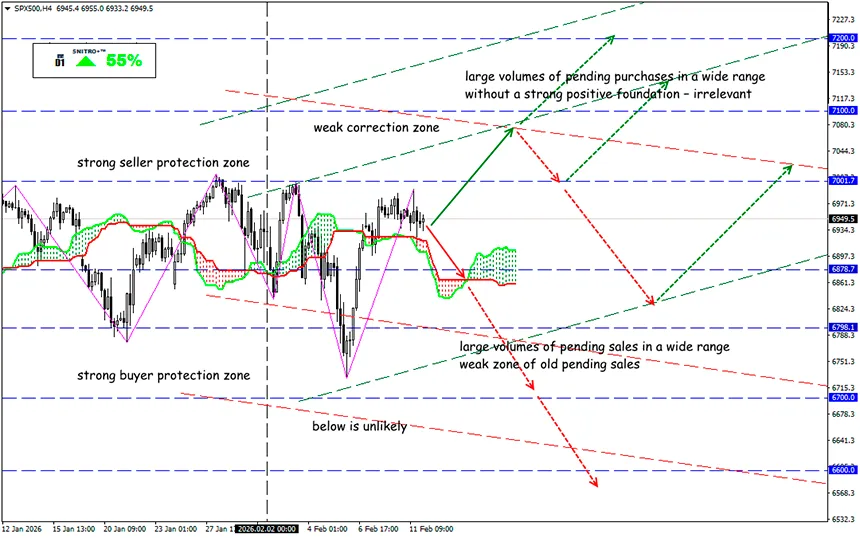
SP500
Key zone: 6,900 - 7,000
Buy: 7,050(on a confident breakout of the 7,000 level); target 7,150; StopLoss 7,000
Sell: 6,880(on strong negative fundamentals); target 6,880-6,850; StopLoss 6,930
Sentiment in financial markets is turning negative: stock indices are falling, precious metals have entered a correction, and traditional “safe haven” currencies no longer guarantee stable protection.
Against an aggressive fundamental backdrop, everything is declining — and defensive assets are no exception.
We suggest looking for non-traditional risk hedging options, for example, in the stock market.
Financial markets have gone through a sharp risk-off phase: investors reduced positions in major instruments and increased allocations to liquid assets. The situation was aggravated by forced selling due to margin requirements.
Pressure intensified in sectors sensitive to the cost of capital and corporate earnings expectations, particularly in technology. Index dynamics became an indicator of the market shifting into defensive mode.
Gold and silver also corrected after strong gains earlier this year; during periods of stress, even defensive instruments can fall if market participants simultaneously take profits and reduce exposure.
Cryptocurrencies, in general, have fallen into an abyss from which they will not emerge anytime soon.
Unexpectedly, consumer sector stocks have become a new stable hedge, with the classic representative being the famous “burger” — McDonald’s.
Against the backdrop of a broad sell-off, McDonald’s (MCD) showed calm dynamics, without sharp drawdowns and without overheating.
Reminder:
The company went public back in 1965, and its key feature is not rapid growth but predictability. This business has gone through multiple recessions and demand shocks without major disruptions, without losing investor confidence, and with virtually no “red” (loss-making) years.
This is the result of an efficient business model:
- A significant share of revenue comes not only from food sales, but also from real estate leasing — the company owns the land and buildings of most restaurants and rents them to franchisees for stable income.
- Thousands of small operating partners bear the day-to-day risks — protecting the core corporation from local problems.
- In crises, McDonald’s benefits from changes in consumer habits: when incomes fall, people shift to cheaper options — McDonald’s effectively takes market share from higher-priced restaurants.
- An additional “bonus” is its global presence in more than 100 countries, meaning revenue declines in some regions are offset by growth in others.
A confirmation of McDonald’s global nature is the famous “Big Mac Index”, introduced by The Economist over 30 years ago. This playful indicator compares Big Mac prices across countries to estimate purchasing power parity.
Indirectly, the Big Mac Index reflects local inflation and cost structures: raw materials, labor, rent, logistics, and marketing.
Historically, fiat currencies were tied to gold, and macroeconomic models still rely on consumer price indices, but in practice inflation is increasingly “explained with fingers” through the Big Mac — not because a burger is more accurate than official statistics, but because it is universal, intuitive, and directly linked to real household expenses.
Can McDonald’s shares really compete with gold as a defensive asset?
They can, if an investor’s main goal is capital preservation and predictability.
McDonald’s looks like “protection through stability”, while gold is “protection through fear”, with sharp phases of overheating and correction. MCD volatility is lower than the market, McDonald’s pays dividends with a current yield of about 2.3% and has nearly 50 years of dividend growth. Over the past 10 years, MCD’s average annual total return was about 12.8%.
Gold over the last decade has also shown strong price growth — almost +276% (around 14% annually), but without dividends and with a much more “nervous” trajectory. The metal can serve as a refuge, but does not guarantee a smooth capital curve.
McDonald’s does not replace gold — it complements it. If gold is a bet on fear, McDonald’s is a bet on the stability of everyday demand. This kind of capital diversification is worth considering.
So we act wisely and avoid unnecessary risks.
Profits to y’all!


