

















Hot oil: the safety buffer is running out
The Market is losing its backup routes
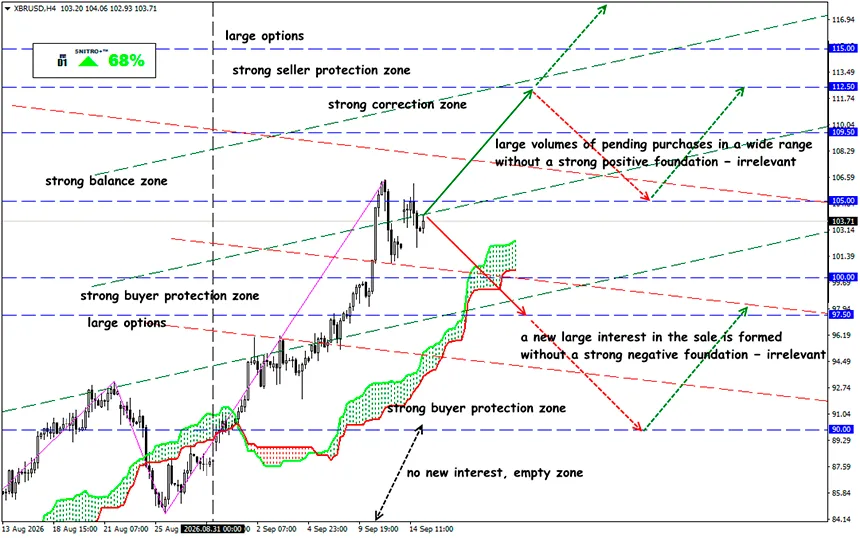
XBR/USD
Key zone: 101.50 - 105.00
Buy: 106.00 (on a confirmed break of 105.00); target 108.50-109.50; StopLoss 105.00
Sell: 100.00 (on strong negative fundamentals); target 96.50; StopLoss 101.00
The global oil market is entering a dangerous phase: crude inventories have fallen by more than 500 million barrels, while the attack on Saudi Arabia’s East-West pipeline has deprived the market of a key bypass around Hormuz. Prices now depend on the speed of repairs, logistics, and demand destruction. Politicians can no longer prop up this market.
The main factor is no longer the volume of production, but the size of the remaining buffer. Inventories have been declining for the sixth consecutive month, part of Middle Eastern production has been halted, the refining system is operating under severe constraints, and the war has simultaneously affected the Strait of Hormuz, the Red Sea, and the main Saudi route created specifically to bypass Hormuz.
A reminder:
The IEA’s September report showed that observed global oil inventories fell by another 95 million barrels in August alone, or approximately 3.1 million bpd. Since the end of February, the cumulative decline has reached 507 million barrels, equivalent to an average draw of around 2.8 million bpd. The pace of inventory depletion is accelerating.
The structure of the August decline is particularly revealing. Oil inventories in “tankers at anchorage” fell by 65 million barrels as attacks restricted exports from the Middle East. Inventories outside the OECD declined by 52 million barrels, with China being one of the main sources of the draw. In OECD countries, inventories rose by 23 million barrels, but this occurred alongside a 19 million-barrel reduction in government reserves.
The global system has not run out of oil yet, but its safety buffer is shrinking rapidly.
The problem is no longer limited to Hormuz. The market tried to offset losses through alternative routes. Flows through Bab el-Mandeb, for example, increased from 5.4 million bpd in Q4 2025 to 8.1 million bpd in Q2 2026. Around 9.4 million bpd passed via the Cape of Good Hope, while 5.8 million bpd moved through the Suez Canal and SUMED.
- The attack on Saudi Arabia’s East-West oil pipeline has proved far more dangerous than ordinary damage to energy infrastructure. Under wartime conditions, Saudi Arabia had effectively been rerouting around 4 million bpd through it, bypassing Hormuz. Pumping was halted following the September 11 attacks.
- An inoperative pipeline does not yet mean the immediate loss of 4 million bpd. Exports from Yanbu can continue for some time using inventories, but at the current shipment rate they will last for approximately 5–7 days. Additional volumes are stored at Egypt’s Ain Sokhna and Sidi Kerir terminals, but they can extend this period only briefly.
- Estimates for the repair timeline vary significantly: from 3 weeks to 5–6 weeks. Saudi Aramco has not yet announced an official restoration timeline.
The market has encountered a classic timing mismatch: export inventories are measured in days, while potential repairs are measured in weeks.
Another negative factor is that the planned meeting between Iran and the Persian Gulf states in Oman on a temporary shipping regime through Hormuz has been postponed. No new date has been set yet.
High prices have already begun destroying global demand. Previously, a trader could assume that the closure of one route would increase the load on another. Now Hormuz — East-West — Bab el-Mandeb are simultaneously vulnerable. Supply is falling faster than demand. The gap is being offset by inventories, logistical adaptation, and actual demand destruction.
So, What Does This Mean?
The price reaction reflects precisely the reduction in available inventories and supplies. What could stop the crisis:
- Partial or full restoration of East-West would provide a strong short-term bearish impulse.
- A diplomatic agreement allowing a sustained increase in traffic through Hormuz.
- Further destruction of global demand due to expensive fuel.
- Full restoration of production in 2027.
Therefore, the current market is extremely bullish over the short term, but significantly less clear-cut on the 2027 horizon.
For Brent, the main scenario remains buy on dips while East-West remains offline and traffic through Hormuz is restricted. The $150 scenario is not yet the base case, but it is no longer considered extreme.
The $110–114 zone is becoming important short-term resistance: consolidation above $113.50 will increase the probability of a move first toward $120–126 and, in the event of another major supply disruption, toward $140–150.
So we act wisely and avoid unnecessary risks.
Profits to y’all!


