

















Can AI Trade CFDs? How Artificial Intelligence is сhanging trading

Many people imagine trading with artificial intelligence (AI) roughly like this: a program monitors the market on its own, finds a good moment for a trade, and makes money while the trader goes about their business.
Many people imagine trading with artificial intelligence (AI) roughly like this: a program monitors the market on its own, finds a good moment for a trade, and makes money while the trader goes about their business.
To some extent, this is already possible. AI can quickly process large volumes of data, identify patterns, analyze news, help with strategies, and find trading signals. And if such a system is connected to a broker or trading platform, even opening trades can be automated.
But there is another side to it. AI does not know where the market will go tomorrow and cannot guarantee profits. It relies on data, and that data may be incomplete or outdated. And a pattern that worked well yesterday may simply disappear tomorrow.
Today, AI for trading is used not only to find signals, but also to analyze news, test strategies, and automate routine tasks.
In this article, we will look at how AI is used in trading, how such trading differs from conventional algorithmic trading, which tools are already available to traders, and what is needed for trades to be opened automatically.
What Is AI Trading
AI trading, or trading with AI, is the use of artificial intelligence to analyze the market, find trading opportunities, and automate some of a trader's tasks.
Artificial intelligence is a fairly broad concept. In trading, it can refer to different technologies.
Artificial intelligence is a general term for technologies that can work with information: for example, analyze texts, compare data, and identify patterns.
Machine learning is one area of AI. In such a system, it is not always necessary to specify every rule in advance. The model is trained on a large amount of data, and it looks for recurring relationships and patterns in it.
For example, a model can be trained on historical quotes, trading volumes, and technical indicators. It will look for combinations of this data that in the past were more often accompanied by a rise or fall in price.
Another important area is data analysis. By itself, it is not always related to AI, but without data such systems simply cannot work. They use quotes, news, economic statistics, company reports, and other information to identify patterns and trading signals.
In practice, AI is used in trading in very different ways.
For example, a trader can upload data to ChatGPT and ask it to analyze it. Another option is for a program to monitor the market on its own and look for the required signals. And with full automation, the signal found is sent to the broker, and the trade can then be opened without human involvement.
So, trading with AI is not one "smart robot" that does everything for the trader. It involves different tools: some help analyze data, others look for signals, and others are involved in trade automation.
Can AI Trade CFDs Independently
The short answer is yes. But only if AI is connected to a trading account.
AI can analyze the market, look for signals, and help make decisions. But it cannot open a real trade on its own if it does not have access to a trading account.
Suppose a system monitors the price of gold and finds a signal to buy a CFD. But this suggestion alone changes nothing: a position will not be opened in the trader's account.
What happens next depends on how the system is configured.
If trading is not automated, AI simply displays the signal. The trader checks it and decides whether to open the trade.
With automated trading, the signal is passed on: the system checks the specified conditions and sends an order to the broker.
AI can take on several tasks at once.
For example, it can simultaneously monitor dozens of instruments and compare them according to the required parameters — manually reviewing such a volume of data is much more difficult.
It can look for trading signals — for example, identify situations similar to those already seen in historical data.
AI can also help test a trading idea or build a strategy: write code, calculate indicators, and find errors in the logic.
Part of risk control can also be automated. For example, you can set a maximum position size in advance or conditions under which the system will not open a trade at all.
If an AI trading platform is connected to a broker, it can already send commands to open and close trades.
It sounds as if the trader is hardly needed. But this does not make the market any more predictable. If the model is wrong, the data is outdated, or the situation changes sharply, AI can also make a poor decision.
And with full automation, an error can also be repeated automatically.
AI Trading and Algorithmic Trading: What Is the Difference
AI trading is often confused with algorithmic trading, although they are not the same thing.
Algorithmic trading works according to predefined rules.
For example, a trader can set a simple rule:
- If the price rises above a certain level, open a position.
- If it falls below another level, close it.
The program does not try to determine whether this is a good moment for a trade. It simply checks the conditions and executes the specified rule.
With AI-based trading, things can be more complex. Machine learning in trading is used to analyze large volumes of data and identify patterns in them.
To simplify it greatly, the difference looks like this:
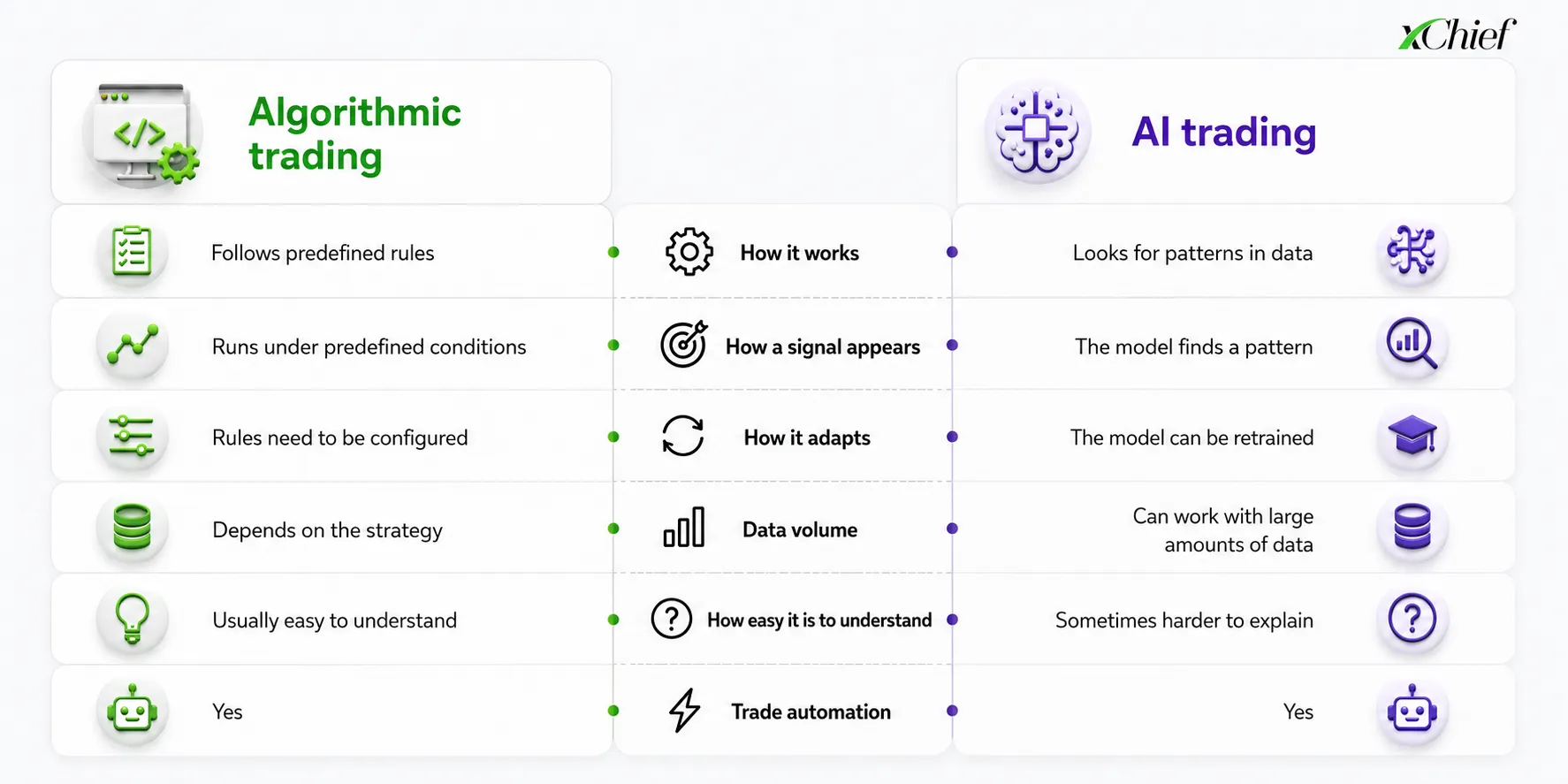
But in practice, the line between them is not always so clear.
For example, AI can find a buy signal, and a conventional algorithm can then check the position size, set a stop-loss, and send the order to the broker.
In practice, algorithmic trading and AI often complement each other: AI finds the signal, while the algorithm checks the conditions and sends the order to the broker. But automated trading does not necessarily use AI.
For example, a trading bot can execute the same rule for years and open trades automatically. But that does not make it AI: such a system may not use machine learning at all.
Where AI Helps CFD Traders
The most obvious use of AI is finding trading opportunities. But in practice, it is no less useful for more routine tasks: wherever large amounts of data, news, or charts need to be reviewed quickly.
Analyzing Large Volumes of Data
A person can carefully study several charts. In the same amount of time, AI can check dozens of instruments.
For example, it can search for instruments with a certain level of volatility, trend, trading volume, or required combination of technical indicators.
Here, AI does not decide for the trader what to buy or sell. It simply helps narrow down the selection: for example, from a hundred instruments to a few that are worth examining more closely.
Finding Trading Opportunities
Some modern AI trading platforms can search for the required situations using a regular text query. The trader describes what they want to find, and the system selects suitable instruments.
For example, instead of manually configuring several filters, the trader simply describes what they want to find: instruments with a certain price movement, trading volume, or technical indicators.
The system selects the required filters itself and displays suitable instruments.
Such features are already appearing in trading platforms and instrument-screening services.
Analyzing News
But charts alone are not enough to analyze the market.
The price can change sharply after a central bank decision, the release of economic data, a company report, or unexpected news.
AI can quickly review a large volume of news and highlight the key points. For example, it can collect the latest reports on a particular instrument or identify events that may affect the price.
But even correctly analyzed news does not tell you where the price will go. AI may correctly understand the event itself and still be wrong about the market's reaction.
Good news does not always lead to a rise, and bad news does not always lead to a fall. Sometimes the market had already expected exactly such an event and priced it in before the publication.
Analyzing Market Sentiment
AI can also assess the overall sentiment in the market.
To do this, it analyzes news and other publications and determines which sentiment currently prevails: positive, negative, or neutral.
This approach is called market sentiment analysis.
But such an assessment should not be turned into a ready-made "buy" or "sell" command. Sentiment can change quickly, and the price is not obliged to follow it.
Developing and Testing Strategies
Another useful scenario is working with strategies.
Suppose a trader has an idea: buy after a certain price movement and close the trade when another condition is met.
AI can help turn this idea into clear rules, write code, select data for testing, or analyze the test results.
But a well-constructed strategy does not mean that it will work.
Therefore, it will still need to be tested to see how it performs under different market conditions.
Handling Routine Tasks
AI is useful not only when something needs to be predicted.
For example, it can:
- sort data;
- find the required instruments;
- briefly summarize news;
- compare indicators;
- calculate statistics;
- help maintain a trading journal;
- find errors in code;
- analyze completed trades;
- create alerts.
And it is precisely in such tasks that AI is especially useful: it handles routine work, while control over the account remains with the trader.
Which AI Tools Are Already Used in Trading
There are more and more AI trading programs, but they serve different purposes: some help analyze the market, others find trading signals, and others automate trades.
Here are a few examples to make them easier to compare.
| AI / Service | What It Is Used For | Opens Trades | Broker Connection | Who It Is Suitable For |
| ChatGPT | Data analysis, calculations, trading ideas, coding assistance | No | No | Beginners and experienced traders |
| Claude | Working with documents, data, strategies, and code | No | No | For analysis |
| Perplexity | Searching for news, reports, and other market information | No | No | For market research |
| TradingView | Chart analysis and finding trading opportunities with AI | Not directly | No for analysis | For technical analysis |
| TrendSpider | Chart analysis, machine learning models, strategy testing, and automation | Yes, when automation is configured | Yes | Active traders |
| Trade Ideas | Finding trading opportunities in the stock market | Not directly | Yes, for opening trades | Active stock traders |
| Capitalise.ai | Creating and automating trading strategies without programming | Yes | Yes | For automation |
| 3Commas | Automated trading bots for cryptocurrencies | Yes | Yes, via API | For cryptocurrencies |
ChatGPT, Claude, and Perplexity can be considered more as AI assistants. They help analyze data, find information, and test ideas, but they do not open trades in a trading account themselves.
TradingView and TrendSpider are already more specifically geared toward trading. TradingView has AI tools for working with charts and finding suitable assets, while TrendSpider allows users to use machine learning models and automate strategies.
Capitalise.ai is more focused on automation. A user can describe the strategy rules in ordinary language and then connect it to a trading account.
3Commas stands out somewhat from the list: it is primarily a service for automating cryptocurrency trading. Its bots can open and close trades on their own after connecting to an exchange. But an AI trading bot and a conventional automated bot are not the same thing: the latter may not use machine learning at all.
And this is an important point: automation and AI are not the same thing. A program can open trades on its own without using machine learning at all.
What Is Needed for AI to Trade Automatically
Imagine that AI has analyzed the market and found a buy signal.
What happens next?
AI itself cannot open a CFD in the trader's account. Trading automation is possible only when its signal can reach the broker.
To simplify it greatly, the process looks like this:
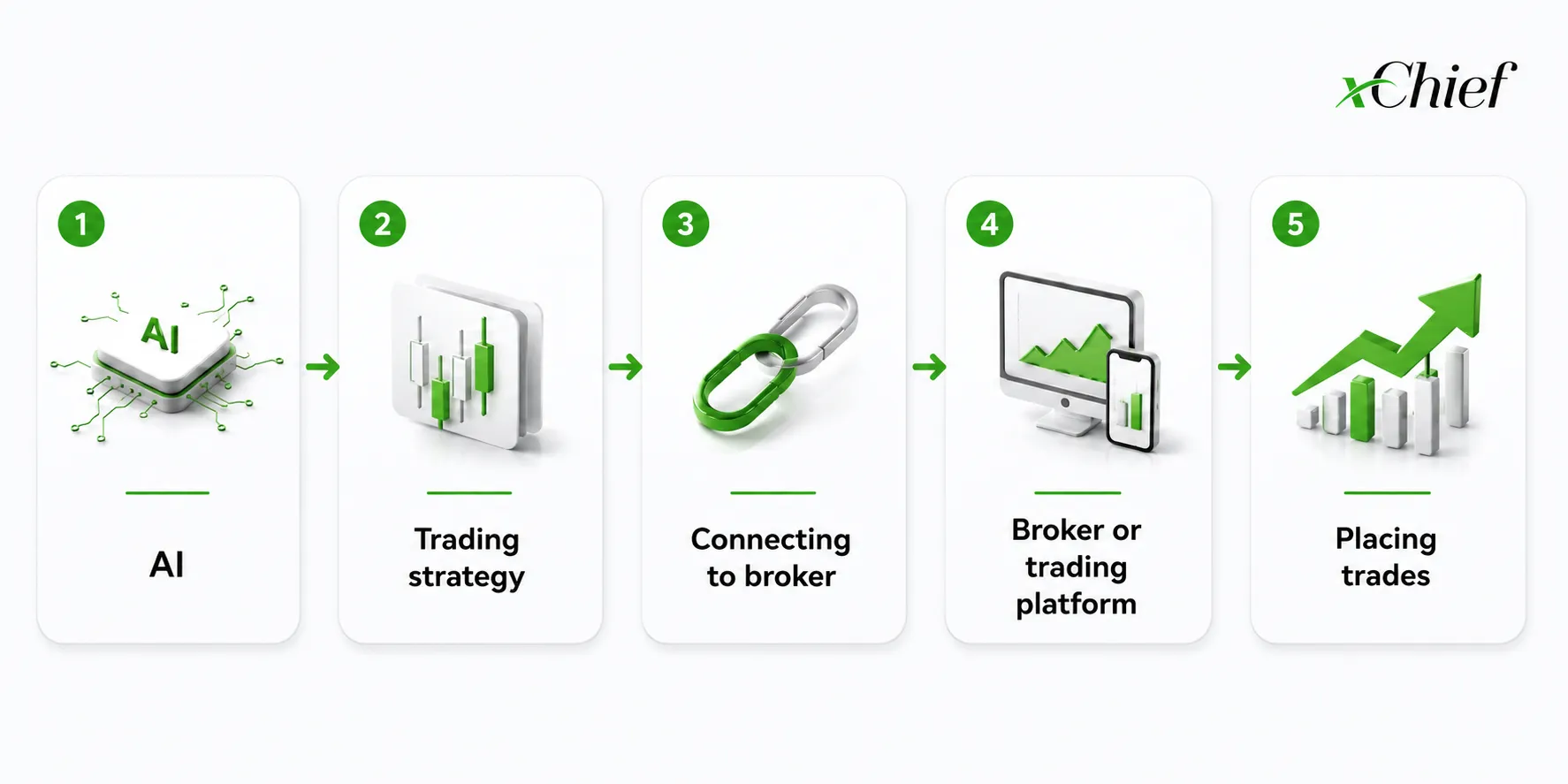
First, AI analyzes the market and finds a trading signal.
Then the system checks the strategy rules: whether a trade can be opened now, what the position size should be, and where to place the stop-loss.
One option is trading via API: the system sends the broker a command to open or close a trade through a special connection.
Only after that is a real trade opened in the account.
Therefore, the phrase "AI trades on its own" is not entirely accurate.
It is more accurate to say that AI can be part of an automated trading system. It finds a signal, while the system itself sends the command to the broker and opens the trade.
Without a connection to a trading account, AI can analyze the market and suggest ideas, but it cannot open a trade itself.
What AI Can Do and What You Should Not Expect From It
It is easy to get confused here, especially when looking at advertisements where an AI trading bot promises to do almost everything for the trader.
So it is easier to look directly at what AI can actually do and what should not be expected from it.
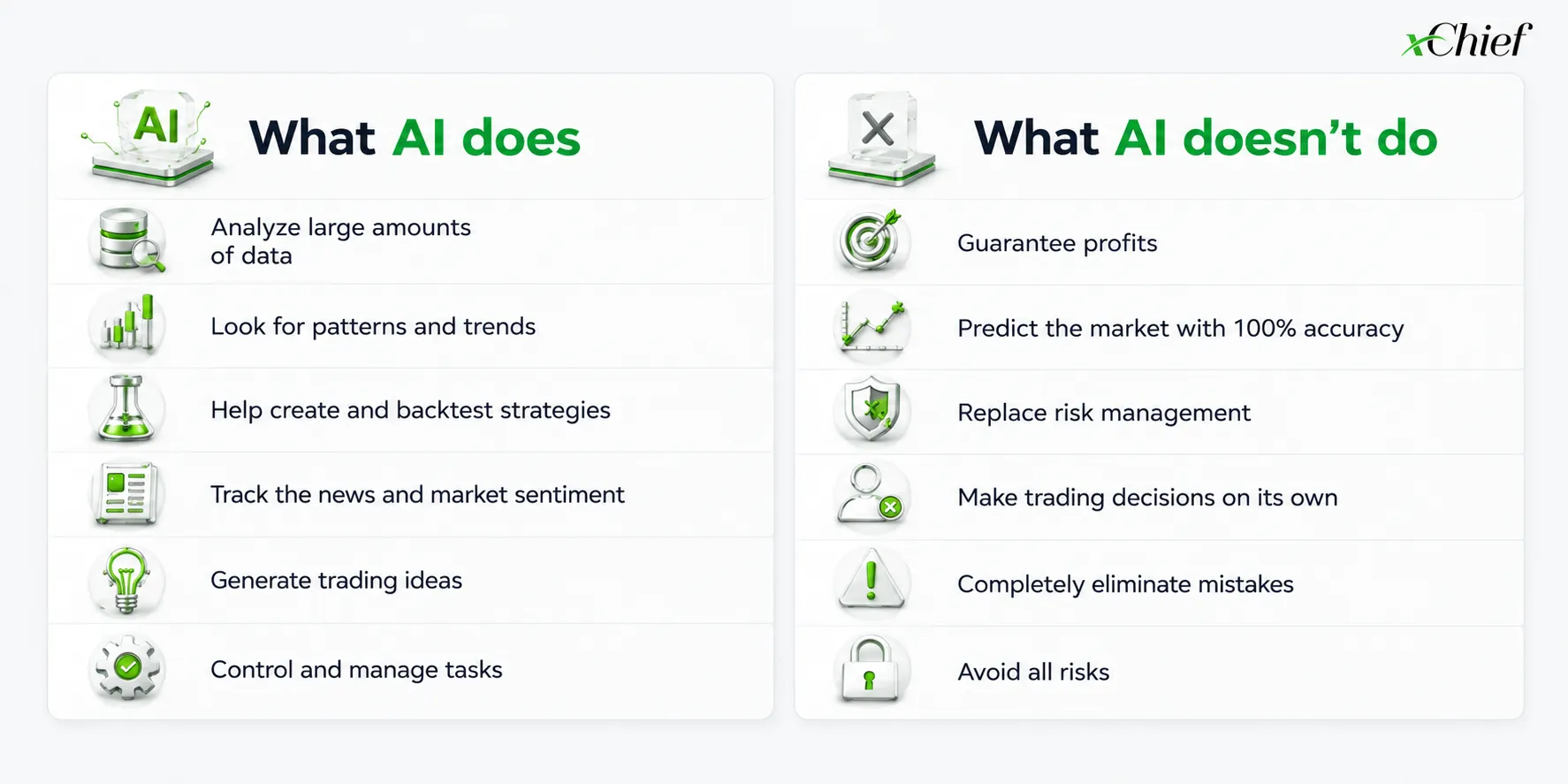
The main advantage of AI is speed.
In a few minutes, it can process a volume of information that would take a person several hours.
But speed does not make a forecast correct.
If there was an error in the data, the model found a random pattern, or the market changed sharply, the result may also be incorrect.
Main Risks of Trading With AI
Trading with AI does not eliminate ordinary market risks. And these are joined by the risks of the technology itself.
The Model May Learn the Past Too Well
One of the main problems of machine learning is overfitting.
Imagine that a model was trained on historical quotes. It found patterns in them and shows an almost perfect result.
At first glance, everything looks excellent.
But with new data, it may turn out that some of the patterns found were simply random.
As a result, the strategy looks convincing on historical data but performs worse in the real market.
Therefore, good past performance does not mean that the strategy will perform equally well in the future.
Bad Data Produces Bad Results
AI is highly dependent on data quality.
If quotes are incomplete, news is outdated, data arrives with a delay, or there is an error in the calculations, the model no longer sees the market as it really is.
And what is unpleasant is that the answer may still look quite convincing.
With automated trading, this is especially dangerous: a person may simply not have time to check every decision before a trade is opened.
The Market Changes
Suppose a strategy worked perfectly for three years in a row.
But that does not mean the next three years will be the same.
Interest rates, volatility, liquidity, and the behavior of market participants change. Things that used to move together may stop doing so, and familiar relationships between assets may disappear.
Therefore, a signal that used to work well may at some point stop working altogether.
The model needs to be checked regularly and updated if necessary.
AI Can Simply Be Wrong
This is especially true for services such as ChatGPT or Claude.
They can explain a complex topic well, help with code, or analyze a table. But sometimes AI gives an incorrect answer with great confidence.
In an ordinary conversation, this is simply unpleasant. In trading, such an error can cost money.
Therefore, an idea, calculation, or code suggested by AI is better double-checked before being used on a real account.
Automation Can Also Fail
There are also more mundane problems — technical ones.
The connection may be lost, a command may arrive with a delay, there may be an error in the code, or a position may be opened with the wrong volume.
And if the system operates without human involvement, it can also repeat the error automatically.
Therefore, the more a trader relies on automation, the more important it is to set limits for it in advance.
AI as a Trader's Assistant
It is more reasonable to use AI not instead of the trader, but together with them. The trader decides what exactly they want to test. AI helps analyze the data faster, automation handles routine tasks, and risk management limits potential losses.
In practice, this may look like this.
First, the trader formulates an idea: for example, what market situation they want to use to enter a trade.
Then AI helps turn this idea into clear rules and determine what data will be needed for testing.
After that, the strategy is tested on historical data.
If the results look good, the strategy should be tested again on new data and then, for example, on a demo account.
Only then should a decision be made about whether to move on to real money.
The position size, acceptable loss, and other risk limits are also set in advance.
Then AI does not become a black box that is simply given control of the account while the trader waits to see what happens. It remains an assistant whose work the trader understands and controls.
The Future of AI in CFD Trading
It seems that AI will increasingly become a standard part of trading platforms.
And some of this is already happening.
For example, more and more tasks can be described in ordinary language. Instead of manually configuring dozens of filters, the trader writes what they want to find, and AI helps build the required search or prepare a strategy.
Analytics may also become more personalized. The system will better take into account which markets interest the trader, which indicators they usually look at, and what matters most to them.
More tasks can be combined in one place: analyzing the market, testing a strategy, finding signals, and sending commands to the broker.
But the more the system can do, the more important it is to control it.
The trader still needs to understand what data it works with, what it is allowed to do, and when they should intervene themselves.
Therefore, completely removing the trader from the process is unlikely to be possible for now. Rather, their work will change: less manual searching and more control over what the system does and what risk it manages.
Conclusion
So, can AI trade CFDs?
Yes, if it is connected to a broker or trading platform and operates as part of an automated system. Then AI can find a signal, the system will check the strategy rules and send the broker a command to open or close a trade.
But the presence of AI does not make trading easy and certainly does not guarantee profits.
AI can quickly analyze data, identify patterns, work with news, and help with strategies. But it can also make mistakes: for example, if the data is poor or the market has changed and previous patterns no longer work.
Therefore, today CFD trading with AI is more reasonably viewed not as a fully autonomous process, but as an approach where AI helps the trader with analysis and automation.
Frequently Asked Questions
What Is AI Trading?
It is the use of artificial intelligence to analyze the market, identify patterns and trading signals, and automate some of a trader's tasks.
Can AI Trade CFDs?
Yes, if the system is connected to a broker or trading platform. Without a connection, AI can analyze the market and suggest ideas, but it cannot open a real trade itself.
Can AI Predict the Market?
AI can identify patterns and assess different scenarios, but it cannot know exactly where the price will go. The market changes, so any model can make mistakes.
How Does AI Trading Differ From Algorithmic Trading?
In algorithmic trading, the program executes predefined rules. AI can identify patterns in data on its own and use them to find signals. In practice, however, the two approaches often work together.
Can an AI Bot for CFD Trading Make a Profit?
They can, but the use of AI itself guarantees nothing. The result depends on the strategy, data quality, market conditions, costs, and risk management.
If a service promises guaranteed or consistently high returns solely because of AI, such promises should be treated with caution.
Can ChatGPT Trade CFDs?
Trading with ChatGPT is more about assistance with analysis than fully automated trading. The service can analyze data, perform calculations, test an idea or code, but it does not open trades itself.
Is It Safe to Trade With AI?
AI does not eliminate trading risks. A model can make a mistake, data can be incorrect, and an automated system can sometimes fail. Therefore, even with AI, risk management and trader oversight are necessary.
Which AI Tools Do Traders Use?
For working with data and information, traders use, for example, ChatGPT, Claude, and Perplexity. There are also specialized trading services: TradingView, TrendSpider, and Trade Ideas. And some platforms, such as Capitalise.ai, allow strategies to be automated and connected to a trading account.
Does AI Need Access to a Broker?
For market analysis — no. But if the system is supposed to open and close trades on its own, it needs a way to send commands to the broker. For example, through an API or a built-in trading platform connection.
Should Beginners Use AI in Trading?
Yes, for example, for learning, analyzing data, and testing trading ideas. But fully handing trading over to AI without first understanding CFDs, leverage, and risk management is not advisable. AI can make the work easier, but it does not replace a trader's basic knowledge.


