

















Weak reserves: how politics is putting pressure on consumers
U.S. oil inventories have fallen to critical levels
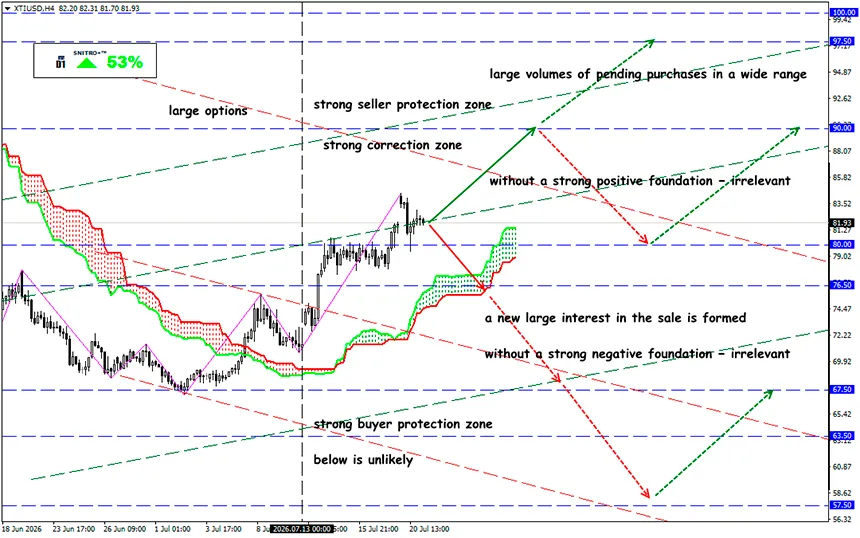
XTI/USD
Key zone: 76.50 - 81.50
Buy: 83.50 (on a pullback after retesting 81.50); target 85.00-87.50; StopLoss 82.80
Sell: 76.00 (on strong negative fundamentals); target 73.50; StopLoss 76.70
By the end of the week, crude oil inventories at Cushing had fallen below 20 million barrels. The U.S. Strategic Petroleum Reserve (SPR) declined by approximately 5.1 million barrels last week to 311.4 million barrels, reaching its lowest level since March 1983.
Total U.S. crude oil inventories, including both commercial stocks and the Strategic Petroleum Reserve, dropped by 129 million barrels to 726.2 million barrels, the lowest level recorded since 1984.
Reminder:
Strategic petroleum reserves are one of the most important pillars of any country's energy security. If inventories fall below a certain threshold—the so-called "tank bottom"—an economic collapse becomes virtually inevitable. The Cushing storage hub is known to have a capacity of approximately 94 million barrels of crude oil and refined petroleum products, but its official minimum operational level remains undisclosed.
Analysts now suspect that Cushing is approaching that critical threshold based largely on the fact that the spread between WTI and Brent prices has turned negative. In other words, a virtual barrel of oil in the United States has become more expensive than a virtual barrel in Europe.
The Cushing facility is particularly important because it serves as the physical delivery point for WTI crude oil futures and petroleum products. But what happens if futures holders decide to take physical delivery? In that case, the consequences could extend beyond the storage hub itself and threaten the futures market as well. If sellers have no physical oil to deliver, buyers have nothing to receive.
The United States steadily moved toward this crisis throughout the Middle East conflict. During the first phase of the Persian Gulf conflict, President Trump expressed concern that global oil inventories were beginning to shrink and warned that continued disruption of the Strait of Hormuz could trigger a global oil shock.
To prevent global oil prices from rising to critical levels, the United States has released 172 million barrels from the SPR over the past 100 days. Strategic reserves were used as a buffer designed to offset the supply deficit in the global market while restrictions remained in place. Since the beginning of the U.S.-Israeli military campaign against Iran, SPR inventories have declined by 104.04 million barrels.
American oil companies have largely followed the same approach. At current oil prices, expanding drilling activity would appear to be the logical strategy. Instead, after increasing production at the beginning of the conflict, many companies shifted toward selling existing inventories.
The commercial logic is straightforward: these reserves were accumulated when oil prices were low, while the oil was sold at exceptionally high prices during the military conflict. Investing in new production becomes less attractive when existing inventories can generate substantial profits through current market margins. Moreover, it remains unclear whether the conflict has truly ended—or when it ultimately will.
However, the overall oil market situation is becoming increasingly dangerous.
- European Union countries have also drawn down their reserves. All 32 member states of the International Energy Agency (IEA) participated in the largest coordinated release of emergency oil stocks, injecting a combined 400 million barrels into the market. This additional supply helped reduce Brent prices by approximately $20 per barrel.
- Even more importantly, China is returning to the market. During the Strait of Hormuz crisis, Beijing chose not to use its strategic petroleum reserves for short-term gains. On the contrary, the country sharply reduced exports of refined petroleum products.
- Instead, Beijing actively relied on accumulated commercial inventories while reducing refinery throughput to multi-year lows. As a result, the return of Chinese oil traders with demand of approximately 5 million barrels per day is now expected to push global oil prices higher.
- Beyond China, Japan, India, Pakistan, and a number of smaller Asian and African countries are also expected to actively replenish oil inventories. This represents additional demand amounting to hundreds of millions of barrels over the next two to three years.
What does this mean?
The global oil market is entering a phase of structural supply deficit, where declining strategic reserves coincide with recovering global demand. Without a significant increase in production, any new geopolitical escalation could trigger a sharp spike in prices and substantially increase volatility across energy markets.
Our medium-term outlook remains moderately bullish. However, aggressive short positions could prove increasingly risky. Investors should closely monitor IEA inventory data, OPEC+ production decisions, China's import dynamics, and developments in the Middle East.
So we act wisely and avoid unnecessary risks.
Profits to y’all!


