



Wall street braces for a market reshuffle
What lies ahead for the Dollar, Gold, and Technology Stocks?
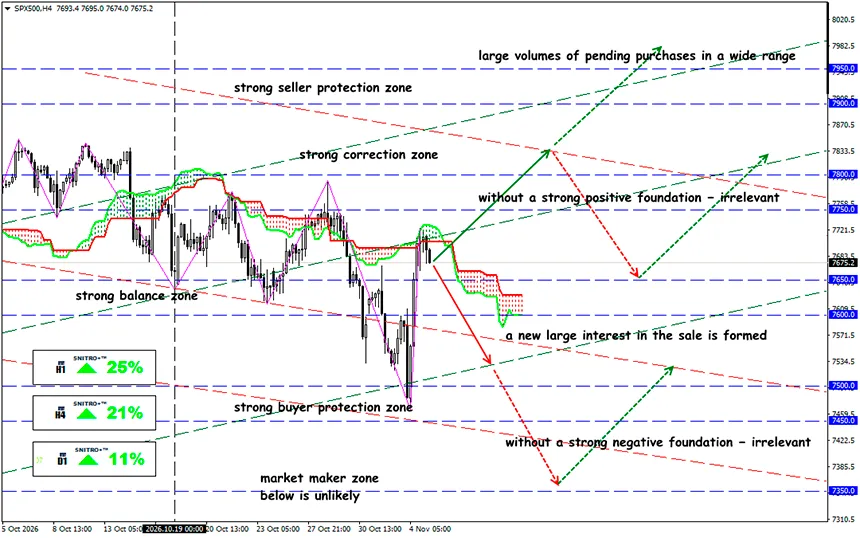
SP500
Key zone: 7,650 - 7,750
Buy: 7,750 (on a pullback following a retest of 7,650); target 7,7900-8,100; StopLoss 7,680
Sell: 7,600 (on strong negative fundamentals); target 7,350; StopLoss 7,670
The Democrats' victory in the U.S. midterm elections changes the balance of power in Washington and investment expectations. Restrictions on Trump's budget initiatives support bonds and gold but increase risks for technology giants. Will political gridlock drive stock gains, or should we expect a sweeping sector rotation?
Trump has lost control of both chambers of Congress, including in states that traditionally vote Republican.
A reminder:
The main factors behind the Republicans' defeat were dissatisfaction with the cost of living, inflationary pressure, the consequences of the war with Iran, and voters' attitudes toward the administration's economic policies. However, the Democrats' victory does not mean an immediate change in legislation.
After January 3, 2027, Democrats will be able to control the legislative agenda, budget committees, and congressional investigations, but Trump will retain his presidential veto power.
The United States is moving toward a divided government model, in which the White House and Congress are controlled by opposing parties.
For financial markets, this means three structural changes:
- The likelihood of new large-scale tax breaks and additional fiscal stimulus is declining.
- The possibility of revising regulatory approaches to AI, energy, and the largest technology companies is increasing.
- The risks of budget conflicts are rising, including disputes over government funding and raising the federal debt ceiling in 2027.
The market's initial reaction was mixed. Nasdaq 100 futures fell more than 2% overnight following the elections, but U.S. stocks had already turned higher during trading on November 4.
Gold also showed a strong reaction. Bloomberg recorded a price of around $4,043.70, while Charles Schwab's morning market review quoted $4,052.30.
The market thus produced an unusual combination: stocks are rising, bond yields are falling, the dollar is weakening, and gold is gaining.
This is not a classic risk-off environment. Rather, investors are simultaneously pricing in reduced political uncertainty and limits on future fiscal expansion.
The most logical strategy now is to buy companies with positive free cash flow, moderate debt burdens, and demonstrated returns on AI investment — Alphabet (GOOGL), Microsoft (MSFT), Meta Platforms (META), Amazon (AMZN), and Broadcom (AVGO). It is particularly important to consider the latest earnings reports for the third quarter of 2026.
The next critical test for the market is the U.S. employment report on November 6. It will help assess how much of the decline in yields is attributable to the elections and how much to expectations regarding Federal Reserve policy.
If the broader market continues to rise while companies dependent on data center construction remain under pressure, this will confirm a shift from the speculative AI boom toward a more selective assessment of investment profitability.
And What Is the Result?
- The Democrats' victory did not become a catalyst for a sustained selloff in U.S. stocks. On the contrary, the S&P 500 ended its first post-election session up 1.6%. For now, investors view constraints on presidential power as a potential stabilizing factor for policymaking rather than an immediate threat to the economy.
- Falling Treasury yields could support the stock market, but the effect will depend on why yields are declining. If yields fall because inflationary and fiscal risks are diminishing, that is positive for stocks. If the cause is a sharp deterioration in the economy, the effect could be the opposite.
- AI remains the main source of conflict between sectors. The winners may be companies capable of increasing profits without a proportional rise in capital expenditures. The greatest risk is borne by businesses whose valuations assume virtually unlimited expansion of computing infrastructure.
Wall Street has not lost its appetite for risk. For now, the market is betting on a more restrained fiscal policy and a lower cost of capital. The main threats to this scenario are inflation and a reassessment of AI companies' future earnings.
So we act wisely and avoid unnecessary risks.
Profits to y’all!


