

















Trump vs. big oil
How oil companies fell out with the president
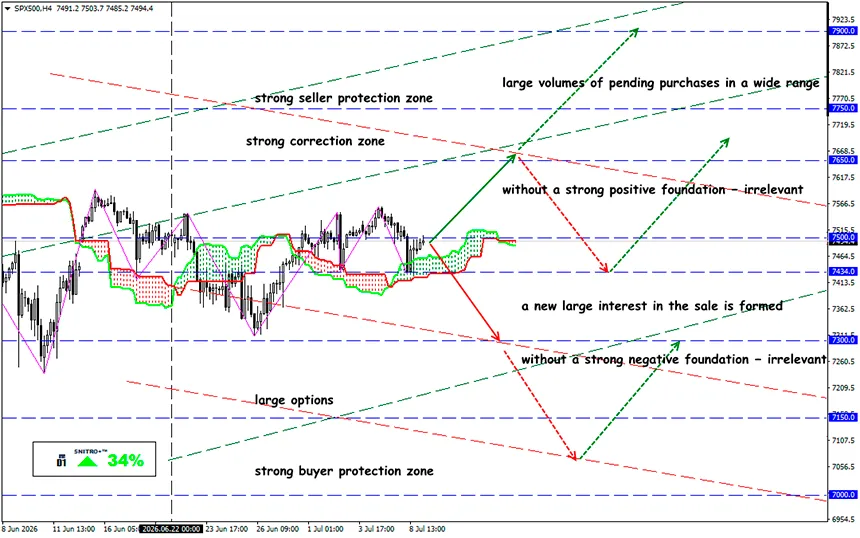
SP500
Key zone: 7,400 - 7,500
Buy: 7,570 (on a decisive break above 7,550); target 7,700-7.750; StopLoss 7,520
Sell: 7,400 (on a pullback after retesting 7,500); target 7,250; StopLoss 7,450
The military conflict surrounding Iran has triggered yet another crisis inside the United States. This time, the Trump administration has directed its criticism at America's largest oil corporations, as high gasoline prices are becoming a political problem.
According to the American Automobile Association (AAA), the average gasoline price in the United States has risen by 24% compared with a year ago, reaching $3.80 per gallon. Diesel prices have climbed by approximately 30% to $4.80 per gallon.
Trump insists that gasoline should cost no more than $2.25 per gallon, although prices at that level were last seen in 2020, when demand collapsed during the COVID-19 pandemic.
The president believes gasoline prices are declining too slowly and that fuel giants are profiting at consumers' expense.
The industry rejects these accusations:
- Gasoline prices are determined not only by crude oil prices but also by transportation costs, logistics, refining expenses, seasonal environmental fuel requirements, and petroleum product inventories.
- A portion of crude oil is purchased in advance at higher prices, meaning that declines in crude prices reach retail fuel markets with a certain time lag.
During periods of crisis, gasoline and diesel prices traditionally rise faster than crude oil prices. As a result, the so-called crack spread—the difference between refined product prices and the cost of crude oil—widens.
At the end of June, the U.S. gasoline crack spread exceeded $30 per barrel, compared with a range of $18–22 per barrel in May.
Industry leaders Valero Energy, Marathon Petroleum, and Phillips 66 are expected to report their strongest financial results in several quarters. Meanwhile, integrated giants ExxonMobil and Chevron are benefiting from both upstream production and downstream refining. Profits in certain refining segments could increase by 30–60% in the second quarter compared with the first quarter.
Unfortunately, high fuel prices have a direct impact on inflation expectations, transportation costs, household expenses, and consumer sentiment. Freight rates, airline tickets, food prices, and many other goods become more expensive.
Several months of elevated fuel prices have become a serious burden for American consumers and are gradually turning into a political risk for Republicans seeking to retain their majority in both chambers of Congress. According to a Financial Times poll, 58% of American voters believe the war with Iran was not worth its economic cost.
The military conflict has once again increased the geopolitical premium in oil prices. Tight fuel supplies continue to support industry profits. Analysts believe fuel prices will remain elevated as long as uncertainty surrounding the Strait of Hormuz persists.
Even if oil exports from Persian Gulf countries continue to recover, it will take time before additional crude passes through refineries and translates into lower prices for gasoline, diesel, and jet fuel.
What does this mean?
The dispute between the Trump administration and Big Oil demonstrates that today's oil market is becoming increasingly driven by factors beyond the traditional balance of supply and demand.
Pressure from Washington could influence not only oil company stocks but also the refining sector, inflation expectations, and the Federal Reserve's monetary policy. However, political pressure rarely has an immediate impact on corporate financial performance. Far more important are actual crude oil prices, refining volumes, commercial inventories, and seasonal demand.
We continue to monitor not only Brent and WTI price movements, but also crack spread dynamics, EIA inventory data, average U.S. gasoline prices, and statements from the White House. Together, these factors now determine the direction of not only oil prices but also the market capitalization of the entire U.S. energy sector.
So we act wisely and avoid unnecessary risks.
Profits to y’all!


